by Bruce Wells | Feb 26, 2026 | Offshore History
Thousands of offshore petroleum platforms provide energy and create marine habitats.
Offshore petroleum platforms act as artificial reefs, creating multiple marine habitats, according to scientists. Beginning in 1979 with an Exxon (ExxonMobil) experimental subsea structure, the U.S. government’s “Rigs to Reefs” program established the largest artificial habitat in the world.
The Gulf of Mexico, both onshore and offshore, has continued to be a key contributor to U.S. oil and natural gas resources and energy infrastructure. Federal offshore oil production in 2023 accounted for 15 percent of total U.S. crude oil and five percent of natural gas production, according to the U.S. Energy Information Administration (EIA).
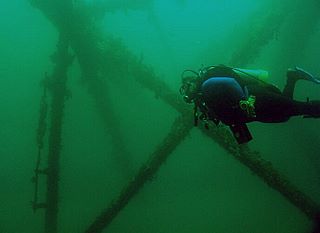
Offshore platforms make good artificial reefs. The open design attracts fish — and divers — where they can swim easily through the circulating water. Photo courtesy U.S. Bureau of Safety and Environmental Enforcement.
(more…)
by Bruce Wells | Feb 1, 2026 | Petroleum Technology
Camouflaged wells on man-made islands and world-renowned technologies save a sinking California city.
Reversing an earlier ban, voters in Long Beach, California, in February 1962 approved petroleum exploration in their harbor. They wanted to save a community that had become known as “America’s Sinking City.” Five major oil companies formed a company called THUMS and built four artificial islands to produce the oil.
California’s headline-making 1921 oil discovery at Signal Hill launched a drilling boom that transformed the quiet residential area. So many derricks sprouted it became known as “Porcupine Hill.”
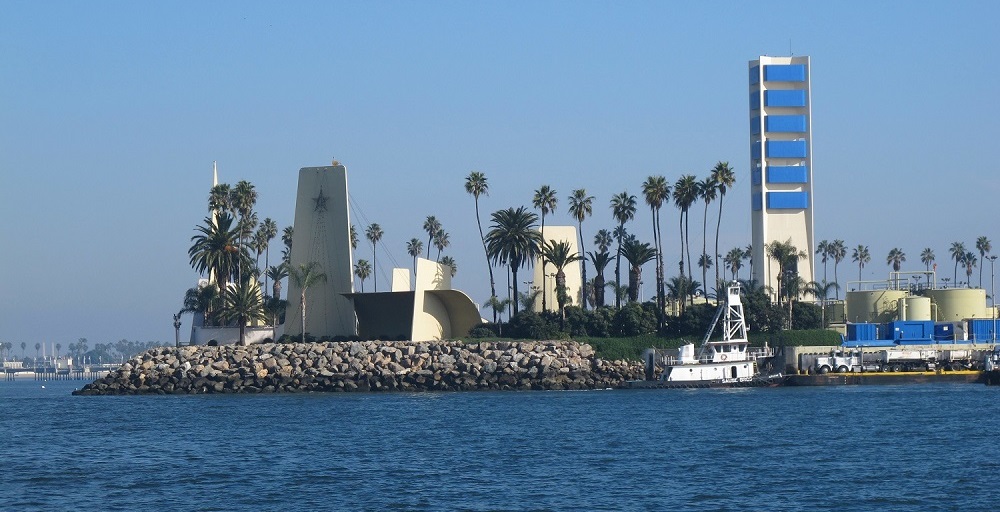
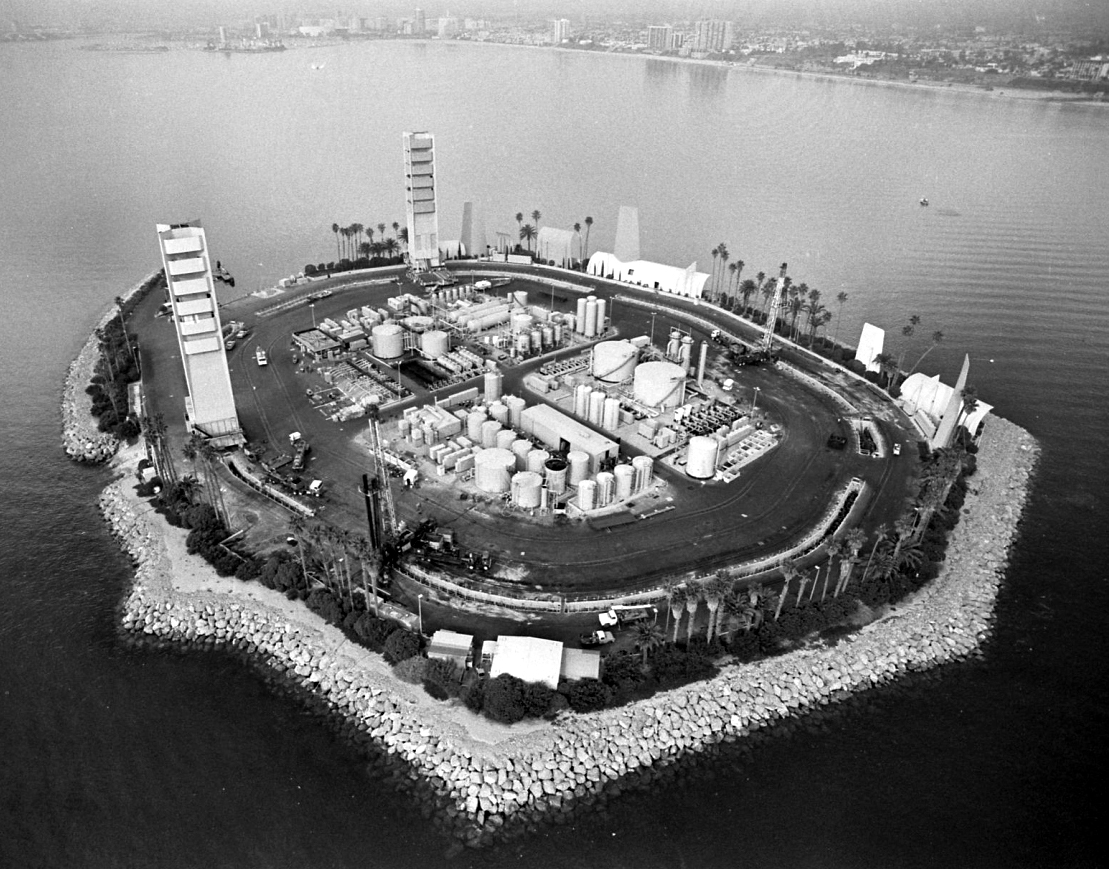
Island Grissom, one of the four THUMS islands at Long Beach, California, was named after astronaut Virgil “Gus” Grissom, who died in the 1967 Apollo fire. Photo courtesy U.S. Department of Energy.
With many homeowners aspiring to become drillers and oilfield speculators, much of Signal Hill’s land was sold and subdivided into real estate lots of a size described as “big enough to raise chickens.”
Derricks were so close to one cemetery that graves “generated royalty checks to next-of-kin when oil was drawn from beneath family plots,” noted one local historian. Neighboring Long Beach joined the drilling boom.
By 1923, oil production reached more than one-quarter million barrels of oil per day. When Long Beach instituted a per-barrel oil tax, Signal Hill residents voted to incorporate in 1924.
At the time, “the law of capture” for petroleum production ensured the formerly scenic landscape would be transformed. Competing exploration and production companies crowded around newly completed wells and chased any signs of oil to the Pacific Ocean.
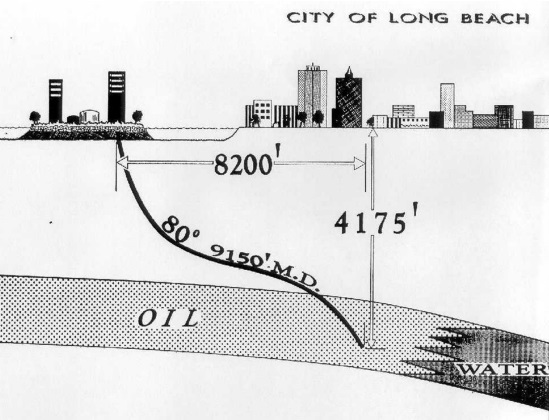
The islands are among the most innovative oilfield designs in the world. Circa 1965 illustration courtesy Oxy Petroleum.
By the early 1930s, the massive Wilmington oilfield extended through Long Beach as reservoir management concerns remained in the future. Naturally produced California oil seeps had led to many discoveries south of the 1892 Los Angeles City field.
Onshore and offshore tax revenues generated by the production of more than one billion barrels of oil and one trillion cubic feet of natural gas helped underwrite much of the Los Angeles area’s economic growth. But not without consequences.
Long Beach: A Sinking City
The U.S. Army Corps of Engineers reported, “Subsidence, the sinking of the ground surface, is typically caused by extracting fluids from the subsurface.”

Southern California’s oilfield production in 1923 reached more than one-quarter million barrels of oil per day from Signal Hill, seen in the distance. Photo courtesy Library of Congress.
Californians had a lot of experience dealing with groundwater-induced subsidence and the building damage it caused, but by 1951, Long Beach was sinking at the alarming rate of about two feet each year.
Earth scientists noted that between 1928 and 1965, the community sank almost 30 feet. A TIME magazine headline called the bustling port “America’s Sinking City.”

After decades of prospering from petroleum production, the city prohibited “offshore area” drilling to slow the subsidence as the community looked for a solution.
On February 27, 1962, Long Beach voters approved “controlled exploration and exploitation of the oil and gas reserves” underlying their harbor. The city’s charter had prohibited such drilling since a 1956 referendum. Advancements in oilfield technologies enabled Long Beach to stay afloat.
Directional drilling and water injection opened another 6,500 acres of the Wilmington field — and saved the sinking city.
THUMS: Texaco, Humble, Union, Mobil, and Shell
Five oil companies formed a Long Beach company called THUMS: Texaco (now Chevron), Humble (now ExxonMobil), Union Oil (now Chevron), Mobil (now ExxonMobil), and Shell Oil Company. They built four artificial islands at a cost of $22 million in 1965 (more than $200 million in 2024 dollars).
The islands — named in 1967 Grissom, White, Chaffee, and Freeman in honor of lost NASA astronauts — would include 42 acres for about 1,000 active wells producing 46,000 barrels of oil and 9 million cubic feet of natural gas a day.
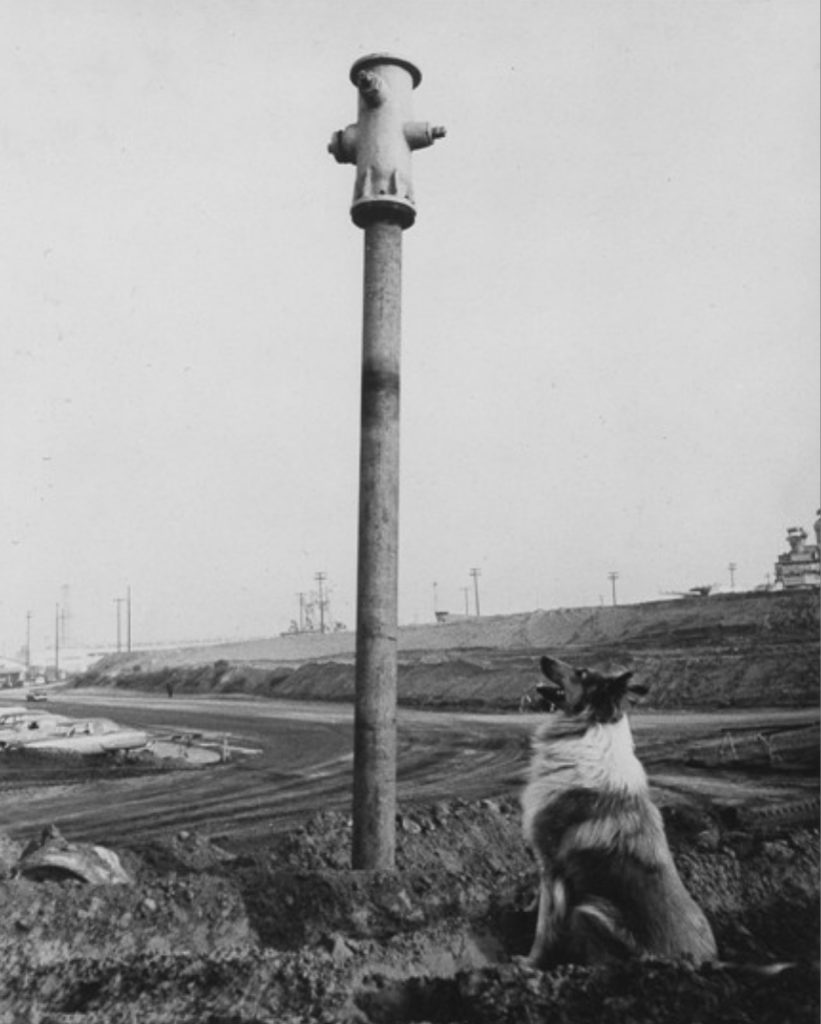
The prospering but “sinking city” of Long Beach would solve its subsidence problem with four islands and advanced drilling and production technologies. Photo by Roger Coar, 1959, courtesy Long Beach Historical Society.
To counter subsidence, five 1,750-horsepower motors on White Island drive water injection pumps to offset extracted petroleum, sustain reservoir pressures, and extend oil recovery. The challenge was once described as “a massive Rubik’s Cube of oil pockets, fault blocks, fluid pressures, and piping systems.”
Meanwhile, all of this happens amidst the scenic boating and tourist waters in Long Beach Harbor.
The California Resources Corporation operates the offshore part on the islands of the Wilmington field, the fourth-largest U.S. oilfield, according to the Los Angeles Association of Professional Landmen, whose members toured the facilities in November 2017.
Producing in Plain Sight
“Most interestingly, the islands were designed to blend in with the surrounding coastal environment,” explained LAAPL Education Chair Blake W.E. Barton of Signal Hill Petroleum. “The drilling rigs and other above-ground equipment are camouflaged and soundproofed with faux skyscraper skins and waterfalls.”
Most people simply do not realize the islands are petroleum production facilities. From the shore, the man-made islands appear occupied by upscale condos and lush vegetation. Many of the creative disguises came courtesy of Joseph Linesch, a pioneering designer who helped landscape Disneyland.

The THUMs islands required exceptional designs, and “the people who were involved at the time were very creative visionaries,” said Frank Komin, executive vice president for southern operations of the California Resources Corporation (CRC), owner of the islands.
About 80 percent of the company’s properties would overlie the Wilmington oilfield, according to CRC, noting that from 2003 to 2018, CRC operations generated over $5.2 billion in revenues, taxes, and fees for the City of Long Beach and the state.
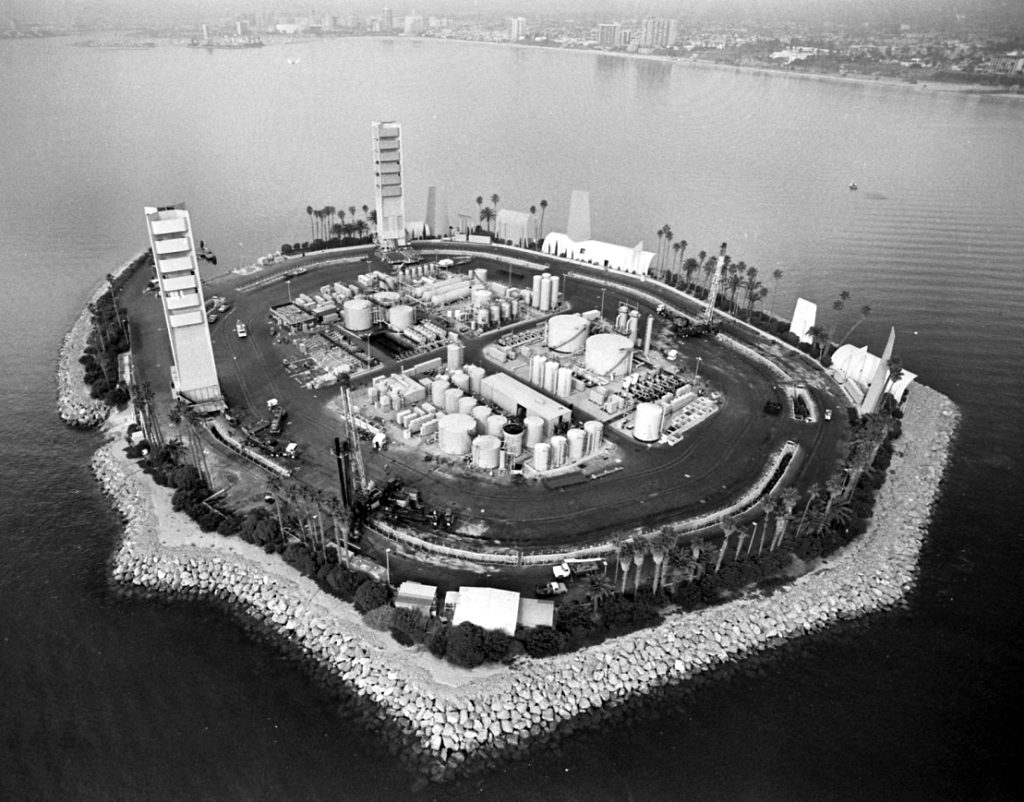
THUMS Island White, named for Edward White II, the first American to walk in space, who died in 1967 with astronauts “Gus” Grissom and Roger B. Chaffee. A fourth island was named for NASA test pilot Ted Freeman, a fellow astronaut who died in 1963. Photo courtesy UCLA Library Digital Collections.
“Even today, those islands are viewed as one of the most innovative oil field designs in the world,” CRC executive Komin declared in a 2015 Long Beach Business Journal article. “The islands have grown to become icons in which the City of Long Beach takes a great deal of pride.”
The Journal explained that 640,000 tons of boulders, some as large as five tons, were mined and placed to build up the perimeters of the islands. “Concrete facades constructed for aesthetic purposes also divert industrial noise away from nearby residents,” the article added. For more noise abatement, electricity has provided nearly all the power for the islands.
The THUMS aesthetic integration of 175-foot derricks and production structures has been described by the Los Angeles Times as “part Disney, part Jetsons, part Swiss Family Robinson.”
_______________________
Recommended Reading: An Ocean of Oil: A Century of Political Struggle over Petroleum Off the California Coast (1998); Black Gold in California: The Story of California Petroleum Industry  (2016); Early California Oil: A Photographic History, 1865-1940
 (1985). Your Amazon purchases benefit the American Oil & Gas Historical Society. As an Amazon Associate, AOGHS earns a commission from qualifying purchases.
_______________________
The American Oil & Gas Historical Society (AOGHS) preserves U.S. petroleum history. Please support AOGHS to help maintain this energy education website, a monthly email newsletter, This Week in Oil and Gas History News, and expand historical research. Contact bawells@aoghs.org. Copyright © 2026 Bruce A. Wells.
Citation Information – Article Title: “THUMS – California’s Hidden Oil Islands.” Authors: B.A. Wells and K.L. Wells. Website Name: American Oil & Gas Historical Society. URL: https://aoghs.org/technology/thums-california-hidden-oil-islands. Last Updated: February 12, 2026. Original Published Date: March 8, 2018.
by Bruce Wells | Jan 28, 2026 | Petroleum Products
G.M. scientists discover the anti-knock properties of tetraethyl lead gasoline.
General Motors scientists in 1921 discovered the anti-knock properties of tetraethyl lead as an additive to gasoline. By 1923, many American motorists would be driving into service stations and saying, “Fill ‘er up with Ethyl.”
Early internal combustion engines frequently suffered from “knocking,” the out-of-sequence detonation of the gasoline-air mixture in a cylinder. The constant shock added to exhaust valve wear and frequently damaged engines.
Automobiles powered with gasoline had been the least popular models at the November 1900 first U.S. auto show in New York City’s Madison Square Garden.
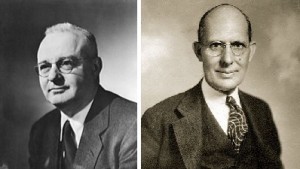
General Motors chemists Thomas Midgely Jr. and Charles F. Kettering tested many gasoline additives, including arsenic.
On December 9, 1921, after five years of lab work to find an additive to eliminate pre-ignition “knock” problems of gasoline, General Motors researchers Thomas Midgely Jr. and Charles Kettering discovered the anti-knock properties of tetraethyl lead.
Early experiments at GM examined the properties of knock suppressors such as bromine, iodine, and tin — comparing these to new additives such as arsenic, sulfur, silicon, and lead.
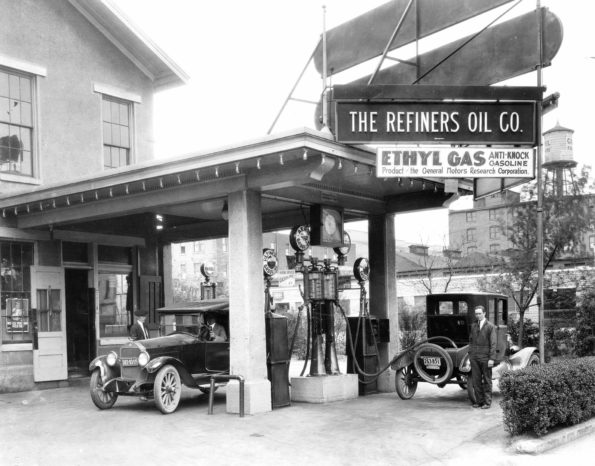
The world’s first anti-knock gasoline containing a tetra-ethyl lead compound went on sale at the Refiners Oil Company service station in Dayton, Ohio. A bolt-on “Ethylizer” can be seen running vertically alongside the visible reservoir. Photo courtesy Kettering/GMI Alumni Foundation.
When the two chemists synthesized tetraethyl lead and tried it in their one-cylinder laboratory engine, the knocking abruptly disappeared. Fuel economy also improved. Ethyl vastly improved gasoline performance.
“Ethylizers” debut in Dayton
Although being diluted to a ratio of one part per thousand, the lead additive yielded gasoline without the loud, power-robbing knock. With other automotive scientists watching, the first car tank filled with leaded gas took place on February 2, 1923, at the Refiners Oil Company service station in Dayton, Ohio.
In the beginning, GM provided Refiners Oil Company and other service stations special equipment, simple bolt-on adapters called “Ethylizers” to meter the proper proportion of the new additive.
“By the middle of this summer you will be able to purchase at approximately 30,000 filling stations in various parts of the country a fluid that will double the efficiency of your automobile, eliminate the troublesome motor knock, and give you 100 percent greater mileage,” Popular Science Monthly reported in 1924.
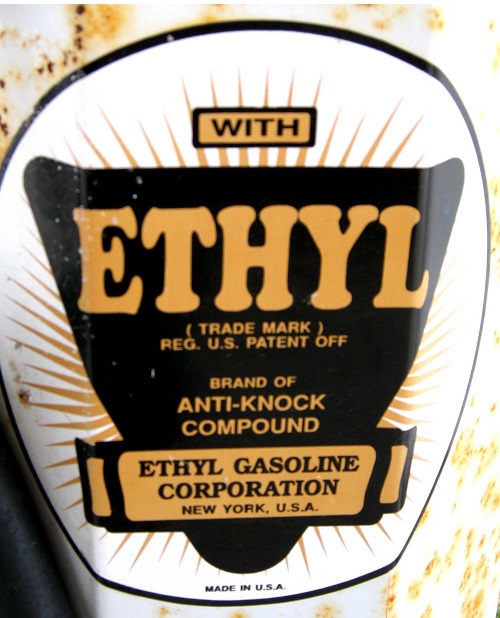
By the late 1970s, public health concerns resulted in the phase-out of tetraethyl lead in gasoline, except for aviation fuel.
Anti-knock gasoline containing a tetraethyl lead compound also proved vital for aviation engines during World War II, even as danger from the lead content increasingly became apparent.
Powering Victory in World War II
Aviation fuel technology was still in its infancy in the 1930s. The properties of tetraethyl lead proved vital to the Allies during World War II. Advances in aviation fuel increased power and efficiency, resulting in the production of 100-octane aviation gasoline shortly before the war.
Phillips Petroleum — later ConocoPhillips — was involved early in aviation fuel research and had already provided high-gravity gasoline for some of the first mail-carrying airplanes after World War I.
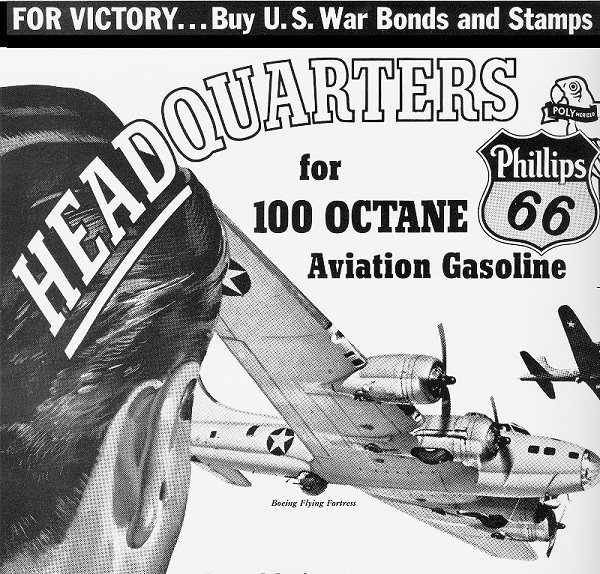
Phillips Petroleum produced tetraethyl leaded aviation fuels from high-quality oil found in Osage County, Oklahoma, oilfields.
Phillips Petroleum produced aviation fuels before it produced automotive fuels. The company’s gasoline came from the high-quality oil produced from Oklahoma’s Seminole oilfields and the 1917 Osage County oil boom.
Although the additive’s danger to public health was underestimated for decades, tetraethyl lead has remained an ingredient of 100-octane “avgas” for piston-engine aircraft.
Tetraethyl Lead’s Deadly Side
Leaded gasoline was extremely dangerous from the beginning, according to Deborah Blum, a Pulitzer Prize-winning science writer. “GM and Standard Oil had formed a joint company to manufacture leaded gasoline, the Ethyl Gasoline Corporation,” she noted in a January 2013 article. Research focused solely on improving the formula, not on the danger of the lead additive.
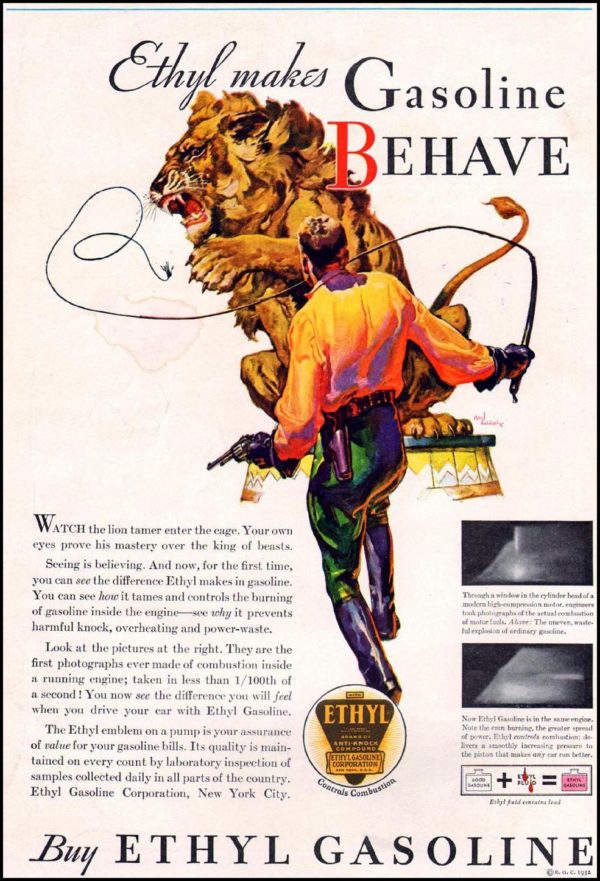
A 1932 magazine advertisement promoted the Ethyl Gasoline Corporation fuel additive as a way to improve high-compression engine performance.
“The companies disliked and frankly avoided the lead issue,” Blum wrote in “Looney Gas and Lead Poisoning: A Short, Sad History” at Wire.com. “They’d deliberately left the word out of their new company name to avoid its negative image.”
In 1924, dozens were sickened, and five employees of the Standard Oil Refinery in Bayway, New Jersey, died after they handled the new gasoline additive.

By May 1925, the U.S. Surgeon General called a national tetraethyl lead conference, Blum reported. An investigative task force was formed. Researchers concluded there was ”no reason to prohibit the sale of leaded gasoline” as long as workers were well protected during the manufacturing process.
So great was the additive’s potential to improve engine performance, the author notes, by 1926 the federal government approved continued production and sale of leaded gasoline. “It was some fifty years later — in 1986 — that the United States formally banned lead as a gasoline additive,” Blum added.
By the early 1950s, American geochemist Clair Patterson discovered the toxicity of tetraethyl lead; phaseout of its use in gasoline began in 1976 and was completed by 1986. In 1996, EPA Administrator Carol Browner declared, “The elimination of lead from gasoline is one of the great environmental achievements of all time.”
Learn more about high-octane aviation fuel in Flight of the Woolaroc.
_______________________
Recommended Reading: An Illustrated Guide to Gas Pumps (2008); Unleaded: How Changing Our Gasoline Changed Everything (2021). Your Amazon purchase benefits the American Oil & Gas Historical Society. As an Amazon Associate, AOGHS earns a commission from qualifying purchases.
_______________________
The American Oil & Gas Historical Society (AOGHS) preserves U.S. petroleum history. Please become an AOGHS annual supporter and help maintain this energy education website, expand historical research, and extend public outreach. For annual sponsorship information, contact bawells@aoghs.org. © 2026 Bruce A. Wells. All right reserved.
Citation Information – Article Title: “Ethyl Anti-Knock Gas.” Authors: B.A. Wells and K.L. Wells. Website Name: American Oil & Gas Historical Society. URL: https://aoghs.org/products/tetraethyl-lead-gasoline. Last Updated: December 4, 2025. Original Published Date: December 7, 2014.