by Bruce Wells | Mar 11, 2026 | Petroleum Pioneers
The Texas independent producer who “rocketed into the national imagination in the late 1940s.”
As giant oilfield discoveries created Texas millionaires after World War II, people started calling “Diamond Glenn” McCarthy the reigning king of the wildcatters. Some historians have said a $21 million hotel McCarthy opened in 1949 put Houston on the map.
Glenn H. McCarthy’s petroleum career began with a 1935 well 50 miles east of Houston when he and partner R.A. Mason completed their No. 1 White well with production of almost 600 barrels of oil a day. The well extended by three miles to the north of the already productive Anahuac field — which McCarthy had earlier discovered.
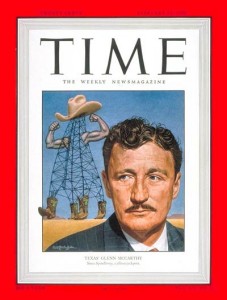
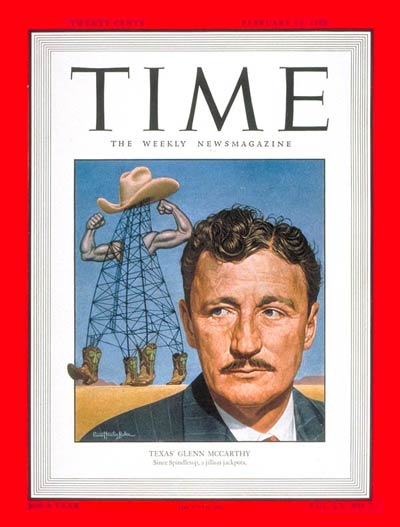
After discovering 11 oil and natural gas fields in Texas, Glenn McCarthy appeared on the February 13, 1950, cover of TIME.
By 1945, McCarthy had gone on to discover 11 new fields and extend others. In Brazoria County one year later, he drilled the highest-pressure gas well drilled to that time. Described as a “bombastic, plucky Irishman best known for building the famous Shamrock Hotel,” the Texas independent oilman would be featured on the February 13, 1950, cover of TIME. (more…)
by Bruce Wells | Mar 1, 2026 | Petroleum Pioneers
As drillers and speculators rushed to Spindletop Hill, the Texas Company was organized in 1902.
A series of oil and natural gas discoveries at Sour Lake, Texas — near the famous 1901 gusher at Beaumont — helped launch the major oil company Texaco.
Originally known as Sour Lake Springs because of sulfurous spring water popular for its healing properties, a series of oil discoveries brought wealth and new petroleum companies to Hardin County in southeastern Texas.
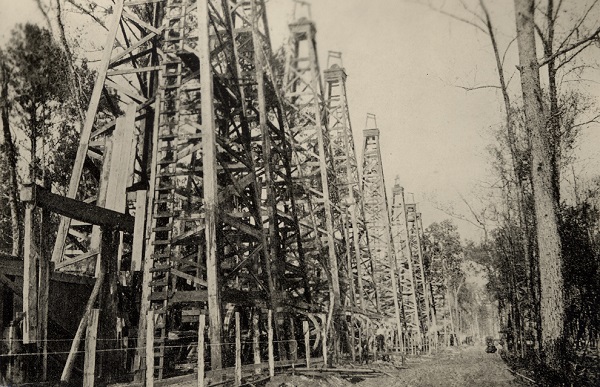
“A forest of oil well derricks at Sour Lake, Texas,” circa early1900s, courtesy the W.D. Hornaday Collection, Texas State Library and Archives Commission, Austin. Oil discoveries at the resort town northwest of the world-famous 1901 Spindletop gusher transformed the Texas Company into Texaco.
As the science of petroleum exploration and production evolved, some geologists predicted oil was trapped at a salt dome at Sour Lake, similar to that of Beaumont’s Spindletop Hill formation, which was producing massive amounts of oil.
According to Charles Warner in Texas Oil & Gas Since 1543, in November 1901 an exploratory well found “hot salt water impregnated with sulfur between 800 and 850 feet…and four oil sands about 10 feet thick at a depth of approximately 1,040 feet.”
Warner noted that the Sour Lake Springs field’s discovery well came four months later when a second attempt by the Great Western Company drilled “north of the old hotel building” in the vicinity of earlier shallow wells.
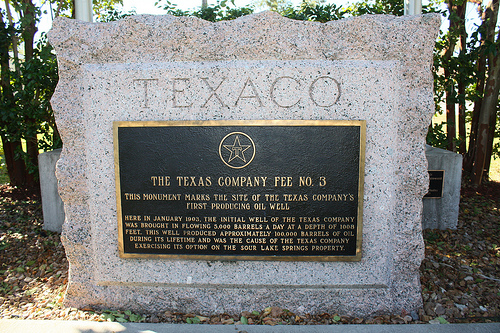
A monument marks the site where in 1903 the Fee No. 3 well flowed at 5,000 barrels of oil a day, launching the Texas Company into becoming Texaco.
“This well secured gusher production at a depth of approximately 683 feet on March 7, 1902,” Warner reported. “The well penetrated 40 feet of oil sand. The flow of oil was accompanied by a considerable amount of loose sand, and it was necessary to close the well in from time to time and bail out the sand, after which the well would respond with excellent flows.”
As more discoveries followed, Joseph “Buckskin Joe” Cullinan and Arnold Schlaet were among those who rushed to the area from their offices in Beaumont.
The Texas Company
The most significant company that started during the Spindletop oil boom was The Texas Company, according to historian Elton Gish.

“Cullinan worked in the Pennsylvania oil industry and later went to Corsicana, Texas, about 1898 when oil was first discovered in that district, where he became the most prosperous operator in the field,” reported Gish in his “History of the Texas Company and Port Arthur Works Refinery.”
Cullinan formed the Petroleum Iron Works, building oil storage tanks in the Beaumont area — where he was introduced to Schlaet. “When the Spindletop boom came in January 1901, Mr. Cullinan decided to visit Beaumont,” Gish noted. Schlaet managed the oil business of two brothers, New York leather merchants.
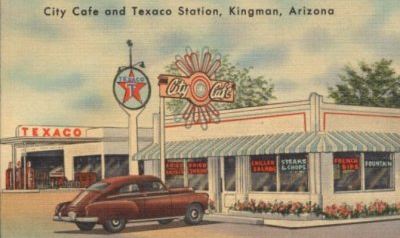
Named after its New York City telegraph address, the Texaco brand became official in 1959. Postcard of a Texaco service station next to a cafe in Kingman, Arizona.
“Schlaet’s field superintendent, Charles Miller, traveled to Beaumont in 1901 to witness the Spindletop activity and met with Cullinan, whom he knew from the oil business in Pennsylvania. He liked Cullinan’s plans and asked Schlaet to join them in Beaumont.”
According to Texaco, Cullinan and Schlaet formed the Texas Company on April 7, 1902, by absorbing the Texas Fuel Company and inheriting its office in Beaumont. Texas Fuel had organized just one year earlier to purchase Spindletop oil, develop storage and transportation networks, and sell the oil to northern refineries.
By November 1902, the new Texas Company was establishing a new refinery in Port Arthur as well as 20 storage tanks, building its first marine vessel, and equipping an oil terminal to serve sugar plantations along the Mississippi River.
Fee No. 3 Discovery
The Texas Company struck oil at Sour Lake Springs in January 1903, “after gambling its future on the site’s drilling rights,” the company explained. “The discovery, during a heavy downpour near Sour Lake’s mineral springs, turned the company into a major oil producer overnight, validating the risk-taking insight of company co-founder J.S. Cullinan and the ability of driller Walter Sharp.”
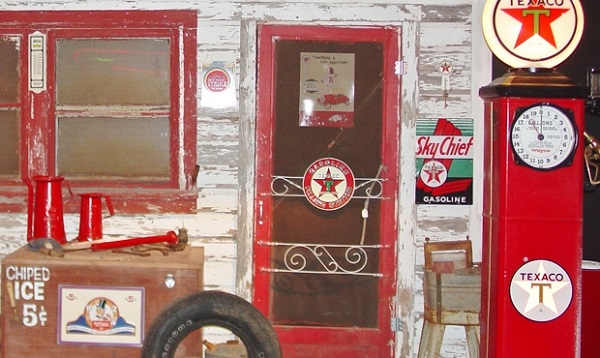
A Texaco station was among the 2012 indoor exhibits featured at the National Route 66 Museum in Elk City, Oklahoma. Photo by Bruce Wells.
Their 1903 Hardin County discovery at Sour Lake Springs — the Fee No. 3 well — flowed at 5,000 barrels a day, securing the Texas Company’s success in petroleum exploration, production, transportation, and refining. Sharp founded the Sharp-Hughes Tool Company in 1908 with Howard Hughes Sr.
High oil production levels from the Sour Lake field and other successful wells in the Humble oilfield (1905) secured the company’s financial base, according to L. W. Kemp and Cherie Voris in the Handbook of Texas Online.
“In 1905 the Texas Company linked these two fields by pipelines to Port Arthur, ninety miles away, and built its first refinery there. That same year the company acquired an asphalt refinery at nearby Port Neches,” the authors noted.
“In 1908 the company completed the ambitious venture of a pipeline from the Glenn Pool, in the Indian Territory (now Oklahoma), to its Southeast Texas refineries,” added Kemp and Voris.
Telegraph Address: Texaco
As early as 1905, the Texas Company had established marketing facilities not only throughout the United States but also in Belgium, Luxembourg, and Panama.
The Texas Company registered “Texaco” as a trademark in 1909.
The telegraph address for the company’s New York office is “Texaco” — a name soon applied to its products. The company registered its first trademark, the original red star with a green capital letter “T” superimposed on it in 1909. The letter remained an essential component of the logo for decades.
In August 1926, the Texas Corporation incorporated in Delaware (from Texas) and by an exchange of shares acquired outstanding stock of The Texas Company, which was dissolved the next year.
The new corporation became the parent company of numerous “Texas Company” — Texaco — entities and other subsidiaries, according to Jim Hinds of Columbus, Indiana (see Histories of Indian Refining, Havoline, and Texaco). By 1928, Texaco operated more than 4,000 gasoline stations in 48 states. It already was a major oil company when it officially renamed itself Texaco in 1959.
1987 Bankruptcy
Texaco lost a 1985 court battle following its purchase of Getty Oil Company. In February 1987 a Texas court upheld the decision against Texaco for having initiated an illegal takeover of Getty Oil after Pennzoil had made a bid for the company. Texaco filed for bankruptcy in April 1987.
The companies settled their historic $10.3 billion legal battle for $3 billion when Pennzoil agreed to drop its demand for interest. The Los Angeles Times reported the compromise was vital for Texaco emerging from bankruptcy, a haven sought to stop Pennzoil from enforcing the largest court judgment ever awarded at the time.

On October 9, 2001, Chevron and Texaco agreed to a merger that created ChevronTexaco — renamed Chevron in 2005. Although the Sour Lake Springs oil boom was surpassed by other Texas discoveries, it has remained the birthplace of Texaco.
Learn more about southeastern Texas petroleum history in Spindletop creates Modern Petroleum Industry and Prophet of Spindletop.
_______________________
Recommended Reading: The Texaco Story, The First Fifty Years 1902 – 1952 by Texas Company (1952). Texaco’s Port Arthur Works, A Legacy of Spindletop and Sour Lake (2003); Giant Under the Hill: A History of the Spindletop Oil Discovery (2008). Your Amazon purchase benefits the American Oil & Gas Historical Society. As an Amazon Associate, AOGHS earns a commission from qualifying purchases.
_______________________
The American Oil & Gas Historical Society (AOGHS) preserves U.S. petroleum history. Please support AOGHS to help maintain this energy education website, a monthly email newsletter, This Week in Oil and Gas History News, and expand historical research. Contact bawells@aoghs.org. Copyright © 2026 Bruce A. Wells.
Citation Information – Article Title: “Sour Lake produces Texaco.” Authors: B.A. Wells and K.L. Wells. Website Name: American Oil & Gas Historical Society. URL: https://aoghs.org/petroleum-pioneers/sour-lake-produces-texaco. Last Updated: February 28, 2026. Original Published Date: April 5, 2014.
by Bruce Wells | Feb 4, 2026 | Petroleum History Almanac
The Ranger who tamed oil and gas boom towns during the Great Depression. “Crime may expect no quarter.”
During much of the 1920s, a Texas Ranger became known for strictly enforcing the law in oilfield communities. By 1930, the discovery year of the largest oilfield in the lower 48 states, he was known as “El Lobo Solo” — the lone wolf — the Ranger who brought law and order to East Texas boom towns.
Manuel Trazazas Gonzaullas was born in 1891 in Cádiz, Spain, to a Spanish father and Canadian mother who were naturalized U.S. citizens. At age 15 he witnessed the murder of his only two brothers and the wounding of his parents when bandits raided their home. Fourteen years later, Gonzaullas joined the Texas Rangers.
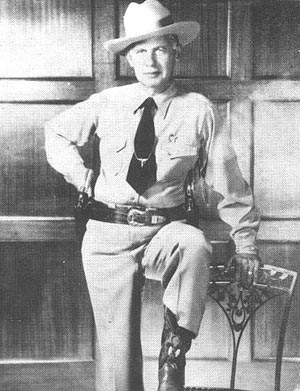
“Give Texas more Rangers of the caliber of ‘Lone Wolf’ Gonzaullas, and the crime wave we are going through will not be of long duration,” reported the Dallas Morning News in 1934.
“He was a soft-spoken man and his trigger finger was slightly bent,” independent producer Watson W. Wise characterized him during a 1985 interview in Tyler, Texas. “He always told me it was geared to that .45 of his.” (more…)
by Bruce Wells | Jan 10, 2026 | Petroleum History Almanac
The North Texas church proclaimed richest in America.
In the fall of 1917 near Ranger, Texas, the cotton-farming town of Merriman was inhabited by “ranchers, farmers, and businessmen struggling to survive an economic slump brought on by severe drought and boll weevil-ravaged cotton fields.”
Everything changed in Eastland County when a wildcat well drilled by Texas & Pacific Coal Company struck oil at Ranger, four miles from Merriman. The J.H. McCleskey No. 1 well produced 1,600 barrels of oil a day.
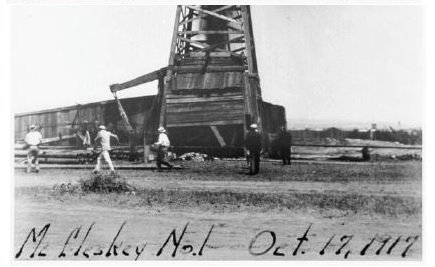
The 1917 headline-making McCleskey No. 1 cable-tool well — called “Roaring Ranger” — brought an oil boom to Eastland County, Texas, about 100 miles west of Dallas.
The rush to acquire leases that followed the oilfield discovery became legendary among drilling booms, even for Texas, home to the legendary 1901 gusher at Spindletop.
WWI Wave of Oil
As drilling continued, the yield of the Ranger oilfield led to peak production reaching more than 14 million barrels in 1919. Production from the “Roaring Ranger” well and its giant North Texas oilfield helped win World War I, with a British War Cabinet member declaring, “The Allied cause floated to victory upon a wave of oil.”
Texas & Pacific Coal Company had taken a great risk by leasing acreage around Ranger, but the risk paid off when lease values soared. The exploration company added “oil” to its name, becoming the Texas Pacific Coal and Oil Company.
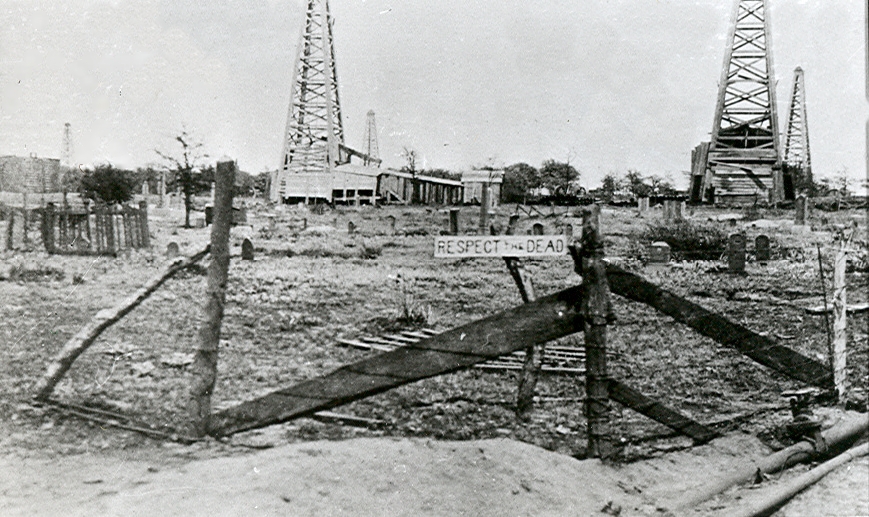
“So as we could not worship God on the former acre of ground, we decided to lease it and honor God with the product,” explained Merriman Baptist Church Deacon J.T. Falls. Photo courtesy Robert Vann, “Lone Star Bonanza, the Ranger Oil Boom of 1917-1923.”
The price of the oil company stock jumped from $30 a share to $1,250 a share as a host of landmen “scanned the landscape to discover any fractions in these holdings. A little school and church, before too small to be seen, now looked like a skyscraper.”
Warren Wagner, driller of the McCleskey discovery well, leased the local school lot and in August 1918 completed a well producing 2,500 barrels of oil a day. Leasing at Merriman Baptist Church proved to be a challenge.
In February, Deacon J.T. Falls complained that drilling new wells “ran us out, as all of the land around our acre was leased, producing wells being brought in so near the house we were compelled to abandon the church because of the gas fumes and noisy machinery.”
Falls added that, “As we could not worship God on the former acre of ground, we decided to lease it and honor God with the product.”
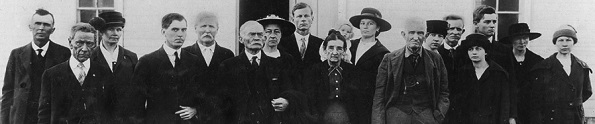
Deacon J.T. Falls (second from left) was not amused when the Associated Press reported in 1919 that his church had refused a million dollars for the lease of the cemetery.
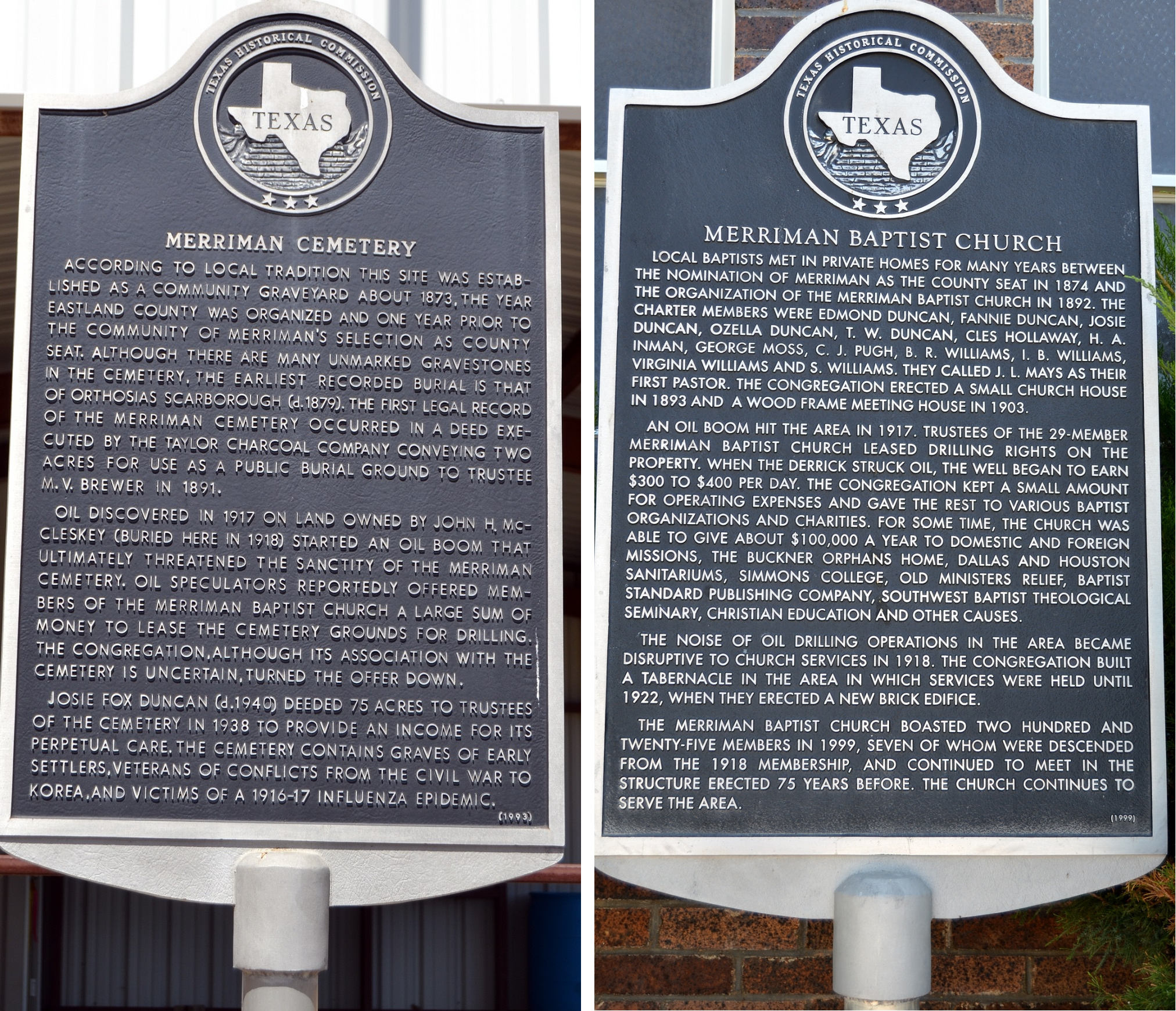
A Texas Historical Commission marker erected in 1999 described when the well on the church’s lease began producing oil, earning the congregation a royalty of between $300 and $400 a day. Merriman Baptist Church “kept a small amount for operating expenses and gave the rest to various Baptist organizations and charities.”
However, drilling in the church graveyard was a different matter. As oil production continued to soar in North Texas, the congregants of Merriman Baptist Church initially resisted one drilling site. As a January 18, 1919, article in the New York Times noted in its headline, “CHURCH MADE RICH BY OIL; Refuses $1,000,000 for Right to Develop Wells in Graveyard.”
Respecting the Dead
At Merriman’s church cemetery, a less seen historical marker erected in 1993 explains the drilling boom’s fierce competition to find property without a well already on it: “Oil speculators reportedly offered members of the Merriman Baptist Church a large sum of money to lease the cemetery grounds for drilling.”
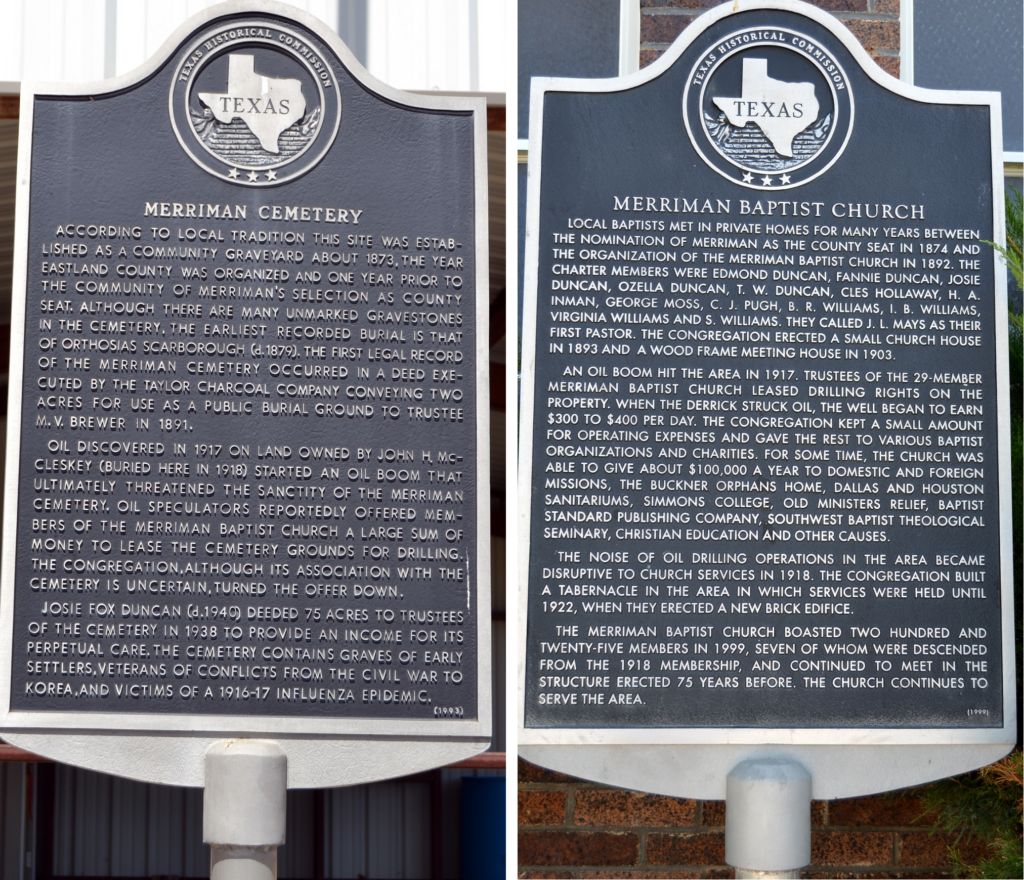
Near Ranger in Eastland County, Texas Historical Commission markers were erected in 1993 (left) and 1999 explaining how members of the Merriman Baptist Church shared their wealth from petroleum royalties. Photos courtesy the Historical Marker Database.
When local newspapers reported the church had refused an offer of $1 million, the Associated Press picked it up, and newspapers from New York to San Francisco ran the story. Literary Digest even featured “the Texas Mammon of Righteousness” with a photograph of “The Congregation That Refuses A Million.”
Deacon J.T. Falls was not amused. “A great many clippings have been sent to us from many secular papers to the effect that we as a church have refused a million dollars for the lease of the cemetery. We do not know how such a statement started,” the deacon opined.
“The cemetery does not belong to the church. It was here long before the church was. We could not lease it if we would, and we would not if we could,” the cleric added.
“If any person’s or company’s heart has become so congealed as to want to drill for oil in this cemetery, they could not — for the dead could not sign a lease, and no living person has any right to do so,” Falls proclaimed.
The church deacon concluded with an ominous admonition to potential drillers, “Those that have friends buried here have the right and the will to protect the graves, and any person attempting to trespass will assume a great risk.”
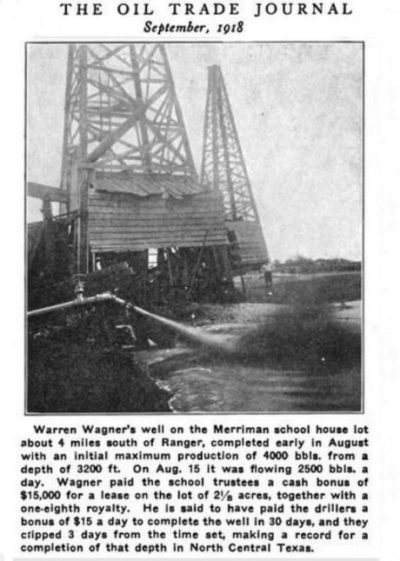
A 1918 article noted a “Merriman school house” oil well drilled to 3,200 feet in record time for North Central Texas.
Roaring Ranger’s oil production dropped precipitously because of dwindling reservoir pressures brought on by unconstrained drilling. Many exploration and production companies failed (including fraudulent ones like Hog Creek Carruth Oil Company).
In the decades since the McCleskey No. 1 well, advancements in horizontal drilling technology have presented more legal challenges to mineral rights of the interred, according to Zack Callarman of Texas Wesleyan School of Law.

In 2014, Callarman wrote an award-winning analysis of laws concerning drilling to extract oil and natural gas underneath cemeteries. “Seven Thousand Feet Under: Does Drilling Disturb the Dead? Or Does Drilling Underneath the Dead Disturb the Living?” was published in the Real Estate Law Journal.
Despite yet another North Texas oilfield discovery at Desdemona, by 1920 the Eastland County drilling boom was over. The faithful still gather at Merriman Baptist Church every Sunday.
_______________________
Recommended Reading: Early Texas Oil: A Photographic History, 1866-1936
 (2000);Texas Oil and Gas, Postcard History (2013);Wildcatters: Texas Independent Oilmen
 (1984). Your Amazon purchase benefits the American Oil & Gas Historical Society. As an Amazon Associate, AOGHS earns a commission from qualifying purchases.
_______________________
The American Oil & Gas Historical Society (AOGHS) preserves U.S. petroleum history. Please become an AOGHS annual supporter and help maintain this energy education website and expand historical research. For more information, contact bawells@aoghs.org. Copyright © 2026 Bruce A. Wells. All rights reserved.
Citation Information – Article Title: “Oil Riches of Merriman Baptist Church.” Authors: B.A. Wells and K.L. Wells. Website Name: American Oil & Gas Historical Society. URL: https://aoghs.org/oil-almanac/oil-riches-of-merriman-baptist-church. Last Updated: January 11, 2026. Original Published Date: January 18, 2019.