by Bruce Wells | Aug 30, 2025 | Petroleum Technology
The science behind petroleum exploration and production — and finding oil and natural gas at greater depths.
“A good cable-tool man is just about the most highly skilled worker you’ll find,” one veteran of the oil patch noted. “Besides having a feel for the job, knowing what’s going on thousands of feet under the ground just from the movement of the cable, he’s got to be something of a carpenter, a steam-fitter, an electrician, and a damned good mechanic.” – A 1939 interview in Voices from the Oil Fields by Paul Lambert and Kenny Franks.
Petroleum exploration technologies have evolved from ancient “spring poles” to steam-powered percussion cable-tools, to modern rotary rigs with steerable, diamond bits that can drill miles deep. (more…)
by Bruce Wells | May 26, 2025 | This Week in Petroleum History
May 26, 1891 – Carbon Black Patent leads to Crayola –
Edwin Binney and C. Harold Smith received a patent for an “Apparatus for the Manufacture of Carbon Black.” The Binney & Smith process created a fine, intensely black soot-like substance — a pigment blacker than any other. Its success would lead to another petroleum product, Crayola crayons.
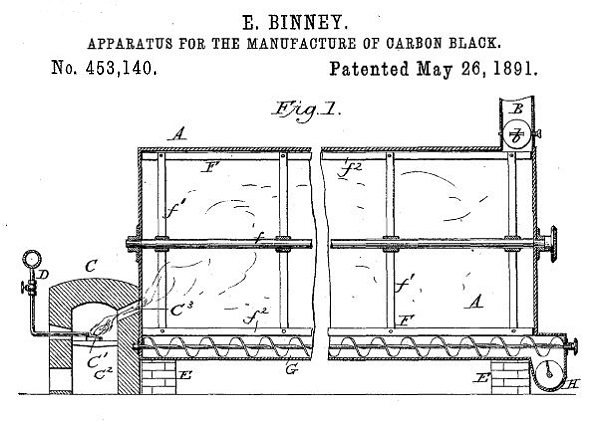
Edwin Binney in 1891 patented a petroleum-burning “Apparatus for the Manufacture of Carbon Black.” Twelve years later, Binney & Smith produced another oilfield product, Crayola, named by his wife Alice.
After introducing a popular black crayon called Staonal (stay-on-all) the Pennsylvania company began manufacturing Crayola crayons in 1903 using paraffin hand-mixed pigments. Each box contained eight colors: red, orange, yellow, green, blue, violet, brown and black.
Learn more in Carbon Black and Oilfield Crayons. (more…)