by Bruce Wells | Mar 2, 2026 | This Week in Petroleum History
March 2, 1922 – Lease sells for $1 Million in Osage Nation –
Under the broad crown of a giant elm next to the Osage Council House in Pawhuska, Oklahoma, Skelly Oil and Phillips Petroleum Company jointly bid more than one million dollars for a 160-acre tract of land.
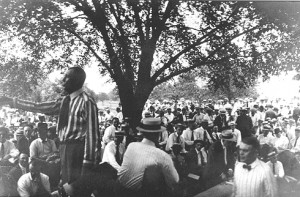
Colonel Elmer Ellsworth Walters (striped shirt), the “Auctioneer of the Osage Nation,” by the 1930s earned the tribe millions from petroleum companies.
The 1922 auction — Oklahoma’s first million-dollar mineral lease — took place in the shade of what became known as the “Million Dollar Elm.” Independent producers such as Frank Phillips, Harry Sinclair, Bill Skelly, J. Paul Getty, and E.W. Marland were frequent bidders for promising leases. The Osage would erect a statue of their auctioneer, Colonel Elmer Ellsworth Walters, in his hometown of Skedee. Learn more in Million Dollar Elm.
March 3, 1879 – United States Geological Survey established
President Rutherford B. Hayes signed legislation creating the United States Geological Survey (USGS) within the Department of the Interior. The legislation resulted from a report by the National Academy of Sciences, which had been asked by Congress to provide a plan for surveying the country.
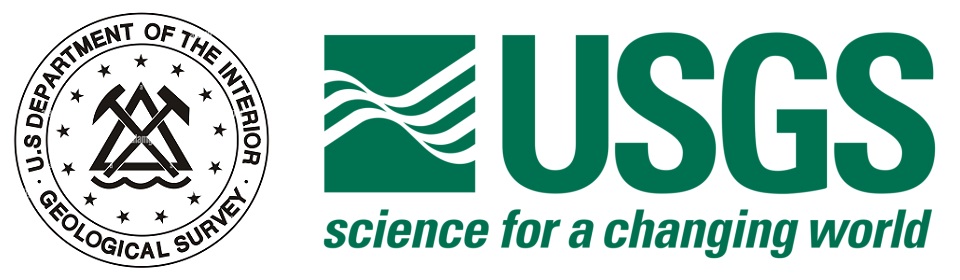
Original logo for the U.S. Geological Survey and the current one. The motto “science for a changing world” was added in 1997.
The new agency’s mission included “classification of the public lands and examination of the geological structure, mineral resources, and products of the national domain,” according to USGS, which since 1974 has been headquartered on a 105-acre site in Reston, Virginia. The USGS maintains the world’s largest library collection dedicated to earth and natural sciences, including more than one million books, 600,000 maps, and 500,000 photographs.
March 3, 1886 – Natural Gas brings light to Paola, Kansas
Paola became the first town in Kansas to use natural gas commercially for illumination. To promote its natural gas resources and attract businesses from nearby Kansas City, civic leaders erected four flambeaux arches in the town square. Pipes were laid for other illuminated displays.
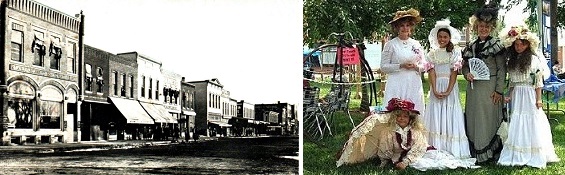
“Pearl Street Looking South, Paola, Kansas,” is among images preserved by the Miami County Kansas Historical Society & Museum. An annual Paola Roots Festival began in 1990.
“Paola was lighted with Gas,” proclaimed an exhibit at the Miami County Historical Museum. “The pipeline was completed from the Westfall farm to the square, and a grand illumination was held.” By the end of 1887, several Kansas flour mills were fueled by natural gas. Paola’s gas wells would run dry, but more mid-continent oil discoveries would follow.
March 4, 1918 – West Virginia Well sets World Depth Record
Hope Natural Gas Company completed an oil well at a depth of 7,386 feet on the Martha Goff farm in Harrison County, West Virginia. The cable-tool well became the world’s deepest until surpassed by a 1919 well in nearby Marion County. The previous world record had been a well in Germany at 7,345 feet deep.
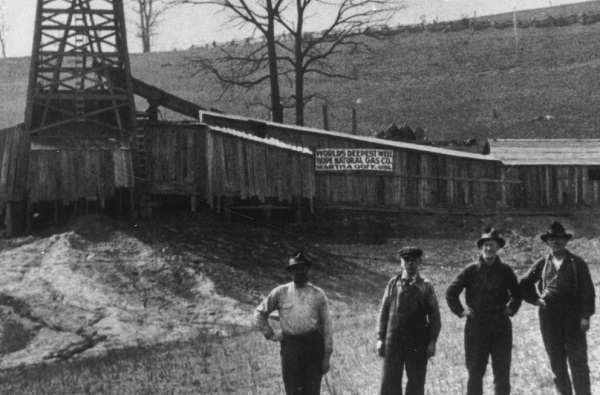
Drilled with cable tools near Clarksburg, this 1918 West Virginia well was the world’s deepest until one drilled in a neighboring county. Photo courtesy West Virginia Oil and Natural Gas Association.
In 1953, the New York State Natural Gas Corporation claimed the world’s deepest cable-tool well at a depth of 11,145 feet at Van Etten, New York. A rotary rig depth record was set in 1974 by the Bertha Rogers No. 1 well at 31,441 feet, and a Soviet Union experimental well in 1989 reached 40,230 feet — the current world record.

March 4, 1933 – Oklahoma City Oilfield under Martial Law
Oklahoma Governor William H. “Alfalfa Bill” Murray declared martial law to enforce his regulations strictly limiting production in the Oklahoma City oilfield, discovered in December 1928. Two years earlier, Murray had called a meeting of fellow governors from Texas, Kansas, and New Mexico to create an Oil States Advisory Committee “to study the present distressed condition of the petroleum industry.”
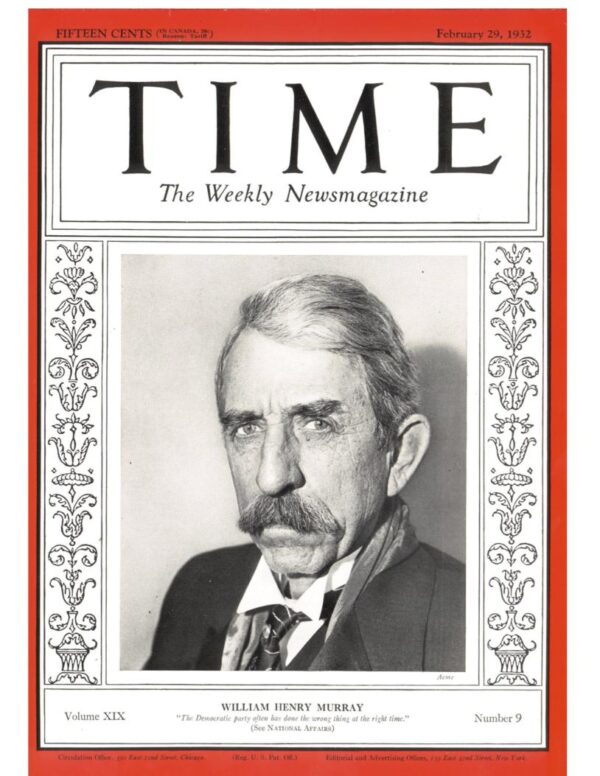
Oklahoma Gov. William “Alfalfa Bill” Murray in 1932.
Elected in 1930, the controversial politician was called “Alfalfa Bill” because of speeches urging farmers to plant alfalfa to restore nitrogen to the soil. By the end of his administration, Murray had called out the National Guard 47 times and declared martial law more than 30 times. He was succeeded as Oklahoma governor by E.W. Marland in 1935.
March 4, 1938 – Giant Oilfield discovery in Arkansas
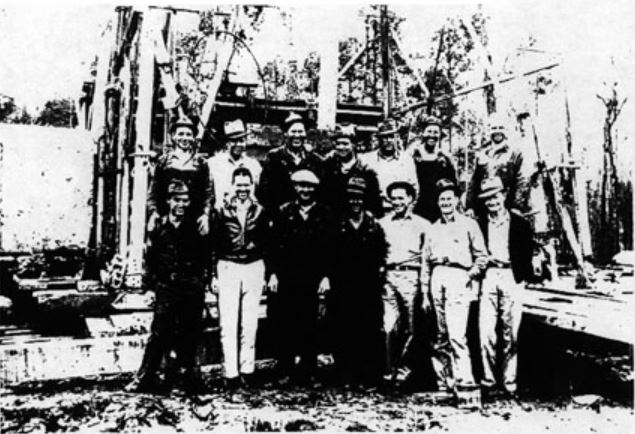
The Kerr-Lynn Oil Company (a Kerr-McGee predecessor) completed its Barnett No. 1 well east of Magnolia, Arkansas, discovering the giant Magnolia oilfield, which would become the largest producing field (in volume) during the early years of World War II, helping to fuel the American war effort.
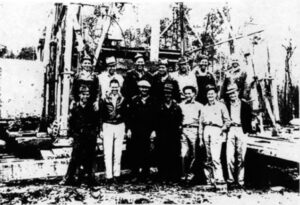
Crew members stand in front of their 1938 giant oilfield discovery well at Magnolia, Arkansas. Photo courtesy W.B. “Buzz” Sawyer.
The southern Arkansas gusher launched a Columbia County oil boom similar to Union County’s Busey-Armstrong No. 1 well southwest of El Dorado in January 1921 (see First Arkansas Oil Wells).
March 5, 1895 – First Wyoming Refinery produces Lubricants
Near the Chicago & North Western railroad tracks in Casper, Civil War veteran Philip “Mark” Shannon and his Pennsylvania investors opened Wyoming’s first refinery. It could produce 100 barrels a day of 15 different grades of lubricant, from “light cylinder oil” to a heavy grease. Shannon and his associates incorporated as the Pennsylvania Oil and Gas Company.
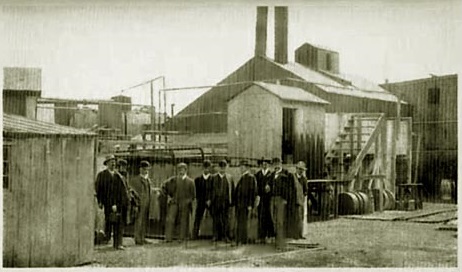
The original Casper oil refinery in Wyoming, circa 1895. Photo courtesy Wyoming Tales and Trails.
By 1904, Shannon’s company owned 14 wells in the Salt Creek field, about 45 miles from the company’s refinery (two days by wagon). Each well produced up to 40 barrels of oil per day, but transportation costs meant Wyoming oil could not compete for eastern markets. The state’s first petroleum boom began in 1908 with Salt Creek’s “Big Dutch” well.
Learn more in First Wyoming Oil Wells.
March 6, 1935 – Search for First Utah Oil proves Deadly
More than a decade before Utah’s first commercial oil wells, residents of St. George had hoped the “shooting” of a well drilled by Arrowhead Petroleum Company would bring black gold prosperity. A crowd had gathered to watch as workers prepared six 10-foot-long explosive canisters to fracture the 3,200-foot-deep Escalante No. 1 well.
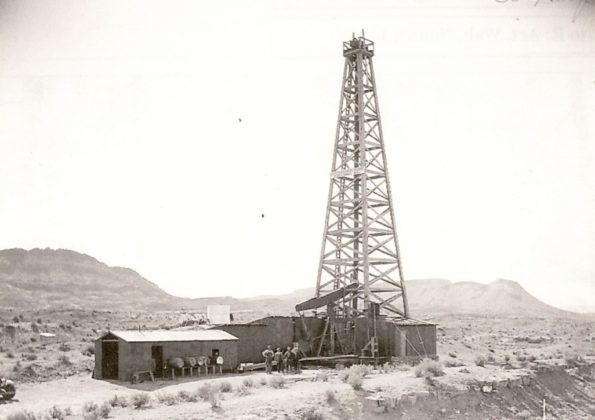
The Escalante well heralded new prosperity for residents of nearby St. George, Utah, in 1935 — until an attempt to shoot the well went wrong and canisters of TNT and nitroglycerin exploded. Photo courtesy Washington County Historical Society.
An explosion occurred as the torpedoes, “each loaded with nitroglycerin and TNT and hanging from the derrick,” were being lowered into the well. Ten people died from the detonations, which “sent a shaft of fire into the night that was seen as far as 18 miles away.”
The 1935 accident has remained the worst oil-related disaster in Utah, according to The Escalante Well Incident, a 2007 historical account.
March 6, 1981 — Shale Revolution begins in North Texas
Mitchell Energy and Development Corporation drilled its C.W. Slay No. 1 well, the first commercial natural gas well of the Barnett shale formation. Over the next four years, the vertical well in North Texas produced nearly a billion cubic feet of gas, but it would take almost two decades to perfect cost-effective shale fracturing methods combined with horizontal drilling.
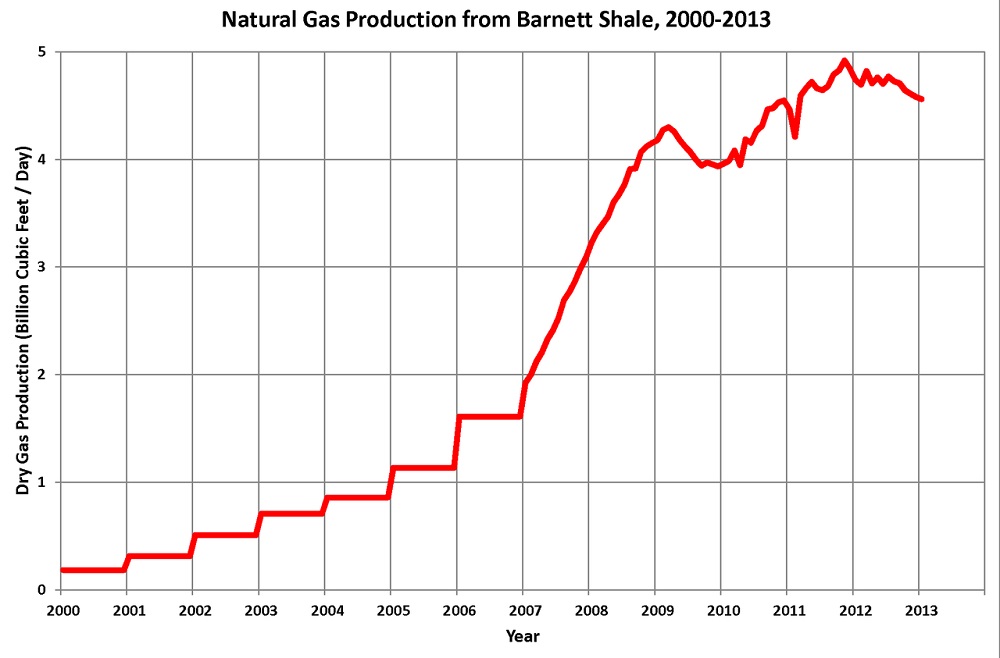
Production from the Barnett shale formation extends from Dallas west and south, covering 5,000 square miles, according to the Texas Railroad Commission. Chart courtesy Dan Plazak.
Mitchell Energy’s 7,500-foot-deep well and others in Wise County helped evaluate seismic and fracturing data to understand deep shale structures. “The C.W. Slay No. 1 and the subsequent wells drilled into the Barnett formation laid the foundation for the shale revolution, proving that natural gas could be extracted from the dense, black rock thousands of feet underground,” the Dallas Morning News later declared.
By the end of 2012, with almost 14,000 wells drilled in the largest natural gas field in Texas, production started to decline, but the Barnett field still accounted for 6.1 percent of Texas natural gas production and 1.8 percent of the U.S. supply, according to the Federal Reserve Bank of Dallas. At the start of 2024, Barnett natural gas still accounted for 5.4 percent of Texas’s natural gas production and 1.7 percent of the U.S.’s supply.
March 7, 1902 – Oil discovered at Sour Lake, Texas
Adding to the giant oilfields of Texas, the Sour Lake field was discovered about 20 miles west of the world-famous Spindletop gusher of January 1901. The spa town of Sour Lake quickly became a boom town where major oil companies, including Texaco, got their start.
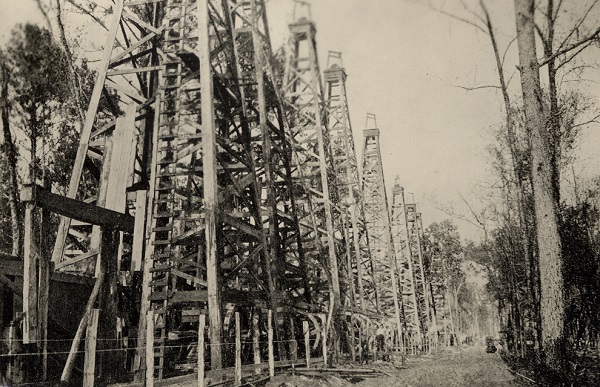
The resort town of Sour Lake, 20 miles northwest of Beaumont, “was transformed into an oil boom town when a gusher was hit in 1902,” according to the Texas State Library and Archives Commission. Photo courtesy the archive’s W.D. Hornaday Collection.
Originally settled in 1835 and called Sour Lake Springs because of its “sulphureus spring water” known for healing, the sulfur wells attracted many exploration companies. Some petroleum geologists predicted a Sour Lake salt dome formation similar to that revealed by Pattillo Higgins, the Prophet of Spindletop.
Sour Lake’s 1902 discovery well was the second attempt of the Great Western Company. The well, drilled “north of the old hotel building,” penetrated 40 feet of oil sands before reaching a total depth of about 700 feet. The Hardin County’s salt dome oilfield yielded almost nine million barrels of oil by 1903, when the Texas Company made its first major oil find at Sour Lake.
Learn more in Sour Lake produces Texaco.
March 7, 2007 – Expansion of National Artificial Reef Plan
The National Marine Fisheries Service of the National Oceanic and Atmospheric Administration (NOAA), approved a comprehensive update of the 1985 National Artificial Reef Plan, popularly known as the “rigs to reefs” program.

A typical platform provides almost three acres of feeding habitat for thousands of species. Photo courtesy U.S. Bureau of Safety and Environmental Enforcement.
The agency worked with interstate marine commissions and state artificial reef programs “to promote and facilitate responsible and effective artificial reef use based on the best scientific information available.” The revised National Artificial Reef Plan included guidelines for converting old platforms into reefs. A typical four-leg structure provides up to three acres of habitat for hundreds of marine species.
“As of December 2021, 573 platforms previously installed on the U.S. Outer Continental Shelf have been reefed in the Gulf of Mexico,” according to the Bureau of Safety and Environmental Enforcement (BSEE).
Learn more in Rigs to Reefs.
_______________________
Recommended Reading: The Osage Oil Boom (1989); Trek of the Oil Finders: A History of Exploration for Petroleum (1975); History of Paola, Kansas
 (1956); Where it all began: The story of the people and places where the oil & gas industry began: West Virginia and southeastern Ohio
 (1994); Oil And Gas In Oklahoma: Petroleum Geology In Oklahoma
 (2013); Kettles and Crackers – A History of Wyoming Oil Refineries
 (2016); Utah Oil Shale: Science, Technology, and Policy Perspectives
 (2016); George P. Mitchell: Fracking, Sustainability, and an Unorthodox Quest to Save the Planet (2019); Sour Lake, Texas: From Mud Baths to Millionaires, 1835-1909
 (1995); Rigs-to-reefs: the use of obsolete petroleum structures as artificial reefs
 (1987). Your Amazon purchase benefits the American Oil & Gas Historical Society. As an Amazon Associate, AOGHS earns a commission from qualifying purchases.
_______________________
The American Oil & Gas Historical Society (AOGHS) preserves U.S. petroleum history. Please support AOGHS to help maintain this energy education website, a monthly email newsletter, This Week in Oil and Gas History News, and expand historical research. Contact bawells@aoghs.org. Copyright © 2026 Bruce A. Wells. All rights reserved.
by Bruce Wells | Jan 5, 2026 | This Week in Petroleum History
January 7, 1864 – Oilfield Discovery at Pithole Creek –
The once-famous Pithole Creek oilfield discovered in Pennsylvania by a well drilled by the United States Petroleum Company — reportedly located by using a witch-hazel dowser. The discovery well, which initially produced 250 barrels of oil a day, made headlines and created the boomtown Pithole five years after the first U.S. oil well at nearby Titusville. (more…)
by Bruce Wells | Jun 30, 2025 | This Week in Petroleum History
June 30, 1864 – Oil Tax funds Civil War –
The federal government taxed oil for the first time when it levied a $1 per barrel tax on production from Pennsylvania oilfields.
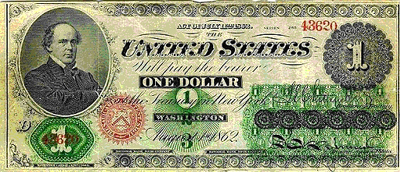
Seeking ways to pay for the Civil War, Treasury Secretary Salmon Chase advocated an oil tax of $6.30 per barrel.
Desperate for revenue to fund the Civil War as early as 1862, Treasury Secretary Salmon Chase advocated a $6.30 tax per barrel of oil and $10.50 per barrel on refined products. Angry oil producers rallied against the tax in Oil City, Pennsylvania, and sent delegates to Washington, D.C., where they negotiated a tax of $1 per 42-gallon barrel of oil.
July 1, 1919 – Top Independent Producers associate in Tulsa –
The two-year-old Mid-Continent Oil & Gas Association established its Kansas-Oklahoma Division in boom town Tulsa. Members were a “who’s who” of top independent oil and natural gas producers.
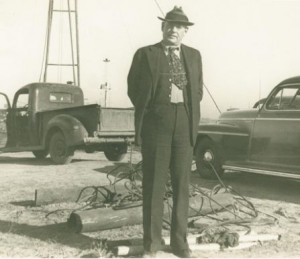
Alf Landon served as Kansas governor and was the 1936 Republican presidential candidate.
Today the U.S. Oil & Gas Association, membership in 1919 included Frank Phillips of Phillips Petroleum; E.W. Marland, whose company became Conoco; W.G. Skelly, founder of Skelly Oil; H.H. Champlin, founder of Champlin Oil; and Alf Landon, the 1936 Republican presidential candidate. Robert Kerr of Kerr-McGee Oil Company presided as president of the Mid-Continent Division from 1935 through 1941.
July 1, 1922 – Smackover Field brings Arkansas Drilling Boom
First settled by French fur trappers in 1844, Smackover, Arkansas, had a population of just 90 people in 1922 when a wildcat well erupted oil. The well, drilled to 2,066 feet by sawmill owner Sidney Umsted, discovered the 25,000-acre Smackover field. Within six months, 1,000 wells were drilled with a success rate of 92 percent.
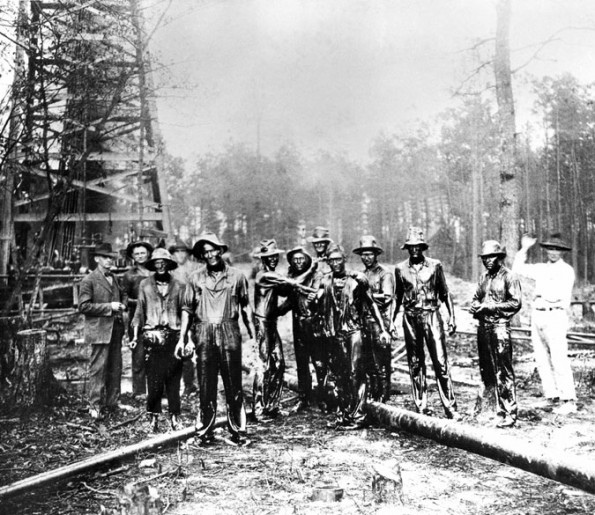
Roughnecks photographed following the July 1, 1922, discovery of the Smackover (Richardson) field in Union County. Photo courtesy of the Southwest Arkansas Regional Archives.
Smackover’s population grew to 25,000 and its uncommon name quickly attained national attention. Nearby less than two years earlier, the first commercial oil well in Arkansas, the Busey-Armstrong No. 1, had revealed the giant El Dorado field and launched the career of a young H.L. Hunt.
Learn more in First Arkansas Oil Wells.
July 1, 1938 – The Texas Company discovers Illinois Oilfield
Using a newly introduced technology of seismic exploration, petroleum geologists found hidden anticlines with commercial quantities of oil in Marion County, Illinois. By January 1939 the Salem field was ranked seventh in U.S. daily production. In one year the field produced more than 20 million barrels of oil.
Natural gas production in Illinois began as early as 1853 when marsh or “drift gas” was produced from two water wells drilled near Champaign. The state’s first drilling boom arrived in 1906, thanks to the John Shore No. 1 oil well in Crawford County, according to the Illinois Oilfield Museum.
July 2, 1910 – President Taft establishes Naval Petroleum Reserves
As the Navy converted from coal to oil-burning ships, President William Howard Taft established three Naval Petroleum Reserves.
“As a prospective large consumer of oil by reason of the increasing use of fuel oil by the Navy, the federal government is directly concerned both in encouraging rational development and at the same time ensuring the longest possible life to the oil supply,” the president declared in a message to Congress.
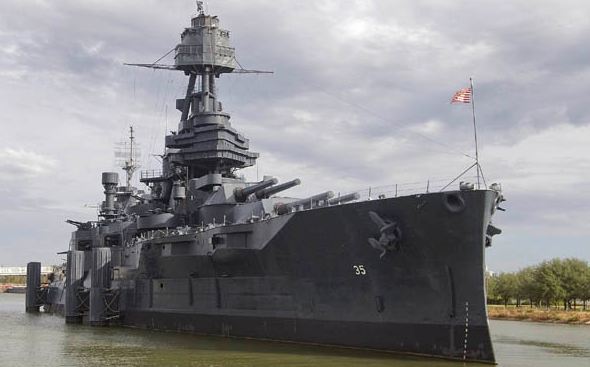
Commissioned in 1914 with coal-powered boilers that were converted to use fuel oil in 1925, the U.S.S. Texas “was the most powerful weapon in the world.”
The last U.S. battleship to be built with coal-fired boilers, the U.S.S. Texas, was launched in 1912 and converted to oil-fired boilers in 1926.
Learn more in Petroleum and Sea Power.
July 2, 1913 – First Gasoline-Electric Hybrid Locomotive
While most U.S. trains were still steam-powered, General Electric built the first commercially successful gasoline-powered engine locomotive. Two General Motors 175-horsepower V-8s powered two 600-volt, direct current generators to propel the 57-ton locomotive to a top speed of 51 miles per hour.
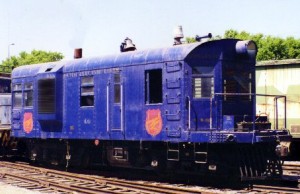
Many consider the locomotive “Dan Patch” the first successful internal combustion engine locomotive in the United States.
The Electric Line of Minnesota Company purchased the new gasoline-powered electric hybrid for $34,500, naming it “Dan Patch” in honor of the world’s champion harness horse of the time. By 1930, diesel engines with G.E. generators launched the modern train industry with Streamliners.
July 2, 1920 – West Columbia Oilfield discovered in Texas
The Abrams No. 1 well erupted oil in Brazoria County, Texas, revealing the West Columbia oilfield southwest of Houston. Drilled by the Texas Company (the future Texaco), the well initially produced up to 30,000 barrels of oil a day. The well was completed on a 1,650-acre tract owned by railroad official William H. Abrams (1843–1926), who administered millions of acres for the Texas Pacific Land Trust.
Abrams also invested in Mitchell County leases in West Texas, where another 1920 wildcat well discovered the first oil production of the Permian Basin. Three years later, drillers from El Paso completed the Santa Rita No. 1 well.
July 5, 1900 – Edison films New Jersey Refinery Fire
An early morning lightning strike at the Standard Oil Company refinery at Bayonne, New Jersey, set off explosions in three storage tanks, each with a capacity of 40,000 barrels of oil. Within minutes, the company’s fire department and tugboats rushed to fight the blaze.
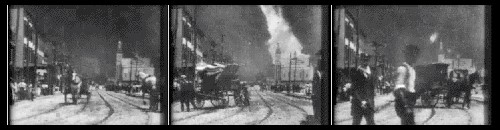
Screenshots from Thomas Edison’s film of the destruction of Standard Oil Company’s refinery at Bayonne, New Jersey, on July 5, 1900, courtesy Library of Congress.
“The tugboats moved the company ships and oil-filled barges away from its burning docks to safe waters,” noted the Jersey Journal in 2017. The Bayonne refinery fire was one of the first newsreels produced by the Thomas A. Edison Company (it can be viewed here). As bad as the conflagration was, there were no fatalities.
July 6, 1988 – Piper Alpha North Sea Tragedy
An explosion and fire on Occidental Petroleum’s Piper Alpha offshore production platform in the North Sea resulted in the deaths of 167 out of 224 personnel. It remains the most deadly offshore disaster in petroleum history.
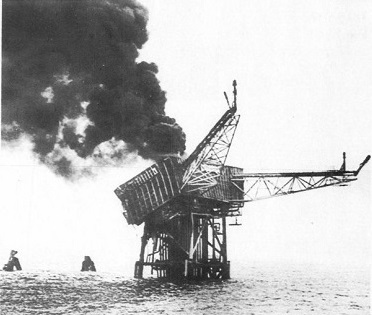
“Smoke pouring from Piper Alpha throws a pall over the North Sea 18 hours after the explosion,” reported The Daily Telegraph of London on July 8, 1988.
Piper Alpha had been receiving natural gas from two platforms while exporting gas to a compression platform. The initial explosion was caused “by a misunderstanding of the readiness of a gas condensate pump that had been removed from service for maintenance of its pressure safety valve,” according to safety expert Gary Karasek.
Improved offshore platform designs, operations engineering, evacuation technologies, and safety procedures emerged following the official inquiry, noted Karasek. “It was a ground-breaking effort, with numerous detailed findings and 106 recommendations, which were readily accepted by industry.”
_______________________
Recommended Reading: Tulsa Where the Streets Were Paved With Gold – Images of America (2000); The Discovery of Oil in South Arkansas, 1920-1924 (1974); Historic Battleship Texas: The Last Dreadnought
 (2007); Evolution of the American Diesel Locomotive, Railroads Past and Present
 (2007); Early Texas Oil: A Photographic History, 1866-1936
 (2000) Death and Oil: A True Story of the Piper Alpha Disaster on the North Sea
 (2011). Your Amazon purchase benefits the American Oil & Gas Historical Society. As an Amazon Associate, AOGHS earns a commission from qualifying purchases.
_______________________
The American Oil & Gas Historical Society (AOGHS) preserves U.S. petroleum history. Please become an AOGHS annual supporter and help maintain this energy education website and expand historical research. For more information, contact bawells@aoghs.org. © 2025 Bruce A. Wells. All rights reserved.
by Bruce Wells | Jun 23, 2025 | This Week in Petroleum History
June 23, 1921 – Signal Hill brings California Oil Boom –
Another southern California drilling boom began when a geyser of “black gold” erupted 114 feet high at Signal Hill. The Alamitos No. 1 well, which revealed a giant oilfield, produced about 600 barrels of oil a day when it was completed.
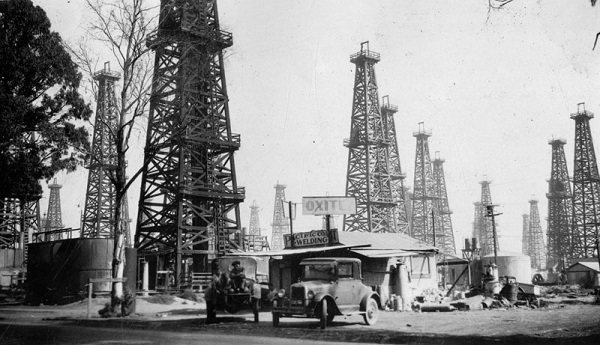
The Signal Hill oil discovery helped make California the source of one-quarter of the world’s oil output. “Porcupine Hill” and the Long Beach field produced 260,000 barrels of oil a day by 1923. Photo courtesy of Los Angeles Museum of Natural History.
Soon known as “Porcupine Hill,” the Signal Hill oilfield 20 miles south of Los Angeles produced almost 260,000 barrels of oil a day by 1923. Combined with the 1892 Los Angeles Oilfield discovery and the 1920 Huntington Beach oilfield, California produced one-fourth of the world’s oil. A monument dedicated in 1952 at Signal Hill’s Discovery Well Park has served “as a tribute to the petroleum pioneers for their success here.”
Learn more in Signal Hill Oil Boom.
June 23, 1947 – Supreme Court limits State Rights to Continental Shelf
The U.S. Supreme Court ruled California could not claim rights to the continental shelf beyond three nautical miles. Litigation resulted from President Harry Truman’s September 1945 Continental Shelf Proclamation, which placed control with the federal government. The Supreme Court ruling on the Truman Proclamation affirmed federal jurisdiction “with respect to the natural resources of the subsoil and seabed of the continental shelf.” Similar rulings affecting Louisiana and Texas would be made in 1950.
June 24, 1937 – Traces of Oil found in Minnesota
In far western Minnesota, a remote wildcat well drilled in Traverse County began producing three barrels of oil a day from a depth of 864 feet. The unlikely discovery prompted more leasing, but no commercial quantities of oil.
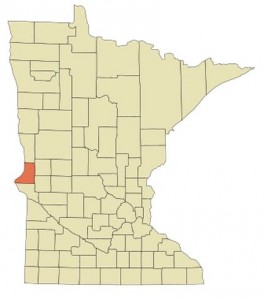
Traverse County, Minnesota, where oil production peaked in 1937.
The lack of an oilfield reaffirmed geologists’ conclusions since 1889 that conditions for significant petroleum deposits did not exist in Minnesota, despite some water wells in southern Minnesota containing small amounts of natural gas.
“Not much oil and gas is obtained from Precambrian rocks, with which Minnesota is very amply blessed,” noted the 1984 book Minnesota’s Geology.
June 25, 1889 – First Oil Tanker catches Fire in California
The first oil tanker built for that purpose, a schooner named W.L. Hardison, burned at its wharf in Ventura, California. The Hardison & Stewart Oil Company (later Union Oil) commissioned the experimental vessel, which offered an alternative to paying for railroad oil tank cars charging one dollar per oil barrel to reach markets in San Francisco.
With oil-fired steam boilers and supplemental sails, the schooner could ship up to 6,500 barrels of oil below deck in specially constructed steel tanks. After the fire, the tanks were recovered and used at the company’s Santa Paula refinery. It took 11 years before the company launched a replacement tanker, the Santa Paula.
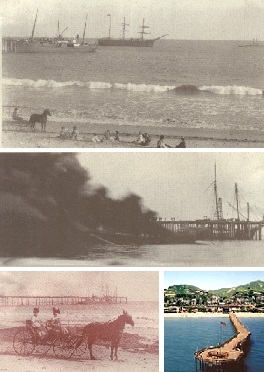
Rare photographs of the doomed oil tanker W.L. Hardison and Ventura pier courtesy the Museum of Ventura County.
The Ventura Wharf Company by April 1898 had exported 518,204 barrels of bulk oil during the previous year, according to the Los Angeles Times. The pier remained a working wharf until 1936 when it became the longest recreational wooden pier in California.
Designated a Ventura Historic Landmark in 1976 and now 1,600 feet long, California’s oldest pier was refurbished for $2.2 million in 2000, according to the Museum of Ventura County, which also operates archaeological and agricultural museums. In nearby Santa Paula, the 1890 headquarters building of Union Oil Company is home to the California Oil Museum.
June 25, 1901 – Red Fork Discovery leads to Tulsa Boom
Six years before statehood, Oklahoma witnessed a second oil discovery (some say the third — see Another First Oklahoma Oil Well) when two drillers from the Pennsylvania oil regions discovered an oilfield at Red Fork in the Creek Indian Nation.
John Wick and Jesse Heydrick drilled the Sue A. Bland No. 1 well near the Creek village across the Arkansas River from Tulsa. Sue Bland, a Creek citizen, was the wife of homesteader Dr. John C. W. Bland. Their Red Fork well produced just 10 barrels of oil a day from a depth of 550 feet, but created a drilling boom attracting petroleum companies to nearby Tulsa.
Learn more in Red Fork Gusher.
June 25, 1999 – Texas Post Office named Historic Place
The former U.S. Post Office building in Graham, Texas, with its Great Depression-era oilfield mural by Alexandre Hogue, joined the National Register of Historic Places. Hogue’s 1939 “Oil Fields of Graham” has been joined by other art exhibits in its historic Art Deco building on Third Street.
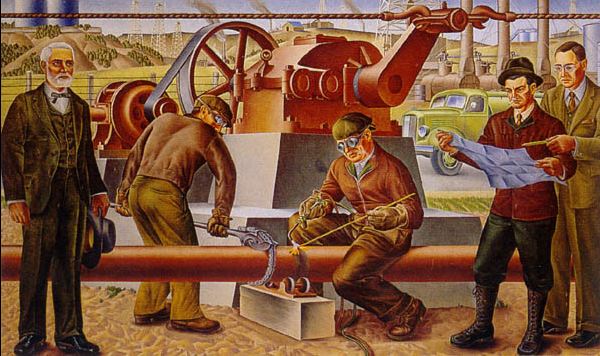
“Oil Fields of Graham” by Alexandre Hogue, a 1939 mural in the Old Post Office Museum & Art Center of Graham, Texas. The white-haired gentleman was the mayor of Graham.
Hogue’s artwork included many southwestern scenes as part of the New Deal Federal Arts Program. His murals on the walls of public buildings often portrayed scenes of the Texas petroleum industry. In Graham’s historic building on Third Street, “Oil Fields of Graham,” 12 feet wide and 7 feet high, is among exhibits at the Old Post Office Museum & Art Center, which opened in 2002.
Learn more in Oil Art of Graham, Texas.
June 26, 1885 – Natural Gas Utility established in Pennsylvania
Peoples Natural Gas Company incorporated — the first Pennsylvania natural gas company chartered by the state to regulate production, transmission, and distribution of natural gas. A similar utility incorporation had taken place a year earlier in New York City when six competing companies combined to form Consolidated Edison.
By 1891, the Pittsburgh-based limited liability company had consolidated pipelines and facilities of Pittsburgh Natural Gas, Lawrence Natural Gas, Conemaugh Gas, and Columbia Natural Gas companies. More than a dozen more companies would be acquired between 1903 and 1961. The large utility added Saxonburg Heat and Light in 1979 and Equitable Gas in 2017, expanding natural gas services in West Virginia and Kentucky.
June 28, 1887 – Kansans celebrate First Natural Gas Jubilee
After erecting flambeau arches at the four corners of the town square, Paola, Kansas, hosted what local leaders described as “the first natural gas celebration ever held in the West.” Excursion trains from Kansas City brought about 2,000 people, “to witness the wonders of natural gas,” according to the Miami County Historical Museum, which preserves the region’s petroleum history.
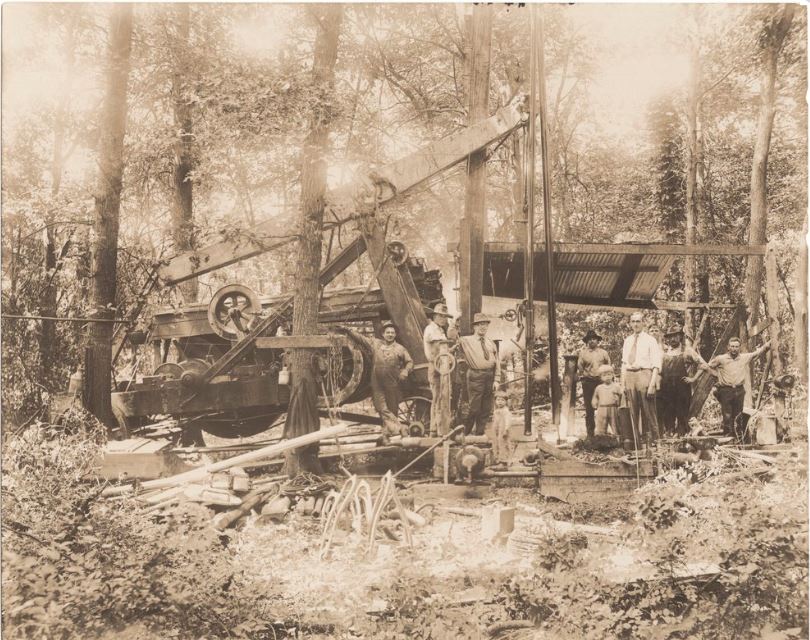
Paola’s giant natural gas field attracted more petroleum exploration to Miami County, including this circa 1920 oil well. Photo courtesy Kansas Historical Society.
The town’s special event included a “grand illumination” of natural gas street lights, where “gas was attached to a yard sprinkler by a rubber hose, and when it was ignited there appeared nests of small blazes which were beautiful and attractive.”
Learn more in First Kansas Oil Well.
June 28, 1967 – Hall of Petroleum opens in Smithsonian Museum
The Hall of Petroleum opened at the Smithsonian Institution’s Museum of History and Technology in Washington, D.C. Exhibits included cable-tool and rotary rig drilling technologies and counterbalanced pumping units, The Hall of Petroleum also featured 1967 developments in offshore exploration and production.
Visitors to what in 1980 became the National Museum of American History were greeted by a mural painted by Delbert Jackson of Tulsa, Oklahoma. Jackson spent two years creating his 13-foot by 56-foot painting with scenes of oil and natural gas exploration, production, refining, and transportation.
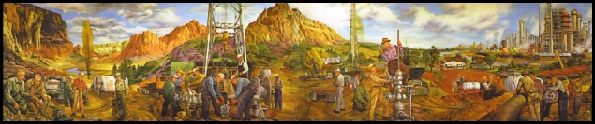
A “Panorama of Petroleum” once greeted visitors to the Smithsonian’s American History Museum in Washington, D.C. The 13-foot by 56-foot mural today is exhibited inside Tulsa International Airport.
Jackson’s “Panorama of Petroleum” featured industry pioneers and served as a visual map to the hall’s oilfield technology exhibits. “If the hall can increase the public’s knowledge of and respect for the technical skill and know-how of those who make this energy available, it will have served its purpose,” noted the exhibit’s 1967 catalog. The mural ended up in storage for three decades, until finding a home at Tulsa International Airport.
Learn more in Smithsonian’s “Hall of Petroleum.“

June 29, 1956 – Interstate Highway System enacted
The Federal-Aid Highway Act of 1956, popularly known as the National Interstate and Defense Highways Act, became law. Passed at the urging of President Dwight D. Eisenhower, the act provided 90 percent federal funding for a “system of interstate and defense highways,” and authorized spending $25 billion through 1969 for construction of about 41,000 miles of interstates.
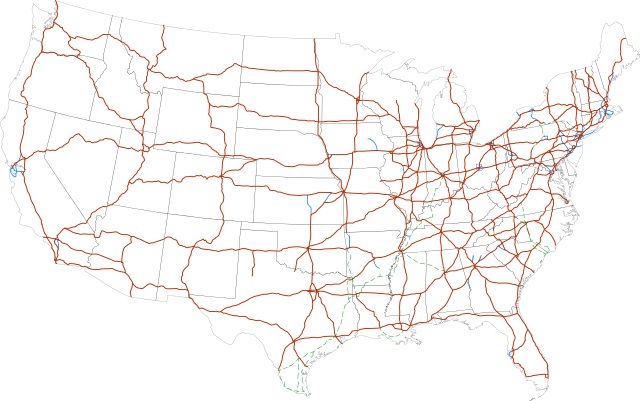
The interstate system reached 48,191 miles in 2016. Federal regulations banned collecting tolls but that would change.
“Of all his domestic programs, Eisenhower’s favorite by far was the Interstate System,” noted historian Stephen Ambrose. The thirty-fourth president urged passage of the act for national defense; interstates would be needed for evacuating major cities during a nuclear war.
_______________________
Recommended Reading: Signal Hill, California, Images of America (2006); Minnesota’s Geology (1982) Tulsa Oil Capital of the World, Images of America
 (2004); Oil in West Texas and New Mexico
 (1982); Minnesota’s Geology (1982); Black Gold in California: The Story of California Petroleum Industry
  (2016); Early California Oil: A Photographic History, 1865-1940
 (1985); Tulsa Oil Capital of the World, Images of America (2004); Oil in West Texas and New Mexico (1982); Official Guide to the Smithsonian
 (2016); Eisenhower: Soldier and President
 (1968). Your Amazon purchase benefits the American Oil & Gas Historical Society. As an Amazon Associate, AOGHS earns a commission from qualifying purchases.
_______________________
The American Oil & Gas Historical Society (AOGHS) preserves U.S. petroleum history. Please become an AOGHS annual supporter and help maintain this energy education website and expand historical research. For more information, contact bawells@aoghs.org. © 2025 Bruce A. Wells. All rights reserved.