by Bruce Wells | Mar 2, 2026 | This Week in Petroleum History
March 2, 1922 – Lease sells for $1 Million in Osage Nation –
Under the broad crown of a giant elm next to the Osage Council House in Pawhuska, Oklahoma, Skelly Oil and Phillips Petroleum Company jointly bid more than one million dollars for a 160-acre tract of land.
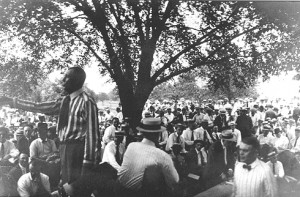
Colonel Elmer Ellsworth Walters (striped shirt), the “Auctioneer of the Osage Nation,” by the 1930s earned the tribe millions from petroleum companies.
The 1922 auction — Oklahoma’s first million-dollar mineral lease — took place in the shade of what became known as the “Million Dollar Elm.” Independent producers such as Frank Phillips, Harry Sinclair, Bill Skelly, J. Paul Getty, and E.W. Marland were frequent bidders for promising leases. The Osage would erect a statue of their auctioneer, Colonel Elmer Ellsworth Walters, in his hometown of Skedee. Learn more in Million Dollar Elm.
March 3, 1879 – United States Geological Survey established
President Rutherford B. Hayes signed legislation creating the United States Geological Survey (USGS) within the Department of the Interior. The legislation resulted from a report by the National Academy of Sciences, which had been asked by Congress to provide a plan for surveying the country.

Original logo for the U.S. Geological Survey and the current one. The motto “science for a changing world” was added in 1997.
The new agency’s mission included “classification of the public lands and examination of the geological structure, mineral resources, and products of the national domain,” according to USGS, which since 1974 has been headquartered on a 105-acre site in Reston, Virginia. The USGS maintains the world’s largest library collection dedicated to earth and natural sciences, including more than one million books, 600,000 maps, and 500,000 photographs.
March 3, 1886 – Natural Gas brings light to Paola, Kansas
Paola became the first town in Kansas to use natural gas commercially for illumination. To promote its natural gas resources and attract businesses from nearby Kansas City, civic leaders erected four flambeaux arches in the town square. Pipes were laid for other illuminated displays.
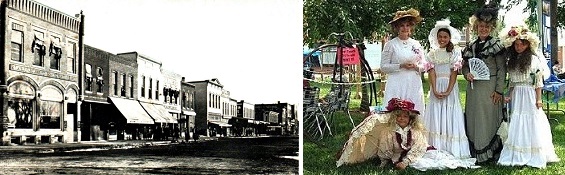
“Pearl Street Looking South, Paola, Kansas,” is among images preserved by the Miami County Kansas Historical Society & Museum. An annual Paola Roots Festival began in 1990.
“Paola was lighted with Gas,” proclaimed an exhibit at the Miami County Historical Museum. “The pipeline was completed from the Westfall farm to the square, and a grand illumination was held.” By the end of 1887, several Kansas flour mills were fueled by natural gas. Paola’s gas wells would run dry, but more mid-continent oil discoveries would follow.
March 4, 1918 – West Virginia Well sets World Depth Record
Hope Natural Gas Company completed an oil well at a depth of 7,386 feet on the Martha Goff farm in Harrison County, West Virginia. The cable-tool well became the world’s deepest until surpassed by a 1919 well in nearby Marion County. The previous world record had been a well in Germany at 7,345 feet deep.
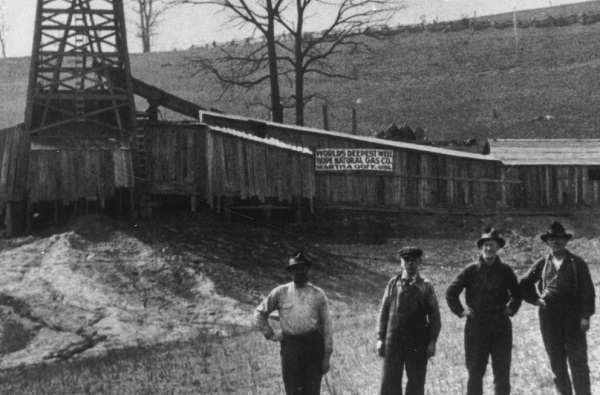
Drilled with cable tools near Clarksburg, this 1918 West Virginia well was the world’s deepest until one drilled in a neighboring county. Photo courtesy West Virginia Oil and Natural Gas Association.
In 1953, the New York State Natural Gas Corporation claimed the world’s deepest cable-tool well at a depth of 11,145 feet at Van Etten, New York. A rotary rig depth record was set in 1974 by the Bertha Rogers No. 1 well at 31,441 feet, and a Soviet Union experimental well in 1989 reached 40,230 feet — the current world record.

March 4, 1933 – Oklahoma City Oilfield under Martial Law
Oklahoma Governor William H. “Alfalfa Bill” Murray declared martial law to enforce his regulations strictly limiting production in the Oklahoma City oilfield, discovered in December 1928. Two years earlier, Murray had called a meeting of fellow governors from Texas, Kansas, and New Mexico to create an Oil States Advisory Committee “to study the present distressed condition of the petroleum industry.”
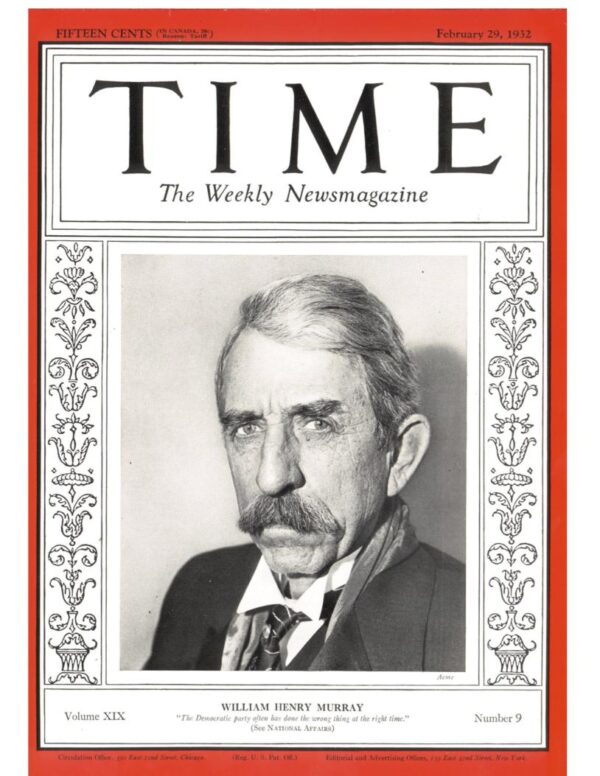
Oklahoma Gov. William “Alfalfa Bill” Murray in 1932.
Elected in 1930, the controversial politician was called “Alfalfa Bill” because of speeches urging farmers to plant alfalfa to restore nitrogen to the soil. By the end of his administration, Murray had called out the National Guard 47 times and declared martial law more than 30 times. He was succeeded as Oklahoma governor by E.W. Marland in 1935.
March 4, 1938 – Giant Oilfield discovery in Arkansas
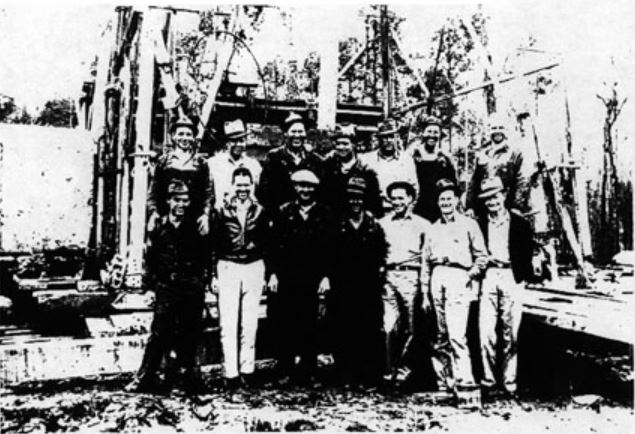
The Kerr-Lynn Oil Company (a Kerr-McGee predecessor) completed its Barnett No. 1 well east of Magnolia, Arkansas, discovering the giant Magnolia oilfield, which would become the largest producing field (in volume) during the early years of World War II, helping to fuel the American war effort.
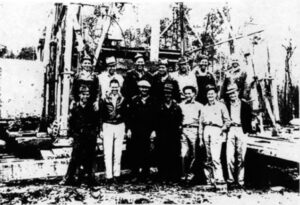
Crew members stand in front of their 1938 giant oilfield discovery well at Magnolia, Arkansas. Photo courtesy W.B. “Buzz” Sawyer.
The southern Arkansas gusher launched a Columbia County oil boom similar to Union County’s Busey-Armstrong No. 1 well southwest of El Dorado in January 1921 (see First Arkansas Oil Wells).
March 5, 1895 – First Wyoming Refinery produces Lubricants
Near the Chicago & North Western railroad tracks in Casper, Civil War veteran Philip “Mark” Shannon and his Pennsylvania investors opened Wyoming’s first refinery. It could produce 100 barrels a day of 15 different grades of lubricant, from “light cylinder oil” to a heavy grease. Shannon and his associates incorporated as the Pennsylvania Oil and Gas Company.
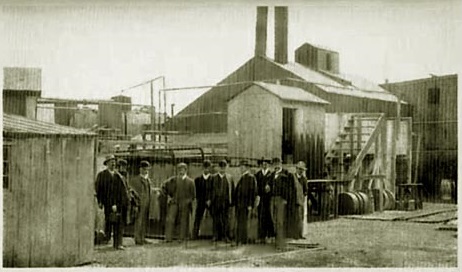
The original Casper oil refinery in Wyoming, circa 1895. Photo courtesy Wyoming Tales and Trails.
By 1904, Shannon’s company owned 14 wells in the Salt Creek field, about 45 miles from the company’s refinery (two days by wagon). Each well produced up to 40 barrels of oil per day, but transportation costs meant Wyoming oil could not compete for eastern markets. The state’s first petroleum boom began in 1908 with Salt Creek’s “Big Dutch” well.
Learn more in First Wyoming Oil Wells.
March 6, 1935 – Search for First Utah Oil proves Deadly
More than a decade before Utah’s first commercial oil wells, residents of St. George had hoped the “shooting” of a well drilled by Arrowhead Petroleum Company would bring black gold prosperity. A crowd had gathered to watch as workers prepared six 10-foot-long explosive canisters to fracture the 3,200-foot-deep Escalante No. 1 well.
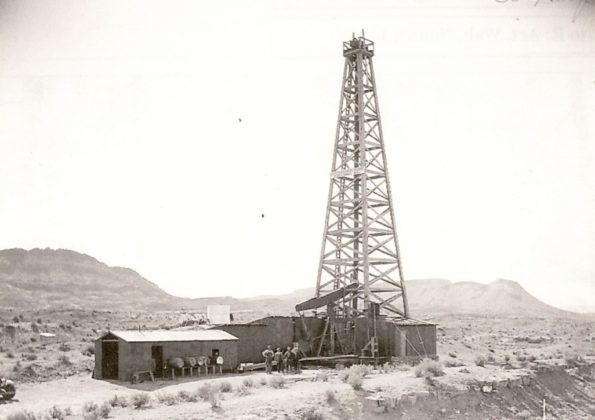
The Escalante well heralded new prosperity for residents of nearby St. George, Utah, in 1935 — until an attempt to shoot the well went wrong and canisters of TNT and nitroglycerin exploded. Photo courtesy Washington County Historical Society.
An explosion occurred as the torpedoes, “each loaded with nitroglycerin and TNT and hanging from the derrick,” were being lowered into the well. Ten people died from the detonations, which “sent a shaft of fire into the night that was seen as far as 18 miles away.”
The 1935 accident has remained the worst oil-related disaster in Utah, according to The Escalante Well Incident, a 2007 historical account.
March 6, 1981 — Shale Revolution begins in North Texas
Mitchell Energy and Development Corporation drilled its C.W. Slay No. 1 well, the first commercial natural gas well of the Barnett shale formation. Over the next four years, the vertical well in North Texas produced nearly a billion cubic feet of gas, but it would take almost two decades to perfect cost-effective shale fracturing methods combined with horizontal drilling.
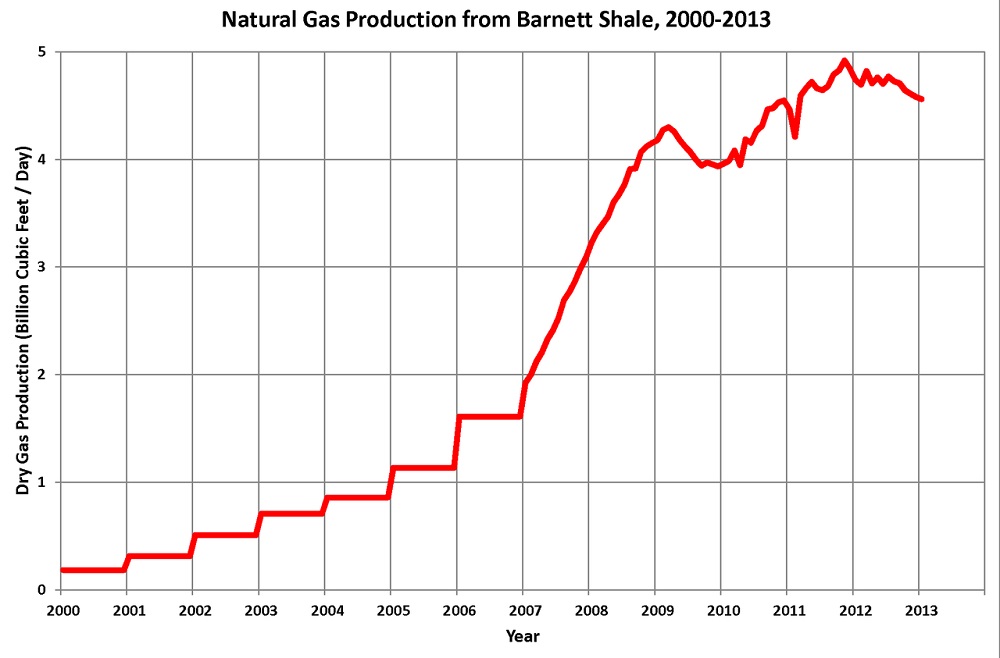
Production from the Barnett shale formation extends from Dallas west and south, covering 5,000 square miles, according to the Texas Railroad Commission. Chart courtesy Dan Plazak.
Mitchell Energy’s 7,500-foot-deep well and others in Wise County helped evaluate seismic and fracturing data to understand deep shale structures. “The C.W. Slay No. 1 and the subsequent wells drilled into the Barnett formation laid the foundation for the shale revolution, proving that natural gas could be extracted from the dense, black rock thousands of feet underground,” the Dallas Morning News later declared.
By the end of 2012, with almost 14,000 wells drilled in the largest natural gas field in Texas, production started to decline, but the Barnett field still accounted for 6.1 percent of Texas natural gas production and 1.8 percent of the U.S. supply, according to the Federal Reserve Bank of Dallas. At the start of 2024, Barnett natural gas still accounted for 5.4 percent of Texas’s natural gas production and 1.7 percent of the U.S.’s supply.
March 7, 1902 – Oil discovered at Sour Lake, Texas
Adding to the giant oilfields of Texas, the Sour Lake field was discovered about 20 miles west of the world-famous Spindletop gusher of January 1901. The spa town of Sour Lake quickly became a boom town where major oil companies, including Texaco, got their start.
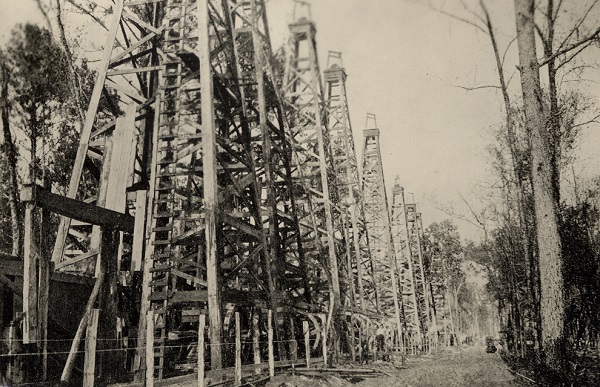
The resort town of Sour Lake, 20 miles northwest of Beaumont, “was transformed into an oil boom town when a gusher was hit in 1902,” according to the Texas State Library and Archives Commission. Photo courtesy the archive’s W.D. Hornaday Collection.
Originally settled in 1835 and called Sour Lake Springs because of its “sulphureus spring water” known for healing, the sulfur wells attracted many exploration companies. Some petroleum geologists predicted a Sour Lake salt dome formation similar to that revealed by Pattillo Higgins, the Prophet of Spindletop.
Sour Lake’s 1902 discovery well was the second attempt of the Great Western Company. The well, drilled “north of the old hotel building,” penetrated 40 feet of oil sands before reaching a total depth of about 700 feet. The Hardin County’s salt dome oilfield yielded almost nine million barrels of oil by 1903, when the Texas Company made its first major oil find at Sour Lake.
Learn more in Sour Lake produces Texaco.
March 7, 2007 – Expansion of National Artificial Reef Plan
The National Marine Fisheries Service of the National Oceanic and Atmospheric Administration (NOAA), approved a comprehensive update of the 1985 National Artificial Reef Plan, popularly known as the “rigs to reefs” program.

A typical platform provides almost three acres of feeding habitat for thousands of species. Photo courtesy U.S. Bureau of Safety and Environmental Enforcement.
The agency worked with interstate marine commissions and state artificial reef programs “to promote and facilitate responsible and effective artificial reef use based on the best scientific information available.” The revised National Artificial Reef Plan included guidelines for converting old platforms into reefs. A typical four-leg structure provides up to three acres of habitat for hundreds of marine species.
“As of December 2021, 573 platforms previously installed on the U.S. Outer Continental Shelf have been reefed in the Gulf of Mexico,” according to the Bureau of Safety and Environmental Enforcement (BSEE).
Learn more in Rigs to Reefs.
_______________________
Recommended Reading: The Osage Oil Boom (1989); Trek of the Oil Finders: A History of Exploration for Petroleum (1975); History of Paola, Kansas
 (1956); Where it all began: The story of the people and places where the oil & gas industry began: West Virginia and southeastern Ohio
 (1994); Oil And Gas In Oklahoma: Petroleum Geology In Oklahoma
 (2013); Kettles and Crackers – A History of Wyoming Oil Refineries
 (2016); Utah Oil Shale: Science, Technology, and Policy Perspectives
 (2016); George P. Mitchell: Fracking, Sustainability, and an Unorthodox Quest to Save the Planet (2019); Sour Lake, Texas: From Mud Baths to Millionaires, 1835-1909
 (1995); Rigs-to-reefs: the use of obsolete petroleum structures as artificial reefs
 (1987). Your Amazon purchase benefits the American Oil & Gas Historical Society. As an Amazon Associate, AOGHS earns a commission from qualifying purchases.
_______________________
The American Oil & Gas Historical Society (AOGHS) preserves U.S. petroleum history. Please support AOGHS to help maintain this energy education website, a monthly email newsletter, This Week in Oil and Gas History News, and expand historical research. Contact bawells@aoghs.org. Copyright © 2026 Bruce A. Wells. All rights reserved.
by Bruce Wells | Oct 15, 2025 | Petroleum Companies
Hard lessons learned in the Wyoming Powder River Basin.
During World War I, the Winona Oil Corporation set up operations in Casper, Wyoming, with holdings of 1,200 acres of “selected land in the heart of Powder River.” The small, newly established exploration company reported having one drilling rig and another ready to be “rigged up” at another site.
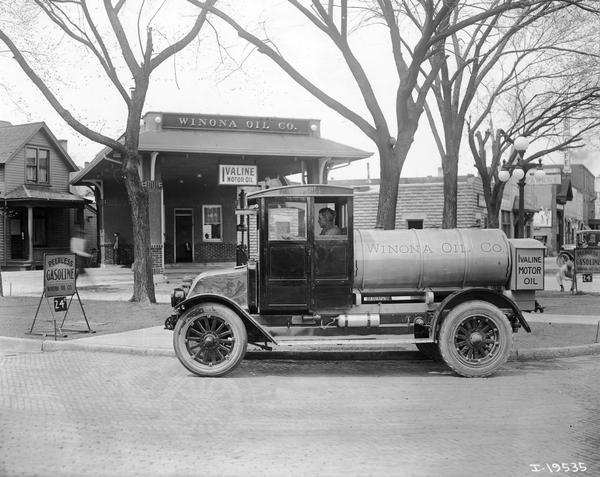
A Winona Oil Company station sold gasoline and and Ivaline Motor Oil, circa 1919. After months of difficult drilling, the company’s first exploratory well reached a depth of 700 feet without finding oil.
As the Powder River Basin attracted exploration companies, a 1918 discovery at a depth of about 2,600 feet by the Ohio Oil Company (later Marathon) would grow into the largest in the Rocky Mountains. Ohio Oil could afford drilling more productive wells a thousand feet deeper.
Along with earlier discoveries at Salt Creek (1908) and Big Muddy (1916), the Lance Creek field “brought an immediate boom and derricks sprang up everywhere,” according to the Niobrara Historical Society. The Basin’s abundant shale deposits also played a role.
With capitalization of $200,000, Winona Oil was considered a “poor boy” drilling venture dependent upon investors to fund continued drilling despite the risks. The company offered stock at 5 cents a share. Advertisements in the Ogden Standard enticed investors with “Winona Is Here to make Money, Money, Money.”

In February 1918, C. Kirchner, secretary of the Winona Oil, conducted a promotional demonstration of the reduction of shale oil to gas for about 50 onlookers. “This gas was lighted and burned during the entire experiment to such an extent that a couple of engineers in the party made the remark that the gas itself would furnish 90 percent of the fuel necessary for the original reduction,” it was later proclaimed.
This Winona Oil interest in shale oil did not develop, although other contemporary ventures did pursue it (see Ute Oil Company).
Powder River Oilfield
Winona Oil by 1919 had only been able to drill 700 feet in its first drilling effort somewhere “on the north side of the railroad.”
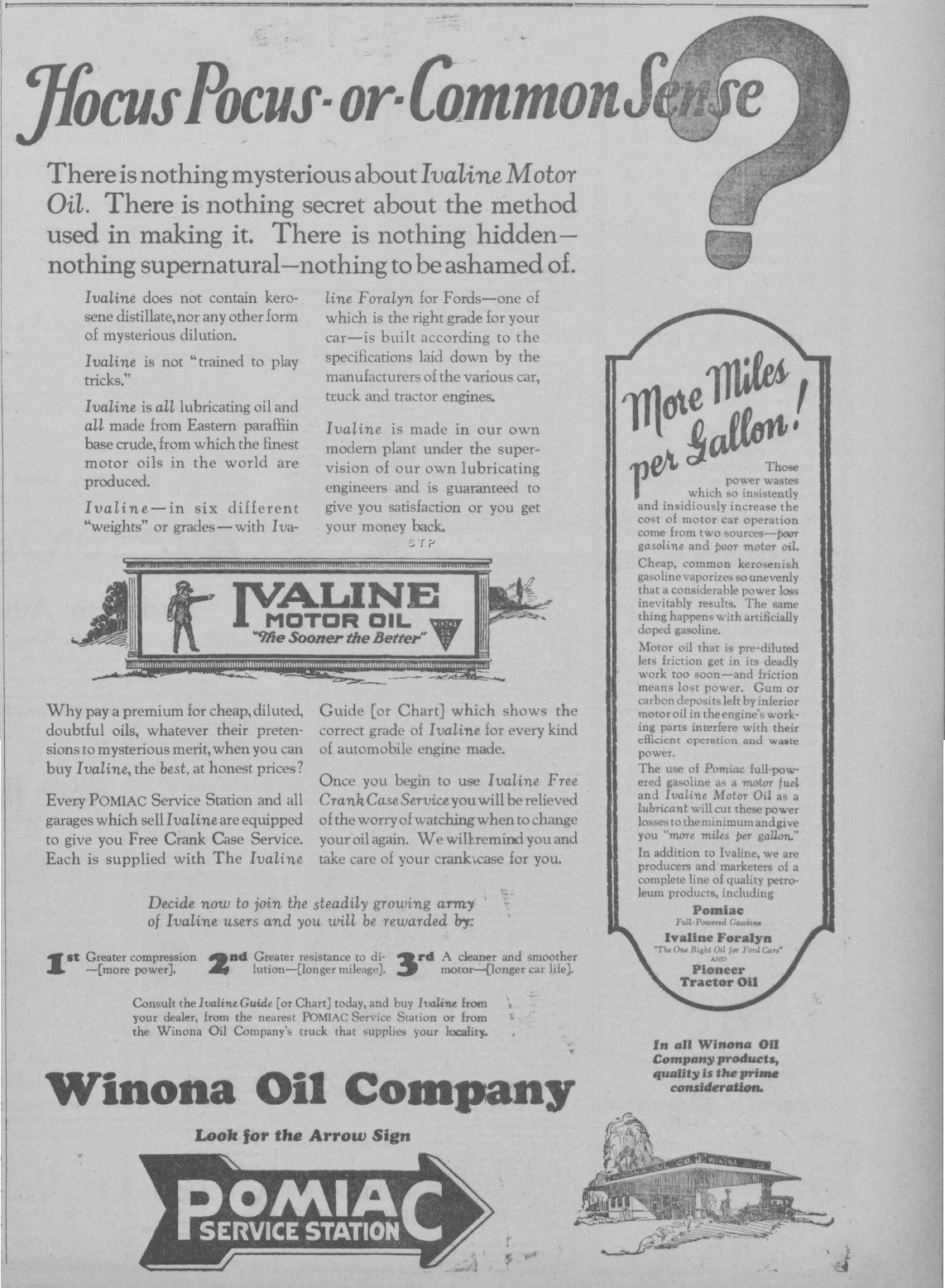
“Hocus Pocus-or-Common Sense?” Ivaline Motor Oil sales did not help the Winona Oil Company to survive its drilling ventures in the highly competitive oilfields of the Powder River Basin.
In March 1919, a trade magazine noted that “the Powder River Syndicate has undertaken to finish the well commenced by the Winona Oil Corporation at Powder River, Natrona Co., according to reports current in Casper.”
Another article in the Oil & Gas News added, “In the Powder River field, the Winona Oil Corporation has announced the purchase of a drilling machine which will be used to complete the company’s first well, which has been underway for months. The Winona claims to have solved all its difficulties and expects to go with its work without further delay.”
By the end of May, Winona Oil Company reportedly survived its financial difficulties and had reentered the field. Plans were by then underway to drill a second well.
Good news came the following month when the first well was described as “gassing heavily, and Casper people interested in the enterprise are very optimistic over the prospects,” the trade publication proclaimed, adding. “Should the well prove a good one, a large tract north of Powder River station would be added to the territory considered proven.”

However, by August the good news had gone bad; the gasser well had to be abandoned, “as the hole was started with a casing too small to see it thoroughly.”
Powder River Syndicate
A second well was spudded by the Powder River Syndicate with Winona Oil a fifty-fifty partner. “The Winona Powder River Syndicate well No. 2, which was begun when the first hole pinched-out, is making 100 feet a day, according to reports from the field, and is down about 500 feet. This well is located north of Powder River, on Winona holdings,” noted the Oil & Gas News on September 4.
The publication reported bad news on January 29, 1920. “The Winona well at Powder River is also shut down, but it is claimed that drilling will resume in the spring,” the News noted. “This is the second well, the first having been lost on account of a bit wedged in the hole.”
Drilling did not resume in the spring or anytime thereafter. Despite the efforts of Winona Oil and the hopes of its investors, the independent exploration company did not survive. Cities Service Company bought Winona Oil and moved the Winona division to St. Paul, Minnesota.
More articles about small exploration and production companies attempting to join petroleum booms (and avoid busts) can be found in Is my Old Oil Stock worth Anything?
______________________
Recommended Reading: Black Gold, Patterns in the Development of Wyoming’s Oil Industry (1997); Trek of the Oil Finders: A History of Exploration for Petroleum (1975). Your Amazon purchase benefits the American Oil & Gas Historical Society. As an Amazon Associate, AOGHS earns a commission from qualifying purchases.
_______________________
The American Oil & Gas Historical Society (AOGHS) preserves U.S. petroleum history. Please become an annual AOGHS supporter and help maintain this energy education website and expand historical research. For more information, contact bawells@aoghs.org. Copyright © 2025 Bruce A. Wells. All rights reserved.
Citation Information – Article Title: “Winona Corporation.” Authors: B.A. Wells and K.L. Wells. Website Name: American Oil & Gas Historical Society. URL: https://aoghs.org/old-oil-stocks/winona-oil-corporation. Last Updated: October 18, 2025. Original Published Date: March 23, 2016.
by Bruce Wells | Oct 6, 2025 | This Week in Petroleum History
October 6, 1886 – Natural Gas fuels Glass Manufacturing –
A 900-foot-deep natural gas well in a cornfield near Kokomo, Indiana, led to the establishment of the Indiana Natural Gas Company, and in 1888, the Opalescent Glass Works, which has been in continuous operation since. The state’s first natural gas well was completed in 1867, seeking oil reserves (see Indiana Natural Gas Boom).
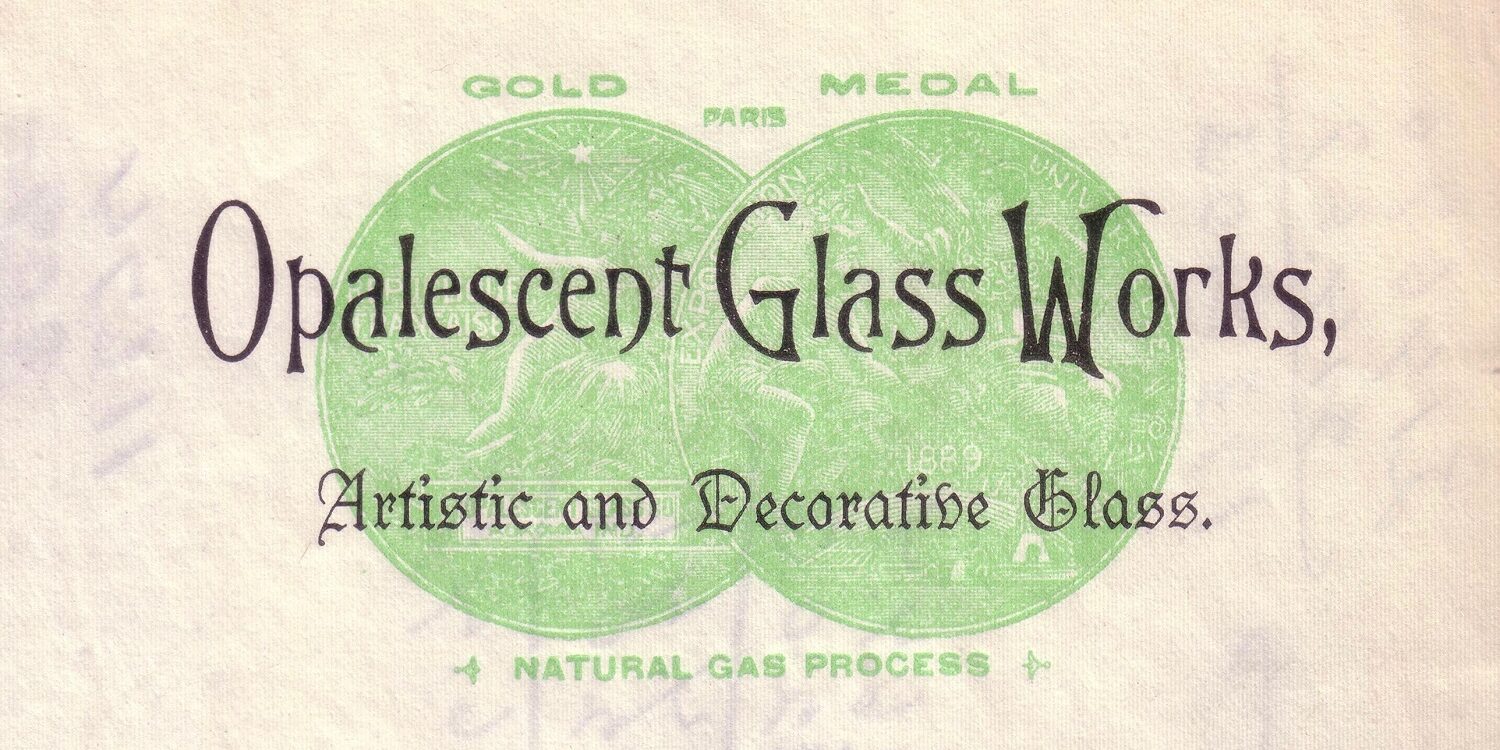
Opalescent Glass Works won a gold medal at the 1889 Exposition Universelle in Paris for its “natural gas process” glass. Photo courtesy Kokomo Opalescent Glass.
Opalescent Glass Works, today Kokomo Opalescent Glass, almost went bankrupt when natural gas supplies dwindled, but in 1893 it recovered by selling electric insulators to Edison General Electric Company — and thousands of pounds of stained glass to Tiffany studios in New York City.
October 6, 1957 – Society of Petroleum Engineers established
The first board of directors meeting of the Society of Petroleum Engineers (SPE) established the professional society in an expansion of the American Institute of Mining, Metallurgical and Petroleum Engineers (AIME), which had created a Petroleum Division in 1922.

An American Institute of Mining Engineers program led to the Society of Petroleum Engineers.
AIME began in 1871, when a small group of Pennsylvania mining engineers sought to “preserve their collective knowledge and experiences for the benefit of future engineers.” SPE has grown into an independent, nonprofit global society with 132,000 members in 146 countries.
October 7, 1859 – First U.S. Oil Well catches Fire
The wooden derrick and engine house of America’s first oil well erupted in flames along Oil Creek at Titusville, Pennsylvania. The well had been completed the previous August by Edwin L. Drake for George Bissell and the Seneca Oil Company of New Haven, Connecticut. Working with driller William “Uncle Billy” Smith, Drake used steam-powered cable-tool technology.
The first U.S. oil well fire began when Uncle Billy inspected a vat of oil with an open lamp. When the lamp’s flame set gases alight, the conflagration consumed the derrick, the stored oil, and the driller’s home. Drake and Seneca Oil Company would quickly rebuild at the already famous well site.
Learn more in First Oil Well Fire.
October 7, 2014 – 200th Anniversary of Ohio Oil Discovery
The Noble County Historical Society of Caldwell, Ohio, hosted a 200th anniversary festival and park dedication celebrating a brine well drilled with a spring pole that produced oil. The 1814 well can be found at Thorla McKee Park, named for Silas Thorla and Robert McKee, the entrepreneurs who established the local salt works, according to researcher Dave Baker in “Early Marietta.”
In 2015, Baker reported the historic well site included the remains of its original sycamore log casing beneath a replica springpole. Thoria and McKee separated the oil from the salt water by soaking it up with blankets before bottling it to sell as a medicinal potion. The remaining brine was boiled to extract the salt. In 1992, the Noble County Department of Tourism and the Ohio Historical Society dedicated a historic marker near the Caldwell site. Ohio’s first well drilled exclusively for oil was completed near Macksburg in the autumn of 1860.
October 8, 1915 – Elk Basin oilfield discovered in Wyoming
An exploratory well drilled in a remote Wyoming valley opened the giant Elk Basin oilfield. Completed by the Midwest Refining Company near the Montana border, the wildcat well produced 150 barrels of high-grade “light oil” a day. The oil needed little refining to provide quality lubricants.

“Gusher coming in, south rim of the Elk Basin field, 1917.” Photo courtesy American Heritage Center, University of Wyoming.
Geologist George Ketchum first recognized the potential of the basin as a source of oil deposits. Ketchum had explored the remote area in 1906 with C.A. Fisher while farming near Cowley, Wyoming. The Elk Basin extended from Carbon County, Montana, into northeastern Park County, Wyoming.
Fisher was the first geologist to map sections of the Bighorn Basin southeast of Cody, Wyoming, where oil seeps had been found as early as 1883. The Wyoming oilfield discovery in unproven territory attracted new ventures like Elk Basin United Oil Company, investors, and oilfield service companies.
Learn more in First Wyoming Oil Wells.
October 8, 1923 – First International Petroleum Exposition and Congress
Five thousand visitors attended the rainy opening day of the first International Petroleum Exposition and Congress in downtown Tulsa, an event that would return for almost six decades.
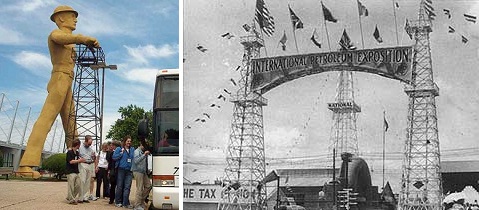
Although still a tourist attraction, the 76-foot-tall Golden Driller arrived decades after Tulsa’s first International Petroleum Exposition in 1923.
With annual attendance growing to more than 120,000, Mid-Continent Supply Company of Fort Worth introduced the original Golden Driller of Tulsa at the expo in 1953. Economic shocks beginning with the 1973 OPEC oil embargo depressed the industry, and after 57 years, the International Petroleum Exposition ended in 1979.
October 9, 1999 – Converted Offshore Platform launches Rocket
Sea Launch, a Boeing-led consortium of companies from the United States, Russia, Ukraine, and Norway, launched its first commercial rocket using the Ocean Odyssey, a modified semi-submersible drilling platform. After a demonstration flight in March, a Russian Zenit-3SL rocket carried a DirecTV satellite to geostationary orbit.
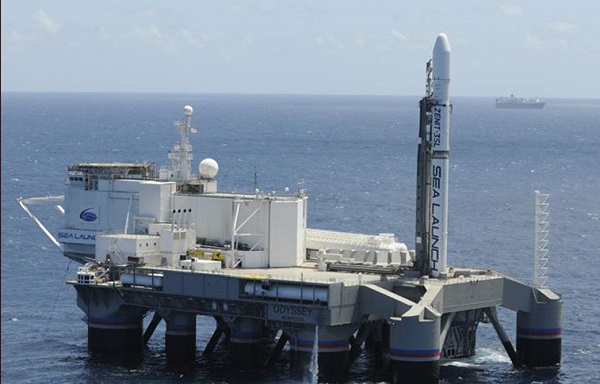
Ocean Odyssey, a modified semi-submersible drilling platform, became the world’s first floating equatorial launch pad in 1999. Photo courtesy Sea Launch.
In 1988, the former drilling platform had been used by Atlantic Richfield Company (ARCO) for North Sea explorations. The Ocean Odyssey made 36 more rocket launches until 2014, when the consortium ended after Russia illegally annexed Ukraine’s Crimean peninsula.
Learn more in Offshore Rocket Launcher.
October 10, 1865 – Oil Pipeline constructed in Pennsylvania
A two-inch iron pipeline began transporting oil five miles through hilly terrain from a well at booming Pithole, Pennsylvania, to the Miller Farm Railroad Station at Oil Creek. With their livelihoods threatened, teamsters attempted to sabotage the pipeline until armed guards intervened. A second oil pipeline would begin operating in December.
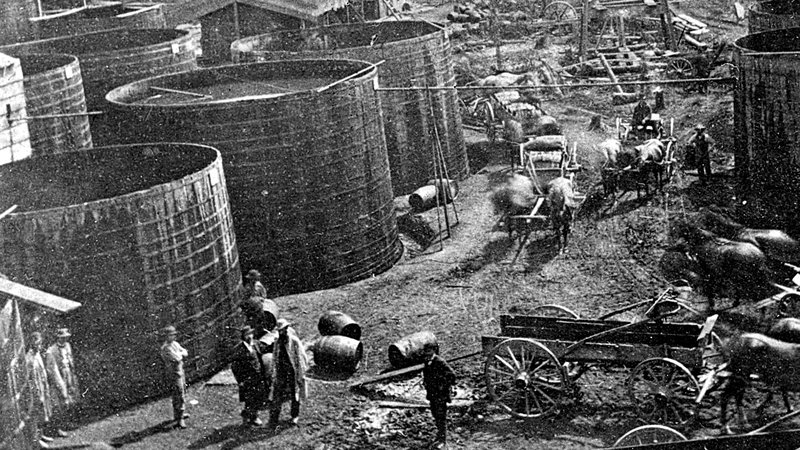
Oil tanks at the boom town of Pithole, Pennsylvania, where Samuel Van Syckel built a five-mile pipeline in 1865. Photo courtesy Drake Well Museum.
Built by Samuel Van Syckel, who had formed the Oil Transportation Association, the pipeline used 15-foot welded joints. Three 10-horsepower Reed and Cogswell steam pumps pushed the oil at a rate of 81 barrels per hour. With up to 2,000 barrels of oil arriving daily at the terminal, more storage tanks were soon added. The pipeline transported the equivalent of 300 teamster wagons working for 10 hours.
“The day that the Van Syckel pipeline began to run oil a revolution began in the business,” proclaimed Ida Tarbell in her 1904 History of the Standard Oil Company. “After the Drake well, it is the most important event in the history of the Oil Regions.”
_______________________
Recommended Reading: The Extraction State, A History of Natural Gas in America (2021); Myth, Legend, Reality: Edwin Laurentine Drake and the Early Oil Industry (2009); Where it All Began: The story of the people and places where the oil & gas industry began: West Virginia and southeastern Ohio
 (1994); Black Gold, Patterns in the Development of Wyoming’s Oil Industry (1997); Tulsa Where the Streets Were Paved With Gold – Images of America
 (2000); Offshore Pioneers: Brown & Root and the History of Offshore Oil and Gas
 (1997); Western Pennsylvania’s Oil Heritage
 (2008); Oil and Gas Pipeline Fundamentals
 (1993); Arizona Rocks & Minerals: A Field Guide to the Grand Canyon State
 (2010). Your Amazon purchase benefits the American Oil & Gas Historical Society. As an Amazon Associate, AOGHS earns a commission from qualifying purchases.
_______________________
The American Oil & Gas Historical Society (AOGHS) preserves U.S. petroleum history. Please become an AOGHS annual supporter and help maintain this energy education website and expand historical research. For more information, contact bawells@aoghs.org. Copyright © 2025 Bruce A. Wells. All rights reserved.