by Bruce Wells | Jan 14, 2026 | Petroleum Products
“New Perfection” kerosene stoves once competed with coal and wood-burning stoves in rural kitchens.
In the early 1900s, a foundry in Cleveland, Ohio, began manufacturing and selling an alternative to coal or wood-burning cast iron stoves. Thanks to a marketing partnership with Standard Oil Company, millions of rural kitchens would cook with kerosene-burning stoves.
America’s energy future changed after 1859 when a new “coal oil” (kerosene) was refined from petroleum purposefully extracted from wells drilled near Oil Creek, Pennsylvania.
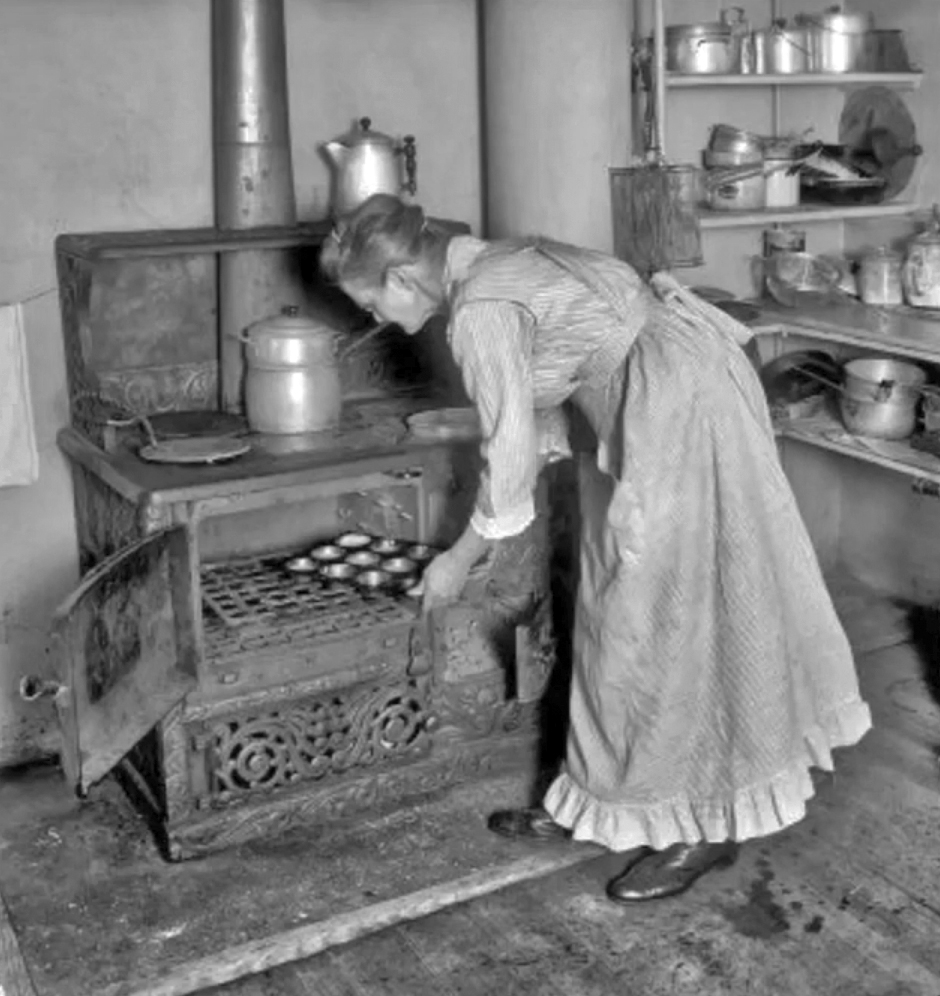
A Cleveland foundry president in 1901 approached John D. Rockefeller about a new, kerosene-fueled alternative to cast iron home stoves like this one.
(more…)
by Bruce Wells | Dec 18, 2025 | Petroleum Products
How a petroleum product at the bottom of the refining process improved American mobility.
As the U.S. centennial approached, President Ulysses S. Grant directed that Pennsylvania Avenue be paved with asphalt. By 1876, the president’s paving project using Trinidad asphalt covered about 54,000 square yards. (more…)
by Bruce Wells | Dec 17, 2025 | Petroleum Products
Petroleum paraffin soon found its way into candles, crayons, chewing gum…and a peculiar wax candy.
When Ralphie Parker and his 4th-grade classmates dejectedly handed over their Wax Fangs to Mrs. Shields in “A Christmas Story,” a generation might be reminded of what a penny used to buy at the local Woolworth’s store. But there is far more to these paraffin playthings than a penny’s worth of fun.
It’s hard to recall a time when there were no Wax Lips, Wax Moustaches, or Wax Fangs for kids to smuggle into classrooms. Many grownups may remember the peculiar disintegrating flavor of Wax Lips from bygone Halloweens and birthday parties, but few know where these enduring icons of American culture started. The answer can be found by way of the oil patch.

“A Christmas Story” in 1983 featured Ralphie, his 4th-grade classmates, and a petroleum product. Photos courtesy MGM Home Entertainment.
Beginning with the August 1859 first commercial U.S. oil well, Pennsylvania oilfields quickly brought an important new source for refining kerosene. “This flood of American petroleum poured in upon us by millions of gallons, and giving light at a fifth of the cost of the cheapest candle,” wrote British chandler James Wilson in 1879.
As kerosene lamps replaced candles for illumination, the much-reduced candle business turned from tallow to versatile paraffin.
A byproduct of kerosene distillation, paraffin found its way from refinery to marketplace in candles, sealing waxes, and chewing gums. Ninety percent of all candles by 1900 used paraffin as the new century brought a host of novel uses. Thomas Edison’s popular new phonographs also needed paraffin for their wax cylinders.
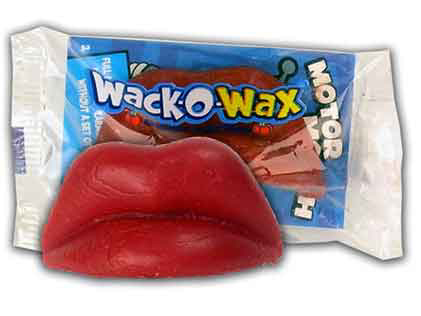
Concord Confections, part of Tootsie Roll Industries, has produced Wax Lips and other paraffin candies for generations of schoolchildren.
Crayons were introduced by the Binney & Smith Company in 1903 and were instantly successful. Alice Binney came up with the name by combining the French word for chalk, craie, with an English adjective meaning oily, oleaginous: Crayola (see Carbon Black and Oilfield Crayons).
In New York City, after collecting unrefined waxy samples from Pennsylvania oil wells, Robert Chesebrough invented a method for turning paraffin into a balm he called “petroleum jelly,” later “Vaseline.” His product also led to a modern cosmetic giant (learn more in The Crude History of Mabel’s Eyelashes).
Paraffin Lips, Fangs, and Horses Teeth
An inspired Buffalo, New York, confectioner soon used fully refined, food-grade paraffin and a sense of humor to find a niche in America’s imagination. When John W. Glenn introduced children to paraffin “penny chewing gum novelties,” his business boomed. By 1923, his J.W. Glenn Company employed 100 people, including 18 traveling sales representatives.

Glenn Confections became the wax candy division of Franklin Gurley’s nearby W.&F. Manufacturing Company. There, the ancestors of Wax Lips chattered profitably down the production line. Among the most popular of these novelties at the time were Wax Horse Teeth (said to taste like wintergreen).
By 1939, Gurley was producing a popular series of holiday candles for the Socony-Vacuum Oil Company using paraffin from a nearby refinery at Olean, New York — once home to the world’s largest crude oil storage site. A field of metal tanks, some holding 20,000 gallons of paraffin, stood next to Gurley’s W.&F. Manufacturing Company in Buffalo.
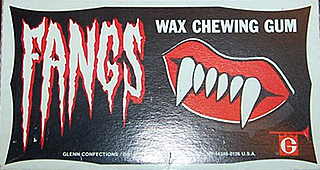
Glenn Confections, a division of W. & F. Manufacturing Company, produced Fun Gum Sugar Lips, Wax Fangs, and Nik-L-Nips.
Decorative and scented paraffin candles soon became the company’s principal products, accounting for 98 percent of W.&F. Manufacturing sales. Gurley’s “Tavern Candle” Santas, reindeer, elves, and other colorful Christmas favorites today are prized by collectors on eBay, as are his elaborately molded Halloween candles.
Glenn Confections, the W.&F. wax candy division, has continued to manufacture the popular Fun Gum Sugar Lips and Wax Fangs, with small, wax bottles — Nik-L-Nips — available from the Old Time Candy Company.
In Emlenton, Pennsylvania, a few miles south of Oil City, the Emlenton Refining Company (and later the Quaker State Oil Refining Company) provided the fully refined, food-grade paraffin for the bizarre but beloved treats. Retired Quaker State employee Barney Lewis remembers selling Emlenton paraffin to W.&F. Manufacturing.

During a 2005 interview, Lewis noted, “It was always fun going to the plant…they were very secret about how they did stuff, but you always got a sample to bring home,” adding, “Wax Lips, Nik-L-Nips…the little Coke bottle-shaped wax, filled with colored syrup.”
Concord Confections, a small part of Tootsie-Roll Industries, continues to produce Wax Lips and other paraffin candies for new generations of schoolchildren. The modern petroleum industry produces an astonishing range of products for consumers. But among the many products that find their history in the oilfield, few are as unique and peculiar as Wax Lips.
In December 2007, “A Christmas Story” was ranked the number one Christmas film of all time by AOL. Set in 1940, the movie has been shown in an annual marathon since 1997. Among the waxy petroleum products featured in the movie is the father’s “major award” — a plastic leg-lamp with black polymer nylon stocking.
_______________________
Recommended Reading: Sweet!: The Delicious Story of Candy (2009); How Sweet It Is (and Was): The History of Candy (2003). Your Amazon purchase benefits the American Oil & Gas Historical Society. As an Amazon Associate, AOGHS earns a commission from qualifying purchases.
_______________________
The American Oil & Gas Historical Society preserves U.S. petroleum history. Please become an AOGHS annual supporter and help maintain this energy education website and expand historical research. For more information, contact bawells@aoghs.org. Copyright © 2025 Bruce A. Wells. All rights reserved.
Citation Information – Article Title: “Oleaginous History of Wax Lips.” Authors: B.A. Wells and K.L. Wells. Website Name: American Oil & Gas Historical Society. URL: https://aoghs.org/products/an-oleaginous-history-of-wax-lips. Last Updated: December 17, 2025. Original Published Date: December 1, 2006.
by Bruce Wells | Dec 1, 2025 | Petroleum Products
Tinsmith recreates 19th-century whale oil, lard, camphene, and two-spouted lamps.
Designed for different fuels, 19th-century lamps burned many fuels, including rapeseed oil, lard, whale oil, and camphene — the distilled spirits of turpentine. Another dangerous but widely used fuel was “burning fluid,” a volatile combination of distilled spirits of turpentine and alcohol with camphor oil added for aroma.
The first commercial U.S. oil well was completed in 1859 to produce oil for making a better lamp fuel. But until replaced by kerosene, risky, two-wicked burning-fluid lamps provided light for much of America.
The burning fluid mixture required a double burner but no chimney, according to Ron Miller, a self-taught tinsmith and “hands-on historian.” He became fascinated by the designs of these early illuminating lamps.
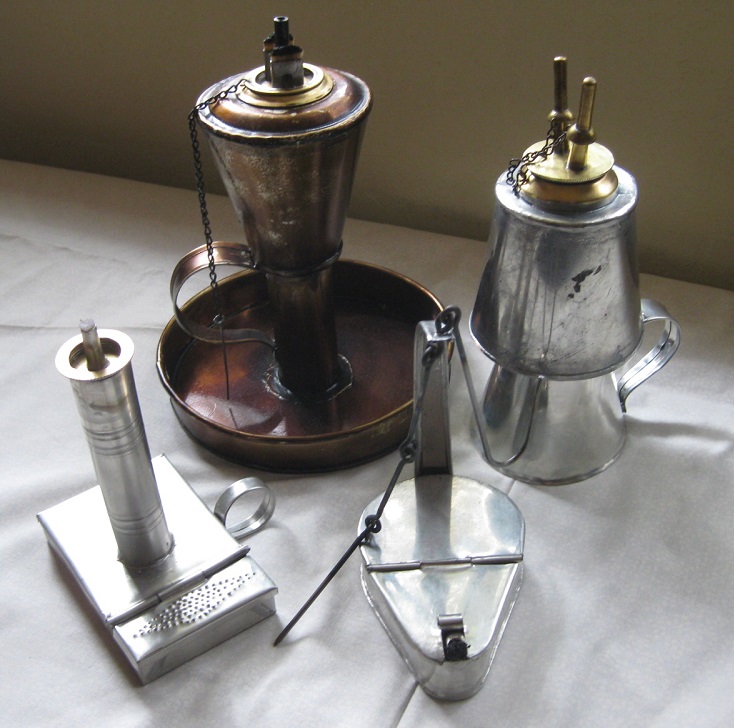
Jim Miller’s 19th-century lamp tin recreations, left to right: a whale oil burner; an 1842 patented lard oil burner; a “Betty Lamp” fueled by fat; and a typical burning fluid two-spout lamp.
“This adventure has deepened my appreciation for past craftsmanship and the intelligence of commonplace things in early America,” explained Miller in his 2012 For the Love of History blog. “Besides, now I have all this cool stuff to play (teach) with.”
The key to learning about early-to-mid-19th-century oil lamps was to study their burners, Miller noted, adding, “Each type of fuel needed a specific style of burner to give the best light.”
Although most of the fuels have become obsolete, Miller “wanted to faithfully replicate the burners in order to understand how they evolved,” he said, adding, “For the time being, substitute fuels would have to do.”

Miller fashioned tin into period lamp designs, including one fueled by fat — a “Betty Lamp” that “has an ancestry extending clear back to the Romans but had been improved on over time.”
The modern-day tinsmith recreated a whale oil lamp, circa 1850, and a patented lard oil burner of 1842 (the lard needed to be warmed to improve its fluidity).
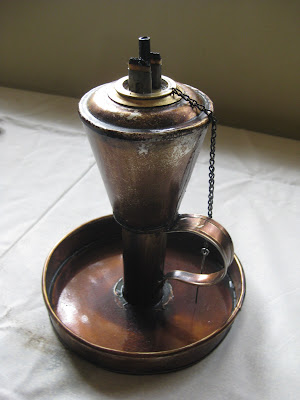
Miller recreated a lard oil lamp using an 1842 patent drawing. By faithfully replicating lamps, he seeks to “understand how they evolved.”
“These tubes never extend down past the mounting plate and never have slots for wick adjustment. Apparently, any heat added to the fuel caused an accumulation of gases,” he noted.
Most surviving original burning-fuel lamps have small covers to snuff out the flame and keep the fuel from evaporating. Newspapers also reported the danger of flash fires during refueling (see Camphene to Kerosene Lamps).
“The style of lamp I chose to replicate is sometimes called a petticoat lamp by collectors for the flared shape of the base. Such lamps are often mislabeled as whale oil lamps but the difference is obvious once you know your burners,” Miller concluded about his replica.
“In case you wondered, my lamp burns modern lamp oil, as I don’t need to kill myself in the pursuit of history,” the tinsmith added.
_______________________
Recommended Reading: Oil Lamps The Kerosene Era In North America (1978). Your Amazon purchase benefits the American Oil & Gas Historical Society. As an Amazon Associate, AOGHS earns a commission from qualifying purchases.
_______________________
The American Oil & Gas Historical Society (AOGHS) preserves U.S. petroleum history. Please become an AOGHS annual supporter and help maintain this energy education website and expand historical research. For more information, contact bawells@aoghs.org. Copyright © 2025 Bruce A. Wells. All rights reserved.
Citation Information – Article Title: “Making a Two-Wick Lamp.” Authors: B.A. Wells and K.L. Wells. Website Name: American Oil & Gas Historical Society. URL: https://aoghs.org/products/two-wick-camphene-lamp. Last Updated: December 1, 2025. Original Published Date: March 11, 2018.
.
by Bruce Wells | Sep 15, 2025 | Petroleum Products
Making “wet gas” in early 20th century Oklahoma oilfields.
When Robert Galbreath and Frank Chesley completed their Ida Glenn No. 1 well on November 22, 1905, they revealed another giant oilfield south of Tulsa. The discovery well, drilled with cable-tool technology, struck oil-bearing sands at a depth of only 1,450 feet. (more…)
by Bruce Wells | Jul 7, 2025 | Petroleum Products
Highly refined propellant began as “coal oil” for lamps.
A 19th-century petroleum product made America’s 1969 moon landing possible. On July 16, 1969, kerosene rocket fuel powered the first stage of the Saturn V of the Apollo 11 mission.
Four days after the Saturn V launched Apollo 11, astronaut Neil Armstrong announced, “Houston, Tranquility Base here. The Eagle has landed.” His achievement rested on new technologies – and tons of fuel first refined for lamps by a Canadian in 1848.
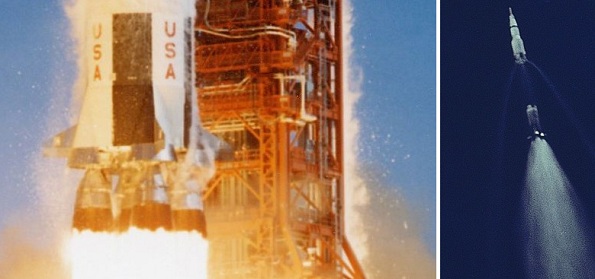
Powered by five first-stage engines fueled by “rocket grade” kerosene, the Saturn V was the tallest, heaviest and most powerful rocket ever built until the SpaceX Starship. Photos courtesy NASA.
During launch, five Rocketdyne F-1 engines of the massive Saturn V’s first stage burn “Rocket Grade Kerosene Propellant” at 2,230 gallons per second – generating almost eight million pounds of thrust.
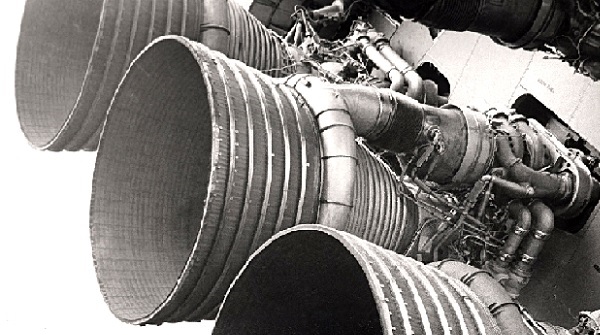
The F-1 engines of the Saturn V first stage at the U.S. Space and Rocket Center in Huntsville, Alabama. Photo courtesy NASA.
Saturn’s rocket fuel is highly refined kerosene RP-1 (Rocket Propellant-1 or Refined Petroleum-1) which, while conforming to stringent performance specifications, is essentially the same “coal oil” invented in the mid-19th century.
1846 Lamp Fuel
Canadian physician and geologist Abraham Gesner began refining an illuminating fuel from coal in 1846. “I have invented and discovered a new and useful manufacture or composition of matter, being a new liquid hydrocarbon, which I denominate Kerosene,” he noted in his patent.
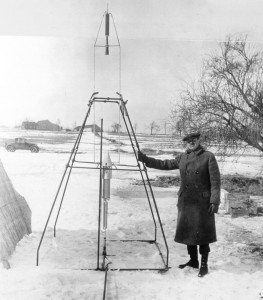
The father of American rocketry, Robert Goddard, in 1926 used gasoline to fuel the world’s first liquid-fuel rocket, seen here in its launch stand. Photo courtesy Library of Congress.
By 1850, Gesner had formed a company that installed lighting in the streets in Halifax, Nova Scotia. In 1854, he established the North American Kerosene Gas Light Company at Long Island, New York.
Although he had coined the term kerosene from the Greek word keros (wax), because his fluid was extracted from coal, most consumers called it “coal oil” as often as they called it kerosene.
By the time of the first U.S. oil well drilled by Edwin Drake in 1859, a Yale scientist (hired by the well’s investors) reported oil to be an ideal source for making kerosene, far better than refined coal. Demand for kerosene refined from petroleum launched the nation’s exploration and production industry.
Electricity replaced kerosene lamps and gasoline dominated 20th century demand for transportation fuel, but kerosene remained a powerful fuel choice.
JP-4 Jet Engines
Nathan Ostrich built the first jet car in 1962 using an engine originally designed for the North American F-86 Sabre jet fighter. Powered by a General Electric J47 at Utah’s Bonneville Salt Flats, his Flying Caduceus set a world record of more than 330 mph.
On November 7, 1965, California race car driver Art Arfons increased the land-speed record to 576.553 miles per hour on the famous one-mile strip. The Ohio drag racer’s home-made Green Monster was powered by JP-4 fuel (a 50-50 kerosene-gasoline blend), in an afterburner-equipped F-104 Starfighter turbojet jet engine.

A kerosene-gasoline blend powered the F-104 jet engine of the Green Monster to world records,.
Arfon set the world land-speed record three times between 1964 and 1965, in what became known as “The Bonneville Jet Wars.”
Record challenger Craig Breedlove’s Spirit of America Sonic 1 in 1965 used a jet engine from an F-4 Phantom II to defeat the Green Monster and set a record of 600.601 mph, which lasted until 1970, when the Blue Flame Natural Gas Rocket Car reached 630.388 mph.
Missiles and Moon Rockets
Kerosene’s ease of storage and stable properties attracted early rocket scientists like America’s Robert H. Goddard and Germany’s Wernher von Braun. During World War II, kerosene-fueled Nazi Germany’s notorious V-2 ballistic missiles.
Decades of post-war rocket engine research and testing led to the Saturn V’s five Rocketdyne F-1 engines. The F-1 was the most powerful single-combustion chamber engine ever developed, according to David Woods, author of How Apollo Flew to the Moon, 2008.
The Rocketdyne F-1 engines, 19 feet tall with nozzles about 12 feet wide, include fuel pumps delivering 15,471 gallons of RP-1 per minute to their thrust chambers. The Saturn V’s upper stages burn highly volatile liquid hydrogen (and liquid oxygen in all three stages).
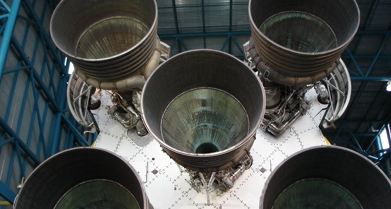
Kerosene fueled the Saturn V’s five main engines used for getting Apollo astronauts to the moon. NASA photo detail.
The five-engine main booster held 203,400 gallons of RP-1. After firing, the engines can empty the massive fuel tank in 165 seconds.
The Apollo 11 landing crowned liquid-rocket fuel research in America dating back to Goddard and his 1914 “Rocket Apparatus” powered by gasoline. In 1926, he launched the world’s first liquid-fuel rocket from his aunt’s farm in Auburn, Massachusetts.
Falcon 9
Although gasoline will be replaced with other propellants, including the liquid hydrogen and liquid oxygen used in the space shuttle’s external tank, RP-1 kerosene continues to fuel spaceflight.
Cheaper, easily stored at room temperature, and far less of an explosive hazard, the 19th-century petroleum product has fueled first-stage boosters for the Atlas, Delta, Antares, and SpaceX rockets. The reusable SpaceX Falcon 9 rockets use nine Merlin engines to generate 1.7 million pounds of thrust.
Last launched in 1972, the Saturn V was the most powerful rocket ever built, until it was surpassed by SpaceX’s Starship — fueled by liquid oxygen and liquid methane.
_______________________
Recommended Reading: Stages to Saturn: A Technological History of the Apollo/Saturn Launch Vehicles (2003). As an Amazon Associate, AOGHS earns a commission from qualifying purchases.
_______________________
The American Oil & Gas Historical Society (AOGHS) preserves oil history. Please become an AOGHS annual supporter and help maintain this energy education website and expand historical research. For more information, contact bawells@aoghs.org. © 2025 Bruce A. Wells.
Citation Information – Article Title: “Kerosene Rocket Fuel.” Authors: B.A. Wells and K.L. Wells. Website Name: American Oil & Gas Historical Society. URL:https://aoghs.org/products/kerosene-rocket-fuel. Last Updated: July 7, 2025. Original Published Date: July 12, 2015.