by Bruce Wells | Jan 4, 2026 | Petroleum Pioneers
Oilfield discoveries at El Dorado and Smackover in the 1920s launched the Arkansas petroleum industry.
Arkansas oil wells of the 1920s created boom towns, established the state’s petroleum exploration and production industry, and boosted the career of a young wildcatter named Haroldson Lafayette Hunt.
The first Arkansas well that yielded “sufficient quantities of oil” was the Hunter No. 1 of April 16, 1920, in Ouachita County, according to the Arkansas Geological Survey. Natural gas was discovered a few days later in Union County by Constantine Oil and Refining Company.
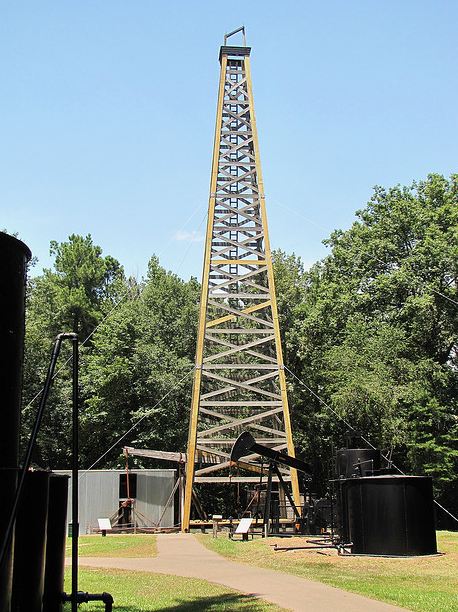
Surrounded by 20 acres of woodlands, the Arkansas Museum of Natural Resources in the Smackover oilfield preserves the state’s petroleum history seven miles north of equally historic El Dorado.
A January 1921 well drilled in the same Union County field at El Dorado marked the true beginning of commercial oil production in Arkansas. When the Busey-Armstrong No. 1 well struck oil in 1921, the oilfield discovery soon catapulted the population of El Dorado from 4,000 to 25,000 people. The well, 15 miles north of the Louisiana border, was the state’s first commercial oil well.
“Twenty-two trains a day were soon running in and out of El Dorado,” noted the Arkansas Gazette. An excited state legislature announced plans for a special railway excursion for lawmakers to visit the oil well in Union County.
Meanwhile, Haroldson Lafayette “H.L.” Hunt arrived from Texas with $50. He joined the crowd of lease traders and speculators at the Garrett Hotel, where fortunes were being made — and lost. Hunt launched his start as an independent oil and natural gas producer during the El Dorado drilling boom.
Some locals said it was his expertise at the poker table that earned him enough to afford a one-half acre parcel lease where his Hunt-Pickering No. 1 well produced some oil but ultimately proved unprofitable.

Hunt persevered and within four years acquired substantial El Dorado and Smackover oilfield holdings. By 1925, he was a successful 36-year-old oilman with his wife Lyda and three young children living in a three-story El Dorado home. He would significantly add to his oilfield successes a decade later in Kilgore, Texas (learn more in East Texas Oilfield Discovery).
Giant Oilfield at El Dorado
Located on a hill a little over a mile southwest of El Dorado, the derrick was visible from the town, according to historians A.R. and R.B. Buckalew. They write that three “gassers” had been completed in the general vicinity but did not produce in commercial quantities.
There was no market for natural gas at the time, the authors explained in their 1974 book, The Discovery of Oil in South Arkansas, 1920-1924.
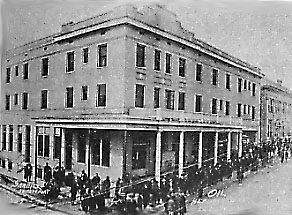
The Garrett Hotel, where H.L. Hunt checked in with 50 borrowed dollars and launched his long career as a successful independent oil producer.
Yet Dr. Samuel T. Busey was convinced “there was oil down there somewhere.”
The authors added, “Among those who gambled their savings with Busey at this time were Wong Hing, also called Charles Louis, a Chinese laundry man, and Ike Felsenthal, whose family had created a community in southeast Union County in earlier years.”
With no oil production nearby, investing in the “wildcat” well was a leap of faith. Chal Daniels, who was overseeing drilling operations for Busey, contributed the hefty sum of $1,000. On January 10, 1921, the well had been drilled to 2,233 feet and reached the Nacatoch Sand. A small crowd of onlookers and the drilling crew — after moving a safe distance away — watched and listened.

“The spectators, among them Dr. Busey, watched with an air of expectancy,” noted the historians. “Drilling had ceased and bailing operations had begun to try to bring in the well. At about 4:30 p.m., as the bailer was being lifted from its sixth trip into the deep hole, a rumble from deep in the well was heard.”
The rumbling grew in intensity, “shaking the derrick and the very ground on which it stood as if an earthquake were passing,” the authors report. “Suddenly, with a deafening roar, ‘a thick black column’ of gas and oil and water shot out of the well,” they added.
The gusher blew through the derrick and “bursts into a black mushroom” cloud against the January sky. The Busey No. 1 well produced 15,000,000 to 35,000,000 cubic feet of gas and from 3,000 to 10,000 barrels of oil and water a day.
Petroleum brings Prosperity
Thanks to the El Dorado discovery, the first Arkansas petroleum boom was on. By 1922, there were 900 producing wells in the state.
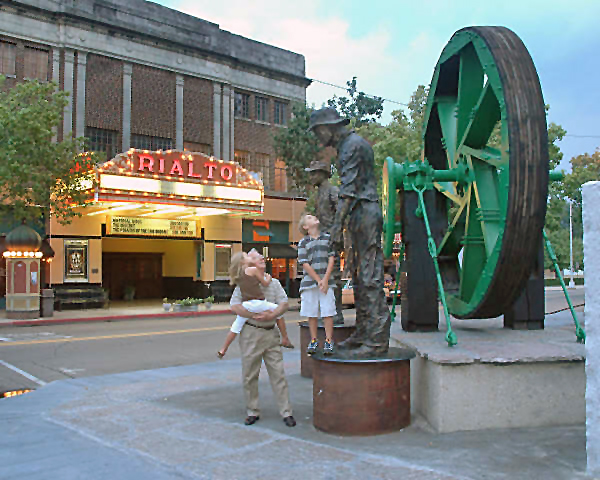
Civic leaders raised funds to preserve El Dorado’s historic downtown — and add an Oil Heritage Park at 101 East Main Street.
“Three months after the Busey well came in, work was underway on an amusement park located three blocks from the town that would include a swimming pool, picnic grounds, rides and concessions,” noted the Union County Sheriff’s Office. “Culture was not forgotten as an old cotton shed in the center of town near the railroad tracks was converted to an auditorium.”
The 68-square-mile field will lead U.S. oil output in 1925 — with production reaching 70 million barrels. “It was a scene never again to be equaled in El Dorado’s history, nor would the town and its people ever be the same again,” the authors concluded. “Union County’s dream of oil had come true.”
In 2002, El Dorado gathered 40 local artists to paint 55 oil drums donated by the local Murphy Oil Company. Preserving the town’s historic assets, including boom-era buildings, remains a major goal of the local group, Main Street El Dorado, which was the “2009 Great American Main Street Award Winner” of the National Trust Main Street Center.
Second Oil Boom: Discovery at Smackover
Prior to the January 1921 El Dorado discovery, the region’s economy relied almost exclusively on the cotton and timber industries “that thrived in the vast virgin forests of southern Arkansas.”
Petroleum wealth helped Smackover, Arkansas, incorporate in 1922.
Six months after the Busey-Armgstrong No. 1 well, another giant oilfield discovery 12 miles north will bring national attention — and lead to the incorporation of Smackover. A small agricultural and sawmill community with a population of 131, Smackover had been settled by French fur trappers in 1844. They called the area “Sumac-Couvert,” meaning covered with sumac or shumate bushes.
According to historian Don Lambert, by 1908 Sidney Umsted operated a large sawmill and logging venture two miles north of town. He believed that oil lay beneath the surface. “On July 1, 1922, Umsted’s wildcat well (Richardson No. 1) produced a gusher from a depth of 2,066 feet,” Lambert reported.
“Within six months, 1,000 wells had been drilled, with a success rate of ninety-two percent. The little town had increased from a mere ninety to 25,000, and its uncommon name would quickly attain national attention,” added Lambert.
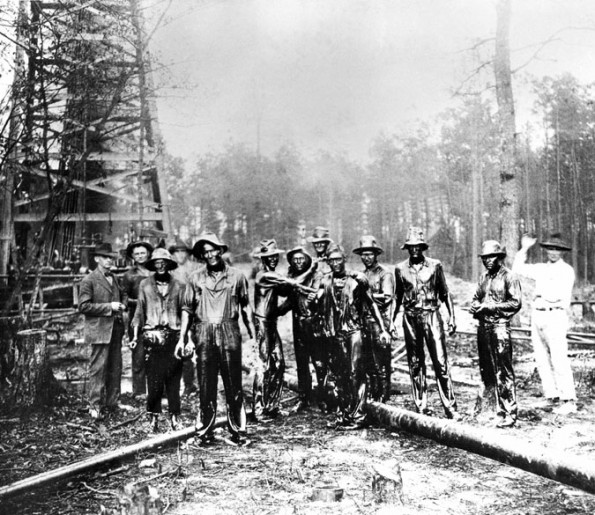
Roughnecks photographed following the July 1, 1922, discovery of the Smackover (Richardson) field in Union County. Courtesy of the Southwest Arkansas Regional Archives.
The oil-producing area of the Smackover field covered more than 25,000 acres. By 1925, it had become the largest-producing oil site in the world. The field will produce 583 million barrels of oil by 2001.
Opened in 1986, the Arkansas Natural Resources Museum educates visitors in the heart of the historic Smackover oilfield. Exhibits explain how the Busey No. 1 well near El Dorado “blew in with a gusty fury” in January 1921.
The museum includes a five-acre Oilfield Park with operating examples of early and modern oil-producing technologies. They can be found one mile south of the once petroleum-rich town of Smackover, which has celebrated its petroleum heritage with an “Oil Town Festival” every June.
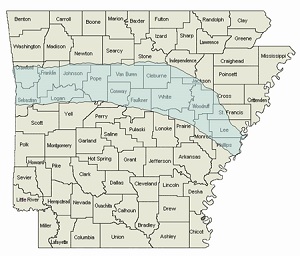
Abundant natural gas in the Fayetteville shale formation brought more drilling to Arkansas.
With more than 46,800 wells drilled between 1925 and 2023, about one-third of the 75 Arkansas counties have produced oil and/or natural gas, reported Mineralsanswers.com in July 2024.
Southern Arkansas also is considered among the most prolific lithium resources of its type in North America, according to ExxonMobil, which in 2023 acquired the rights to 120,000 gross acres of the Smackover formation.
Fayetteville Shale
Thanks to advances in drilling technologies combined with hydraulic fracturing, the Fayetteville Shale — a 50-mile-wide formation across central Arkansas — has added vast natural gas reserves while creating a new petroleum boom for the state.

Unlike traditional fields containing hydrocarbons in porous formations, shale holds natural gas in a fine-grained rock or “tight sands.” Until the 1990s, drilling in most shale formations was not considered profitable for production.
Surrounded by 20 acres of lush woodlands, the Arkansas Museum of Natural Resources collects and exhibits southern Arkansas petroleum — along with the history of brine drilling and the salt industry. It also has documented the social and economic histories that accompanied the 1920s oil boom.
_______________________
Recommended Reading: The Discovery of Oil in South Arkansas, 1920-1924 (1974); The Three Families of H. L. Hunt (1989); Early Louisiana and Arkansas Oil: A Photographic History, 1901-1946
 (1982); Giant Under the Hill: A History of the Spindletop Oil Discovery
 (2008). Your Amazon purchase benefits the American Oil & Gas Historical Society. As an Amazon Associate, AOGHS earns a commission from qualifying purchases.
_______________________
The American Oil & Gas Historical Society (AOGHS) preserves U.S. petroleum history. Please become an AOGHS annual supporter and help maintain this energy education website and expand historical research. For more information, contact bawells@aoghs.org. © 2026 Bruce A. Wells. All rights reserved.
Citation Information – Article Title: “First Arkansas Oil Wells.” Authors: B.A. Wells and K.L. Wells. Website Name: American Oil & Gas Historical Society. URL: https://aoghs.org/petroleum-pioneers/arkansas-oil-and-gas-boom-towns. Last Updated: January 3, 2026. Original Published Date: April 21, 2013.
by Bruce Wells | Jul 13, 2025 | Petroleum History Almanac
As the U.S. petroleum industry expanded following the January 1901 “Lucas Gusher” at Spindletop Hill in Texas, service company pioneers like Carl Baker and Howard Hughes brought new technologies to oilfields.
Baker Oil Tools and Hughes Tools specialized in maximizing petroleum production, as did oilfield service company competitors Schlumberger, a French company founded in 1926, and Halliburton, which began in 1919 as a well-cementing company.
R.C. “Carl” Baker Sr.
Baker Oil Tool Company (later Baker International) had been founded by Reuben Carlton “Carl” Baker Sr., who among other inventions patented a cable-tool drill bit in 1903 after founding the Coalinga Oil Company in Coalinga, California.
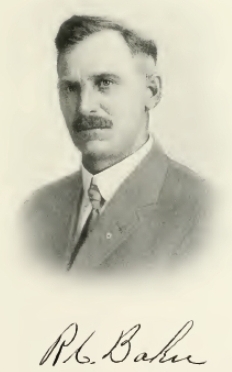
A 1919 portrait of Baker Tools Company founder R.C. “Carl” Baker (1872 – 1957).
The oil wells Carl Baker had drilled near Coalinga encountered hard rock formations that caused problems with casing, so he developed an offset cable-tool bit allowing him to drill a hole larger than the casing. He also patented a “Gas Trap for Oil Wells” in 1908, a “Pump-Plunger” in 1914, and a “Shoe Guide for Well Casings” in 1920.
Coalinga was “every inch a boom town and Mr. Baker would become a major player in the town’s growth,” according to the R.C. Baker Memorial Museum. He also organized several small oil companies and the local power company and established a bank.

After drilling wells in the Kern River oilfield, Baker added to his technological innovations on July 16, 1907, when he was awarded a patent for his Well Casing Shoe (No. 860,115), a device ensuring uninterrupted flow of oil through a well. His invention revolutionized oilfield production.
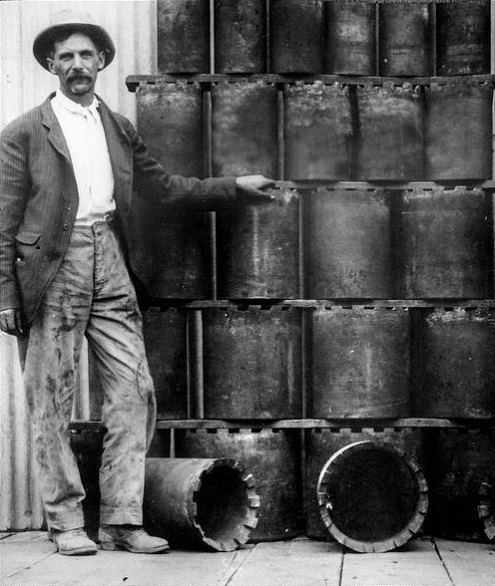
R.C. “Carl” Baker standing next to Baker Casing Shoes in 1914. Photo courtesy R.C. Baker Memorial Museum.
In 1913, Baker organized the Baker Casing Shoe Company (renamed Baker Tools two years later). He opened his first manufacturing plant in Coalinga.
When Baker Tools headquarters moved to Los Angeles in the 1930s, the building remained a company machine shop. It was donated by Baker to Coalinga in 1959. Two years later, the original machine shop and office of Baker Casing Shoe reopened as the R.C. Baker Memorial Museum.
By the time Carl Baker Sr. died in 1957 at age 85, he had been awarded more than 150 U.S. patents in his lifetime. “Though Mr. Baker never advanced beyond the third grade, he possessed an incredible understanding of mechanical and hydraulic systems,” reported the former Coalinga museum.
Baker Tools became Baker International in 1976 and Baker Hughes after the 1987 merger with Hughes Tool Company.
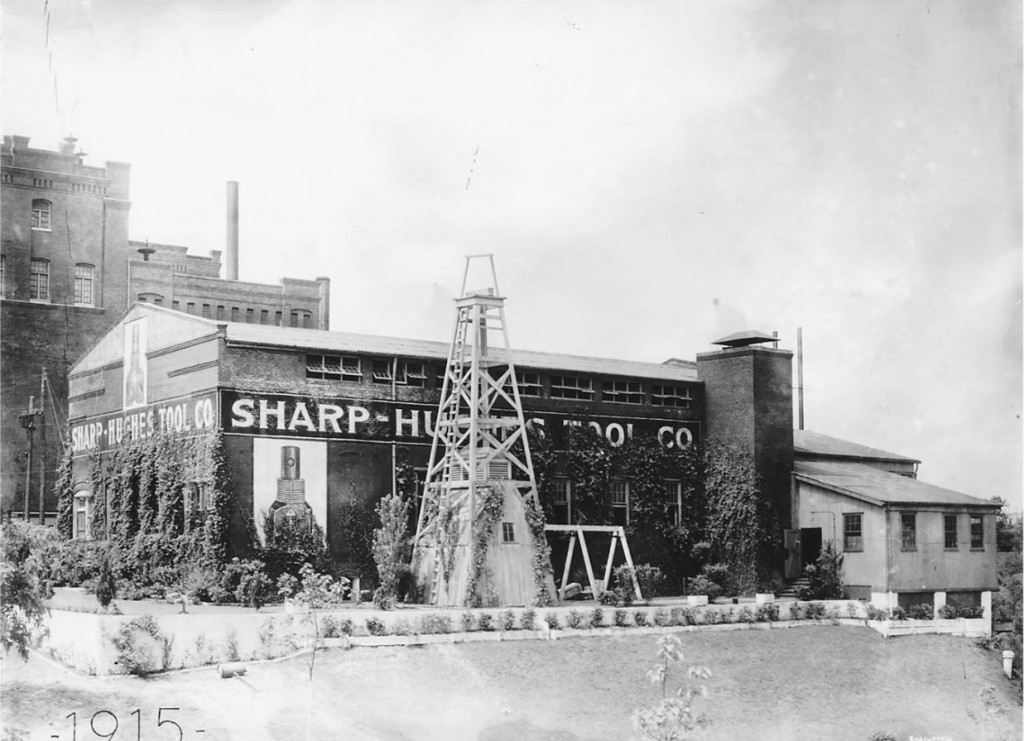
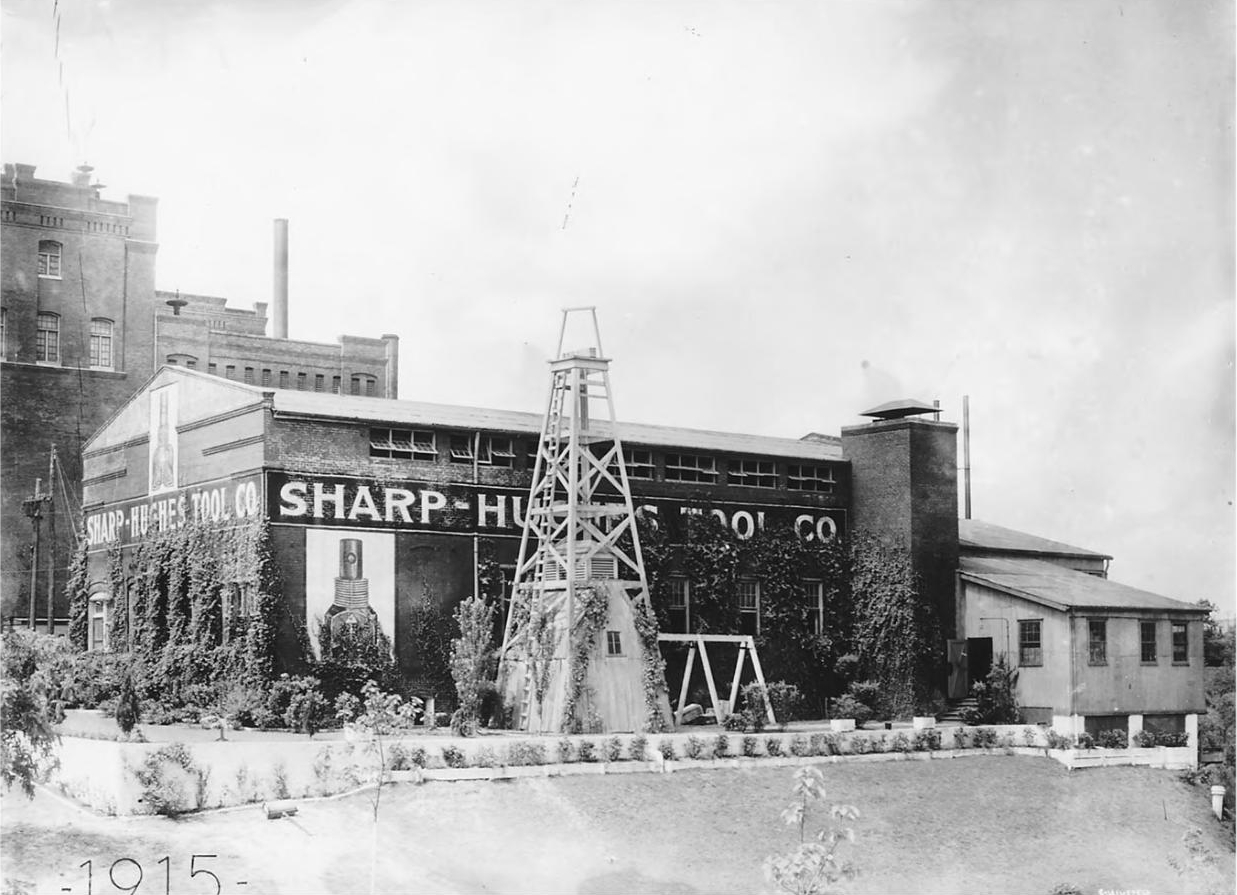
The Houston manufacturing operations of Sharp-Hughes Tool at 2nd and Girard Streets in 1915. The site is on the campus of the University of Houston–Downtown. Photo courtesy Houston Metropolitan Research Center, Houston Public Library.
Howard Hughes and Walter Sharp
The Hughes Tool Company began in 1908 as the Sharp-Hughes Tool Company, founded by Walter B. Sharp (1870–1912) and Howard R. Hughes, Sr.
Sharp was an experienced Texas oilfield pioneer who in 1893 drilled for the Gladys City Oil and Gas Manufacturing Company at Beaumont, Texas. The exploratory well on Spindletop Hill did not find oil, but it helped lead to the giant oilfield’s discovery in 1901, according to Texas State Historical Association (TSHA).
In 1896, Sharp was one of the drillers at Corsicana when the state’s first commercial oilfield was developed. While there, he met Joseph “J.S.” Cullinan, who became a lifelong friend. Cullinan in 1902 founded the Texas Company (see Sour Lake produces Texaco).
Sharp and Hughes in 1907 drilled test wells at Goose Creek/ “When both wells had to be abandoned because of the hard rock encountered, the two men began to consider the possibility of developing a roller rock bit. It was eventually arranged for Hughes to proceed with the designing and construction of a bit, with capital provided equally by Sharp and Cullinan.
Rotary drilling bits shaped like fishtails became obsolete in 1909 when the two inventors introduced a dual-cone roller bit. They created a bit “designed to enable rotary drilling in harder, deeper formations than was possible with earlier fishtail bits,” according to a Hughes historian. Secret tests took place on a drilling rig at Goose Creek, south of Houston.
Hard Rock at Goose Creek
“In the early morning hours of June 1, 1909, Howard Hughes Sr. packed a secret invention into the trunk of his car and drove off into the Texas plains,” noted Gwen Wright of History Detectives in 2006. The drilling site was near Galveston Bay. Rotary drilling “fishtail ” bits of the time were “nearly worthless when they hit hard rock.”
The new technology would soon bring faster and deeper drilling worldwide, helping to find previously unreachable oil and natural gas reserves. The dual-cone bit also created many Texas millionaires, explained Don Clutterbuck, one of the PBS show’s sources.
“When the Hughes twin-cones hit hard rock, they kept turning, their dozens of sharp teeth (166 on each cone) grinding through the hard stone,” he added.
Although several inventors tried to develop better rotary drill bit technologies, Sharp-Hughes Tool Company was the first to bring it to American oilfields. Drilling times fell dramatically, saving petroleum companies huge amounts of money.
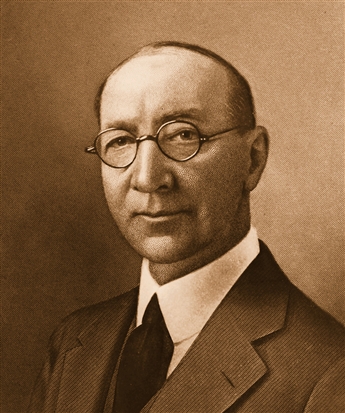
Howard Hughes Sr. (1869 – 1924) on August 10, 1909, was awarded a U.S. patent for a dual-cone drill bit that could crush hard rock.
The Society of Petroleum Engineers has noted that about the same time Hughes developed his bit, Granville A. Humason of Shreveport, Louisiana, patented the first cross-roller rock bit, the forerunner of the Reed cross-roller bit.
Biographers have noted that Hughes met Granville Humason in a Shreveport bar, where Humason sold his roller bit rights to Hughes for $150. The University of Texas Center for American History Collection includes a 1951 recording of Humason talking about that chance meeting. He recalled spending $50 of his sale proceeds at the bar that evening.
After Walter Sharp died in 1912, his widow Estelle Sharp sold her 50 percent share in the company to Hughes. It became Hughes Tool in 1915. Despite legal action between Hughes Tool and the Reed Roller Bit Company in the late 1920s, Hughes prevailed and his oilfield service company prospered.
Hughes Tool
By 1934, Hughes Tool engineers designed and patented the three-cone roller bit, an enduring design that remains much the same today. Hughes’ exclusive patent lasted until 1951, which allowed his Texas company to grow worldwide. More innovations (and mergers) would follow.
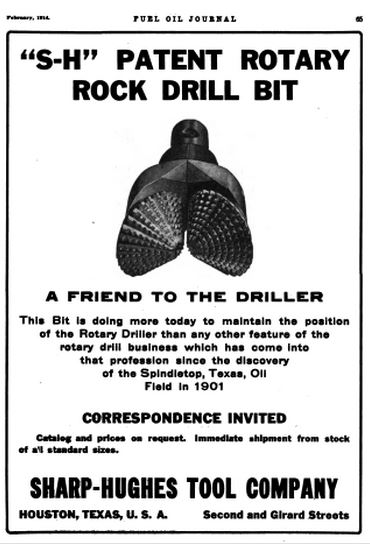
A February 1914 advertisement for the Sharp-Hughes Tool Company in Fuel Oil Journal.
Frank Christensen and George Christensen had developed the earliest diamond bit in 1941 and introduced diamond bits to oilfields in 1946, beginning with the Rangley field of Colorado. The long-lasting tungsten carbide tooth came into use in the early 1950s.
After Baker International acquired Hughes Tool Company in 1987, Baker Hughes acquired the Eastman Christensen Company three years later. Eastman was a world leader in directional drilling.
When Howard Hughes Sr. died in 1924, he left three-quarters of his company to Howard Hughes Jr., then a student at Rice University. The younger Hughes added to the success of Hughes Tool while becoming one of the richest men in the world. His many legacies include founding Hughes Aircraft Company and the Howard Hughes Medical Institute.
Learn more in Making Hole – Drilling Technology.
Oilfield Service Competition
A major competitor for any energy service company, today’s Schlumberger Limited can trace its roots to Caen, France. In 1912, brothers Conrad and Marcel began making geophysical measurements that recorded a map of equipotential curves (similar to contour lines on a map). Using very basic equipment, their field experiments led to the invention of a downhole electronic “logging tool” in 1927.
After developing an electrical four-probe surface approach for mineral exploration, the brothers lowered another electric tool into a well. They recorded a single lateral-resistivity curve at fixed points in the well’s borehole and graphically plotted the results against depth – creating first electric well log of geologic formations.
Meanwhile, another service company in Oklahoma, the Reda Pump Company had been founded by Armais Arutunoff, a close friend of Frank Phillips. By 1938, an estimated two percent of all the oil produced in the United States with artificial lift, was lifted by an Arutunoff pump.
Learn more in Inventing the Electric Submersible Pump (also see All Pumped Up – Oilfield Technology).
_______________________
Recommended Reading: History Of Oil Well Drilling (2007); Trek of the Oil Finders: A History of Exploration for Petroleum (1975). Your Amazon purchase benefits the American Oil & Gas Historical Society. As an Amazon Associate, AOGHS earns a commission from qualifying purchases.
_______________________
The American Oil & Gas Historical Society (AOGHS) preserves U.S. petroleum history. Please become an AOGHS annual supporter and help maintain this energy education website and expand historical research. For more information, contact bawells@aoghs.org. © 2025 Bruce A. Wells.
Citation Information – Article Title: “Carl Baker and Howard Hughes.” Authors: B.A. Wells and K.L. Wells. Website Name: American Oil & Gas Historical Society. URL: https://aoghs.org/oil-almanac/carl-baker-howard-hughes. Last Updated: July 17, 2025. Original Published Date: December 17, 2017.