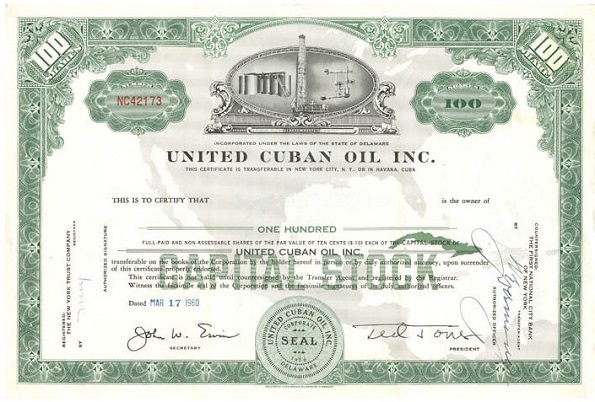
The Batista government stripped United Cuban Oil of its Cuban operations in 1959.
In July 1953, Fidel Castro’s revolutionaries first challenged the government of Fulgencio Batista with organized guerrilla resistance and revolution. Three years later, United Cuban Oil incorporated with Ted Jones as president and offices in Los Angeles. The investment banking firm of S.D. Fuller & Company underwrote the venture, investing $534,694 to control 66 percent of United Cuban Oil stock.
The new petroleum company’s objective was “to consolidate production, development and exploration of oil and gas on concession rights (38 leases) in Cuba.” Jones had existing but independent ventures working on the north coast of the island, including Companie de Fomento Petrolero.
United Cuban Oil filed with the U.S. Securities and Exchange Commission to register 2,573,625 common stocks and an initial public offering of 2,000,000 shares at $1.25 a share. The company exchanged 573,625 shares of stock one-for-one to absorb Jones’ Companie de Fomento Petrolero and make it a subsidiary.
Jones’ holdings in Cuba also became subsidiaries: Empresas Petroleras Jones de Cuba and Compania Perforadora Jones de Cuba. A group headed by James J. McBride bought 1,200,000 shares to be held in escrow for three years.
On June 13, 1957, United Cuban Oil announced plans to drill in California. The selected site was on the 111 acre Muller ranch, about three miles west of La Honda. Drilling of the Muller No. 1 well began on June 29. Interviewed by the Santa Cruz Sentinel, company president Jones took the opportunity to promote United Cuban Oil’s prospects with its six producing wells in Cuba.
Six weeks later, Jones, “reportedly stated that oil was struck at 2,610 feet in 45 feet of oil sand. Officials would only say that it was producing a ‘couple of hundred barrels.’” Regardless of production, by the end of August 1957, United Cuban Oil had plugged and abandoned the Muller well after water intrusion and a failed re-drilling effort.
In Texas, United Cuban Oil completed its No. 1A Coker well in Coleman County, five miles northeast of Novice. But the wildcat well turned out to be just a brief producer. It too was abandoned. At the time, United Cuban Oil was selling for about 56 cents a share on the American Stock Exchange, but for any business operating in Cuba, everything changed on January 1, 1959. Fidel Castro seized power, dictator Fulgencio Batista fled the island, and the Cold War became more dangerous.
Back in the United States, United Cuban Oil was reorganized by three wealthy entrepreneurs from El Paso, Texas. In May 1959, they merged Balcones Corporation, Dell City Gas Company, and United Cuban Oil to form a new company while retaining the United Cuban Oil name and Ted Jones as president. The company planned to move its headquarters to El Paso.
Although United Cuban Oil’s underwriters, S.D. Fuller & Company, offered analysis of prospects to potential investors in the Commercial and Financial Chronicle, few were willing to gamble on Cuba’s uncertain future. By November 1959, the Law 635 of the Batista government effectively stripped United Cuban Oil of its Cuban operations.
The stories of exploration and production companies joining petroleum booms (and avoiding busts) can be found updated in Is my Old Oil Stock worth Anything?The American Oil & Gas Historical Society preserves U.S. petroleum history.
Citation Information – Article Title: “United Cuban Oil Inc.” Authors: B.A. Wells and K.L. Wells. Website Name: American Oil & Gas Historical Society. URL: https://aoghs.org/old-oil-stocks/united-cuban-oil-inc. Last Updated: February 8, 2026. Original Published Date: December 6, 2018.
High hopes and investments end after one well in the Big Muddy.
In October 1917, Wyoming Peerless Oil Company stock promotions first appeared in the pages of the Cheyenne State Leader, Laramie Republican, and Wyoming Tribune newspapers.
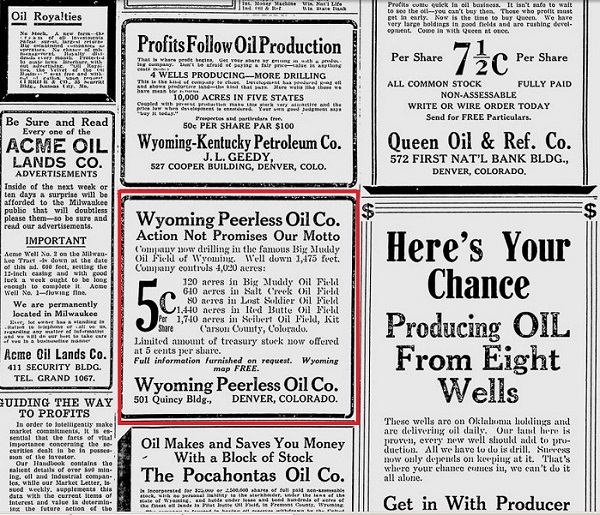
Peerless Oil and other newly formed exploration companies promoted themselves with often exaggerated newspaper ads in the Milwaukee Journal, June 2, 1918.
Within a year the new exploration company’s advertisements appeared in newspapers as far away as Milwaukee, Wisconsin: “Action Not Promises Our Motto,” noted one from 1918 placed in the Milwaukee Journal.
Many U.S. newspapers at the time included similar promotions as oilfield discoveries proliferated from California to Kansas. Just a few years earlier, Col. William F. Cody had searched for Wyoming black gold (see Buffalo Bill Shoshone Oil Company).
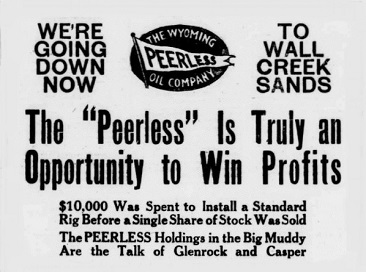
Another example of a Peerless Oil Company promotion of its Wyoming Big Muddy exploration effort.
Meanwhile, demand for gasoline had been growing since the first U.S. auto show in 1900. The Model T Fords and World War I, which the United States would soon join, resulted in a rapid proliferation of petroleum exploration companies.
Some of the startups used questionable claims to keep investors unaware of how risky and expensive the business of finding and producing oil truly was. Nine out of 10 exploratory well attempts proved to be dry holes — and petroleum exploration was expensive in such remote areas.
The Big Muddy
The Wyoming Peerless Oil Company set its sights on drilling a well six miles from the nearest producer in the Big Muddy oilfield east of Casper.
Peerless Oil stock was initially offered at three cents per share. “Don’t wait for our first well to come in. You might not be able to get this stock then for less than 25-cents or 50-cents per share.”
Many companies tried but failed to find petroleum wealth in the Big Muddy field.
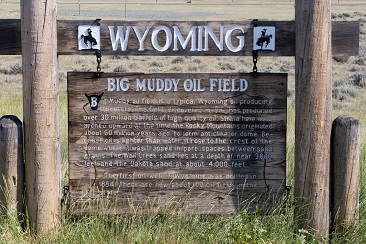
The Big Muddy oilfield, located about four miles west of Glenrock in Converse County, was discovered in 1916, a discovery that touched off widespread drilling and brought about one of Wyoming’s famous oil booms. Today, a marker on the south side of Hwy. 230 at the junction with County Road 33 describes the historic field:
Big Muddy oil field is a typical Wyoming oil producing structure. The field, discovered in 1916, has produced over 30 million barrels of high quality oil.
Strata here were arched upward at the time the Rocky Mountains originated over 60 million years ago, to form anticline, or dome. Because oil is lighter than water, it rose to the crest of the dome where it was trapped in pore spaces between sand grains. The Wall Creek sand lies at a depth of near 3,000 feet and the Dakota sand at about 4,000 feet. The first oil well in Wyoming was drilled in 1884. There are now about 100 oil fields in the state.
The Big Muddy field in Converse County launched a drilling boom, notes a University of Wyoming’s 2019 article, Wyoming Energy History. “Claim jumpers entered the area, some only drilling at night and pretending to be construction workers on the site during the day,” the article reports, adding that 13 steam boilers were stolen — and cable-tools “lost” down holes (see Fishing in Petroleum Wells).
Peerless Oil
Seeking more investors, advertisements reported Wyoming Peerless Oil’s drilling progress on its Big Muddy exploratory well: Down 1,475 feet by June of 1918; down 1,675 feet by July and down to 3,315 feet by August of 1919.
Although rumors of a dry hole began to circulate, the company continued to solicit more investors to fund deeper drilling. But after reaching 4,050 feet without finding oil, company officer Charles Straub announced the well would be abandoned. If more funds could be secured, Wyoming Peerless Oil would drill a second well, Straub added.
“Efforts have been made to extend the limits of the (Big Muddy) field in every direction, but these efforts have all been failures, and the area of the field is plainly marked,” reported the Oil and Gas News (this would change in 1950 with a discovery to the east of the field).
By February 1920, stockholders from Denver had petitioned a court to put the Wyoming Peerless Oil Company into receivership, alleging mismanagement by Straub and other company officers. Straub responded with a $50,000 libel suit, reported by the Casper Daily Tribune on March 5, 1920. Wyoming Peerless Oil never drilled a second well, and the company disappeared from newspaper accounts.
The first record of oil in Wyoming came in 1832. An expedition led by Captain B.L.E. Bonneville took the first wagons through South Pass. Fifty years later, prospector Mike Murphy bought an oil lease on the site of Capt. Bonneville’s “great tar spring” southeast of Lander.
The stories of exploration and production companies joining petroleum booms (and avoiding busts) can be found updated inIs my Old Oil Stock worth Anything?
Citation Information – Article Title: “Wyoming Peerless Oil Company.” Authors: B.A. Wells and K.L Wells. Website Name: American Oil & Gas Historical Society. URL: https://aoghs.org/oil-almanac/buffalo-bill-oil-company. Last Updated: October 1, 2025. Original Published Date: July 29, 2013.
Updated research and articles about the histories of old oil company stock and petroleum company histories.
Found an old oil company stock certificate and hoping for a petroleum financial gusher?
The American Oil & Gas Historical Society’s research and accompanying forum depend upon your individual financial support. The historical society is an independent, energy education organization — unaffiliated with upstream or downstream petroleum companies, state or federal government, or industry advocacy groups.
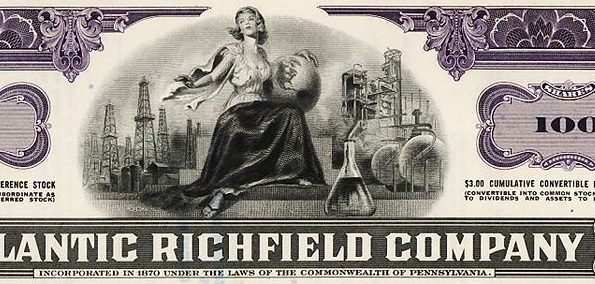
A petroleum company’s old oil stock certificate vignette sometimes has value for collectors of scripophily – the buying and selling of certificates after they have no redeemable value as a security.
Although use of fossil fuels today is highly controversial, the history of U.S. petroleum exploration, production, and transportation provides context for modern energy debates.
From 19th-century kerosene for lamps, 20th-century gasoline for cars, and modern plastic polymers for everyday products, the petroleum industry’s huge social, economic and technological heritage should be preserved.
Do you have an old oil stock certificate found in an attic? You can research the certificate and its company history yourself — or pay for a professional financial researcher. Am you now rich? Probably not. Since first commercial U.S. oil well in 1859, the petroleum industry’s boom and bust cycles have left many casualties.
A Popular Vignette
Collectors have found a surprising number of examples where quickly formed exploration companies picked the exact same oilfield scene for stock certificates.
In the rush to print stock certificates during oil booms, new companies often chose to print certificates using a vignette of derricks. Many ended up using the exact same scene of derricks in an oilfield.
It might have saved time and money by choosing a common vignette today found on shares of Centralized Oil & Gas Company; Double Standard Oil & Gas Company; Evangeline Oil Company; Texas Production Company; Tulsa Producing and Refining Company; Hecla-Wyoming Oil Company; Oil Prospectors Inc.; Craven Oil & Refining; Buck Run Oil and Refining; Home Oil & Gas; Hog Creek Carruth Company; Buffalo-Texas Oil Company; and the Champion Oil Company (see links to them below).
The vast majority of old oil stock certificates — especially petroleum exploration companies formed prior to U.S. Securities and Exchange Commission (SEC) — simply become family mementos. As a financial adviser can explain, documents from old company mergers rarely bring wealth today. For one that led to extended court battles, see Not a Millionaire from Old Oil Stock.
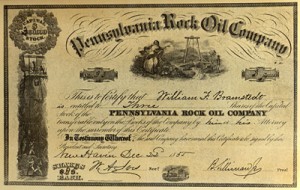
America’s first oil company — the Pennsylvania Rock Oil Company of New York, organized in 1855, and was reorganized by 1859 to drill the first U.S. oil well as the Seneca Oil Company of New Haven, Connecticut.
Unfortunately, this small historical society cannot grant requests for free research regarding individual company histories and the potential value of stock certificates. As you may have discovered, financial research is difficult and time consuming. If you are fortunate, a visitor to this website or a society volunteer may have posted helpful information.
If your certificate is not listed here, and to share further research experiences, you are invited to submit your query in the current Stock Certificate Q&A Forum.
Below is research submitted by a leading volunteer of the American Oil & Gas Historical Society. The company histories presented often tell fascinating stories – and are exclusive of the Stock Certificate Q&A forum posts also on this website. Check back here for more of these rare histories.
Kantexo Oil & Gas Company* Keck Oil Company* Ken-Saw Petroleum Corporation* King George Oil Company* Kokernot Oil Company Kutz Canon Oil & Gas Company* * Research in Progress
Your old oil stock not listed? Please support research by the American Oil & Gas Historical Society (AOGHS) with a donation. You are invited to submit your query in the current Stock Certificate Q&A Forum.
Louisiana oil boom brings pipelines, refineries and competition.
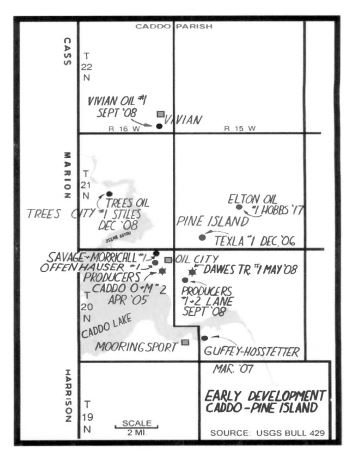
Claiborne Parish made headlines on January 12, 1919, when Consolidated Progressive Oil Company completed the discovery well for northern Louisiana’s prolific Homer oilfield. About 50 miles to the west, a 1905 oil discovery at Caddo-Pines near Shreveport had brought a rush of oil exploration to northern Louisiana.
Caddo Lake drilling platforms – completed over water without a pier to shore – have been called America’s first true offshore oil wells. Exhibits at the state’s Oil City museum tell that story. Like Caddo-Pines, the Homer field was crowded with new companies within months after the discovery.
Petroleum production from the new field soon reached an aggregate of about 10,000 barrels of oil per day. Reporting from the Pennsylvania oil regions, Pittsburgh Press on September 21, 1919, proclaimed the “Homer Field is Sensation of Oil Industry.”
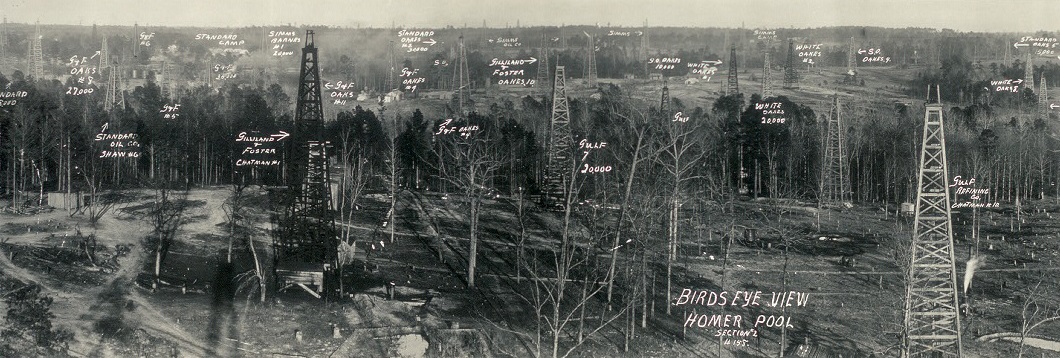
Detail from a panoramic “bird’s eye view” of the Homer oilfield circa 1920s. Photo courtesy Library of Congress Prints and Photographs Division, Washington, D.C.
Superior Oil Works
Paramount Petroleum Company began when the leadership of another company operating in the Homer oilfield decided to expand operations. Superior Oil Works officers, including President George A. Todd of Oklahoma City; Secretary and Purchasing Agent H.H. Todd of Vivian, Louisiana; and Treasurer D.C. Richardson of Shreveport organized the Paramount Petroleum Company.
Superior Oil Works had been formed to build and operate a refinery close to the Homer field. Capitalized at $300,000 with common stock issued, the company began construction in Superior, Louisiana, but its officers were by then contemplating the much-expanded venture — the formation of Paramount Petroleum to integrate exploration, production, transportation and refining under one organization.
Once established, the new company absorbed Superior Oil Works and looked for potential leases near the Consolidated Progressive Oil Company’s discovery well. As construction of the Superior refinery progressed, purchasing agent H.H. Todd advertised that Paramount Petroleum was “in the market for oil refinery equipment, boilers, stills, pumps, and plant machinery, etc.”
Paramount Petroleum made a deal with Consolidated Progressive Oil in May 1919, securing one-half interest in more than 11,000 acres of both proven and unexplored territory in Claiborne Parish. The acreage was already producing about 40,000 barrels of oil, ensuring the refinery would be supplied.
“A giant refining company has been organized recently in Shreveport to be known as the Paramount Petroleum Company,” noted the Oil Distribution News. The venture was capitalized at $10 million with half of its stock subscribed.
“Stock in this company has been consumed by the largest business and banking men of Shreveport,” added the Oil and Gas News. But the best news for investors was the headline: “Paramount Petroleum Gets 10,000 Barrel Well And Will Build Big Refinery.”
In March 1920, the Petroleum Age reported Paramount Petroleum “recently took over the under-construction Superior Oil Works refinery at Vivian [Superior], Louisiana, 23 miles north of Shreveport, to service Pine Island production.”
The publication added that another refinery was to be completed in north Shreveport in November 1920 “with a four-inch pipeline from the Homer field where Paramount Petroleum holds 4,700 acres.”
Paramount Petroleum Company’s newest refinery would be struggling by May 1921.
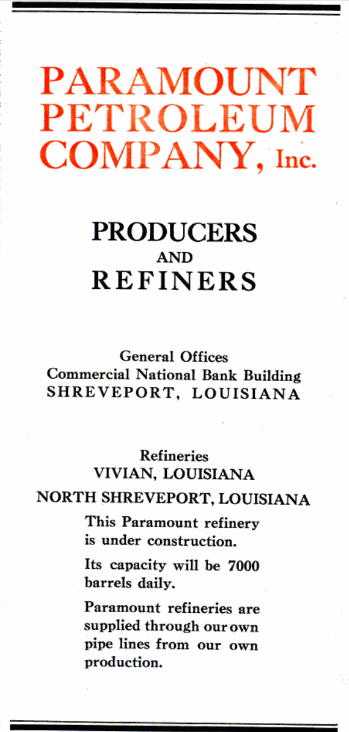
Within a month Paramount Petroleum was drilling in Claiborne Parish and shipping 400,600 barrels of oil a day. The company secured a $1 million mortgage from the Commercial National Bank of Shreveport and advertised, “Paramount refineries are supplied through our own pipelines from our own production.”
Paramount Petroleum in July 1920 completed the No. 5 Shaw well, which produced 500 barrels of oil a day from 2,090 feet deep in the Homer field. In August, the company’s No. 9 Shaw well become another 500-barrels-of-oil-a-day producer from a depth of 2,100 feet.
Anticipating more growth in oil production, Paramount Petroleum committed to an agreement for 300 tank cars from Standard Tank Car Company of St. Louis, Missouri.
“Not too bright”
“Paramount has just closed a deal for one half interest in 24 producing wells in the old Caddo field with 1,200 acres of proven territory on which many wells can yet be drilled,” reported the Petroleum Age in October 1920. “The production department of Paramount Petroleum is making splendid headway and with its large acreage, will no doubt greatly add to the earnings of the company.”
But the Petroleum Age reporter had got it wrong. By February 1921, Paramount Petroleum’s refinery at Superior was running at only about 50 percent capacity. Another trade publication reported the company’s prospects as “not too bright.”
Shipments from Paramount Petroleum’s Homer oilfield holdings dropped to just 168 barrels of oil a day. In May 1921 the struggling company leased its underused refinery and fleet of 390 tank cars to Lucky Six Oil Company for six months.
The Homer field attracted drillers from earlier discoveries at the nearby Caddo-Pines oilfields. Photo courtesy the Petroleum History Institute.
To the south, the Busey-Armstrong No. 1 oil gusher on January 10, 1921, had opened Arkansas’ El Dorado field and Lucky Six Oil Company had entered the scramble to exploit the new field’s huge production (578,000 barrels of oil in the month of May alone).
The oilfield discovery 15 miles north of the Louisiana border was the first Arkansas oil well. It attracted even more exploration and production companies to the region.
As competition intensified, Paramount Petroleum struggled to pay debts. It was unable to make a required $200,000 mortgage payment to Commercial National Bank of Shreveport in July 1921. The deal Paramount had struck with Consolidated Progressive Oil back in 1919 had become toxic.
The National Petroleum News reported on September 7, 1921, that Consolidated Progressive Oil was seeking a court-ordered receiver to take over Paramount Petroleum. The action was based on claims totaling $849,547 — and “averred acts jeopardizing the interests of creditors.” Among the allegations was “the effect that officials of the defendant concern have admitted in writing the company’s inability to meet present and maturing obligations.”
Paramount Petroleum’s epitaph was brief. “It is officially stated that this company is out of business,” reported Poor’s Cumulative Service in December 1921. “Its properties are to be sold by the sheriff December 24 and proceeds applied on the first Mortgage notes.”
The first Louisiana oil well had been drilled 17 years before the end of Paramount Petroleum. More stories about petroleum exploration and production companies trying to join drilling booms (and avoid busts) can be found in an updated series of research at Is my Old Oil Stock worth Anything?
Citation Information – Article Title: “Paramount Petroleum Company.” Authors: B.A. Wells and K.L. Wells. Website Name: American Oil & Gas Historical Society. URL:httpshttps://aoghs.org/old-oil-stocks/paramount-petroleum-company. Last Updated: March 9, 2025. Original Published Date: August 15, 2015.
Three petroleum exploration companies risked everything on one well in their gamble to to find an Oregon oilfield.
The lure of petroleum wealth invited speculators practically since the first U.S. oil well of 1859 in Pennsylvania. Exploratory wells especially have remained a high-risk investment since almost nine out of ten of these “wildcat” wells fail to produce commercial amounts of oil.
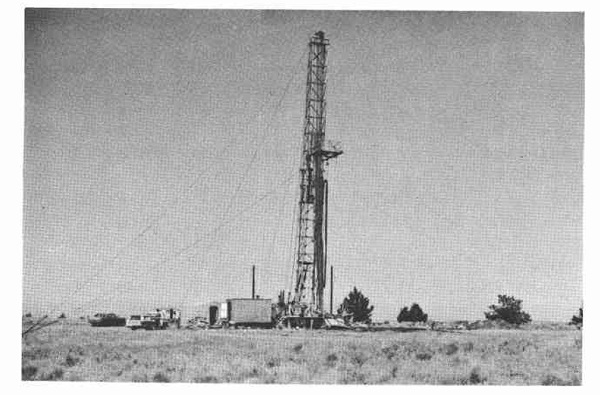
The Morrow No. 1 well, an ill-fated wildcat well first drilled in 1952 in Jefferson County, Oregon. Photo courtesy Oregon Department of Geology and Mineral Industries, “The Ore Bin,” Vol. 32, No.1, January 1970.
With under-capitalized operations turning to public sales of stock to raise money, many small ventures have been forced to bet everything on drilling a first successful well to have a chance at a second. Drilling a producing well can bring some wealth, but a “dry hole” brings bankruptcy.
And so it was in the 1950s on a remote hillside in Jefferson County, Oregon, where three companies searched for riches from the same well.
Northwestern Oils Inc.
The first of these three Oregon wildcatters, Northwestern Oils, incorporated in 1951 with $1 million capitalization in order to “carry on business of mining and drilling for oil.”
With offices in Reno, Nevada, in early 1952 Northwestern Oils began drilling a test well about eight miles southeast of Madras, Oregon. Using a cable-tool drilling rig (see Making Hole – Drilling Technology), drillers reached a depth of 3,300 feet on the Baycreek anticline before work was suspended because of “lost circulation troubles.”
Circulation troubles continued with the Morrow No. 1 well – also known as the Morrow Ranch well – in Jefferson County (Section 18, Township 12 South, range 15 East). By March 1956, with no money and no additional drilling possible, Northwestern Oils’ assets were “seized for non-payment of delinquent internal revenue taxes due from the corporation” and auctioned off at the Jefferson County courthouse.
Central Oils Inc.
Central Oils (Seattle) also was formed in 1956. With plans to join the other rare Oregon wildcatters, the company registered with the Security and Exchange Commission on July 30, 1958. It sought to sell one million shares of stock to the public at 10 cents a share. Proceeds would finance leasing and drilling, just like Northwestern Oils.
Central Oils received a permit to deepen Northwestern Oils’ old Morrow Ranch well in 1966 and planned to continue drilling with a cable-tool rig. Nothing happened.
“Commencement of this venture has been delayed until the spring of 1967,” one newspaper reported. But Central Oils had run afoul of the SEC. Oregon regulators recorded the well abandoned as of September 12, 1967, and Central Oils “out of business; no assets.”
Robert F. Harrison
In May 1968, Robert F. Harrison and his associates took over the same well — this time with plans to deepen it to more than 5,000 feet. But two years later the drilling effort was still stuck at a depth of 3,300 feet. Desperate, Harrison tried to clear the borehole by applying technologies for Fishing in Petroleum Wells.
On February 2, 1971, an intra-office report noted that R.F. Harrison “will abandon as soon as weather permits,” never having exceeded the original Northwestern Oils total depth of 3,300 feet. It would be a dry hole.
Harrison finally plugged and abandoned the Morrow No. 1 well as of October 12, 1971. Oregon’s Department of Geology and Mineral Industries has identified the stubborn nonproducer as well number 36-031-00003. There has never been a successful oil well drilled in Oregon.
America’s first dry hole was drilled in 1859 by John Grandin of Pennsylvania – near and just a few days after the first commercial discovery. In 2014, U.S. oil wells produced more than 8.7 million barrels of oil every day, according to the Energy Information Administration.
The stories of many exploration companies trying to join petroleum booms (and avoid busts) can be found in an updated series of research inIs my Old Oil Stock worth Anything?
Citation Information – Article Title: “Oregon Wildcatters.” Authors: B.A. Wells and K.L. Wells. Website Name: American Oil & Gas Historical Society. URL: https://aoghs.org/old-oil-stocks/oregon-wildcatters. Last Updated: February 26, 2025. Original Published Date: January 29, 2016.




 (reprint, 2017);