by Bruce Wells | Dec 11, 2025 | Petroleum Technology
“Small cannons throwing a three-inch solid shot are kept at various stations throughout the region…”
Early petroleum technologies included cannons for fighting oil tank storage fires, especially in the Great Plains, where lightning strikes ignited derricks, engine houses, and tanks. Shooting a cannonball into the base of a burning storage tank allowed oil to drain into a holding pit or ditch, putting out the fire.
“Oil fires, like battles, are fought by artillery,” proclaimed the Massachusetts Institute of Technology in December 1884. Oilfield conflagrations challenged America’s petroleum industry since the first commercial well in 1859 (see First Oil Well Fire). An MIT student offered a recent, first-person account.
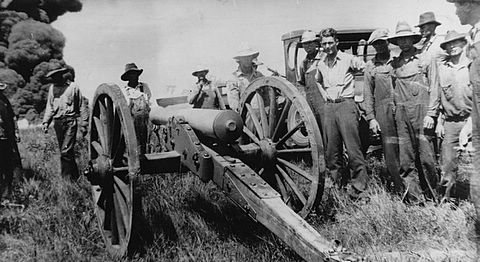
Especially in Midwest oilfields, lightning strikes could ignite derricks, engine houses, and rows of storage tanks. Photo courtesy Butler County History Center & Kansas Oil Museum.
“Lightning had struck the derrick, followed pipe connections into a nearby tank and ignited natural gas, which rises from freshly produced oil. Immediately following this blinding flash, the black smoke began to roll out,” the writer noted in The Tech, a student newspaper established in 1881.
The MIT article, “A Thunder Storm in the Oil Country,” described what happened next:
“Without stopping to watch the burning tank-house and derrick, we followed the oil to see where it would go. By some mischance the mouth of the ravine had been blocked up and the stream turned abruptly and spread out over the alluvial plain,” reported the article.
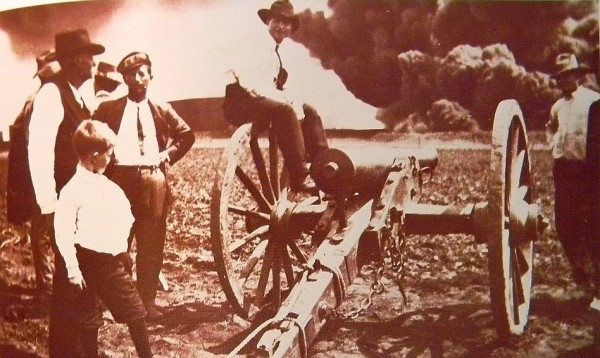
Oilfield operators used muzzle-loading cannons to fire solid shot at the base of burning oil tanks, draining the oil into ditches to extinguish the blaze.
“Here, on a large smooth farm, were six iron storage tanks, about 80 feet in diameter and 25 feet high, each holding 30,000 barrels of oil,” it added, noting the burning oil “spread with fearful rapidity over the level surface” before reaching an oil storage tank.
“Suddenly, with a loud explosion, the heavy plank and iron cover of the tank were thrown into the air, and thick smoke rolled out,” the writer observed.
“Already the news of the fire had been telegraphed to the central office, and all its available men and teams in the neighborhood ordered to the scene,” he added. “The tanks, now heated on the outside as well as inside, foamed and bubbled like an enormous retort, every ejection only serving to increase the heat.”
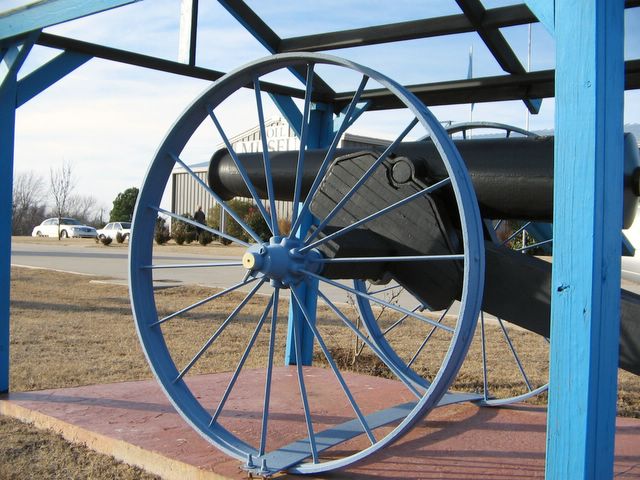
Technological innovations in Oklahoma oilfields helped improve petroleum production worldwide. The oilfield artillery exhibit at the Oklahoma Oil Museum in Seminole educated visitors until the museum closed in 2019. Photo by Bruce Wells.
The area of the fire rapidly extended to two more tanks: “These tanks, surrounded by fire, in turn boiled and foamed, and the heat, even at a distance, was so intense that the workmen could not approach near enough to dig ditches between the remaining tanks and the fire.”
Noting the arrival of “the long looked for cannon,” the reporter noted, adding, “Since the great destruction is caused by the oil becoming overheated, foaming and being projected to a distance, it is usually desirable to let it out of the tank to burn on the ground in thin layers; so small cannons throwing a three-inch solid shot are kept at various stations throughout the region for this purpose.”

The wheeled cannon was placed in position and “aimed at points below the supposed level of the oil and fired,” explained the witness. “The marksmanship at first was not very good, and as many shots glanced off the iron plates as penetrated, but after a while nearly every report was followed by an outburst.”
The oil in three storage tanks was slowly drawn down by this means, “and did not again foam over the top, and the supply to the river being thus cut off, the fire then soon died away.”
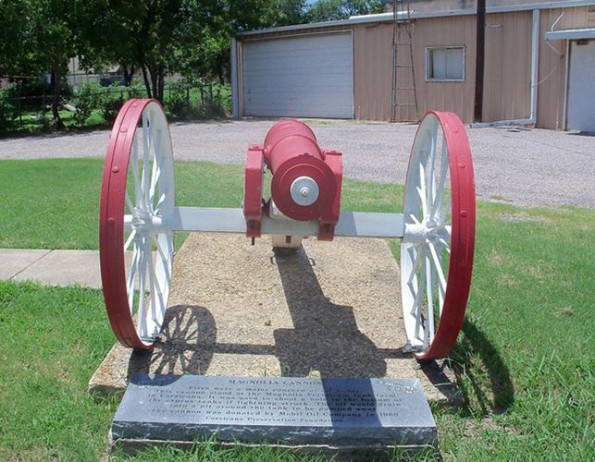
Mobil Oil in 1969 donated to Corsicana, Texas, a cannon that once stood at the Magnolia Petroleum tank farm “to shoot a hole in the bottom of the Cyprus tanks if lightning struck.”
In the end, “it was not till the sixth day from that on which we saw the first tank ignited that the columns of flame and smoke disappeared,” the 1884 MIT article concluded. “During this time 180,000 barrels of crude oil had been consumed, besides the six tanks, costing $10,000 each, destroyed.”
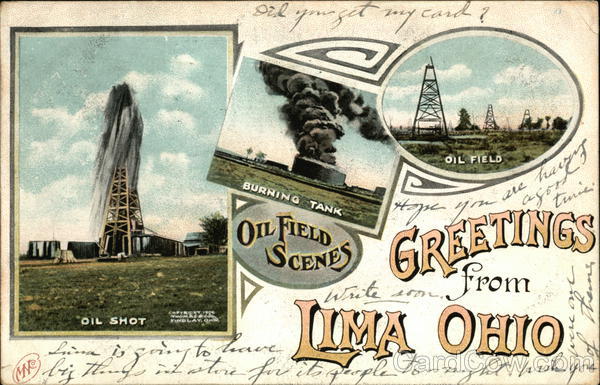
Postcards promoted a community’s petroleum prosperity with images of gushers and burning oil tanks. The Lima oilfield was discovered in 1885. Circa 1910 postcard published by Robbins Bros., Boston.
Visitors to Corsicana, Texas — where oil was discovered while drilling for water in 1894 (see First Texas Oil Boom) — can view an oilfield cannon donated to the city in 1969 by Mobil Oil. The marker notes:
“Fires were a major concern of oil fields. This cannon stood at the Magnolia Petroleum tank farm in Corsicana. It was used to shoot a hole in the bottom of the Cyprus tanks if lightning struck. The oil would drain into a pit around the tank to be pumped away. The cannon was donated by Mobil Oil Company in 1969.”
Another cannon can be found on exhibit in Bartlesville, Oklahoma, near the first Oklahoma oil well, drilled a decade before 1907 statehood. Exhibits at Discovery One Park include an 84-foot cable-tool derrick first erected in 1948 and replaced in 2008.

Still more oilfield artillery also can be found at the Kansas Oil Museum in Butler County. Another educates tourists in Ohio.
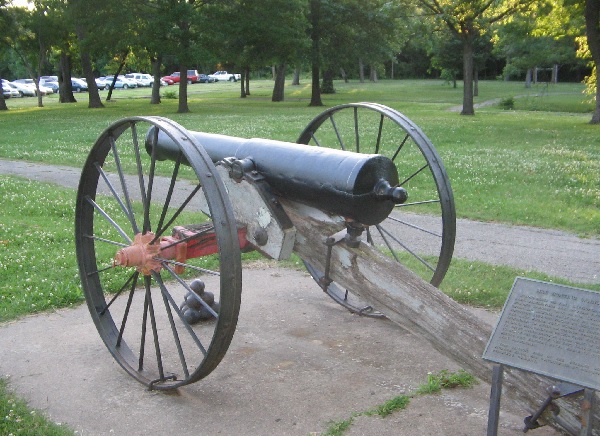
An oilfield cannon exhibit in Discovery One Park in Bartlesville, site of the first significant Oklahoma oilfield discovery of 1897. Photo by Bruce Wells.
The Wood County Historical Center and Museum in Bowling Green displays its “unusual fire extinguisher” among its petroleum-artifact collection. The Buckeye Pipeline Company of Norwood donated the cannon, according to the museum’s director, Kelli King.
“The cannon, cast in North Baltimore (Ohio), was used in the 1920s in Cygnet before being moved to Northwood,” Kelli reported in 2005, adding that more local history can be found in the museum’s documentary “Ohio Crude” and in its exhibit, “Wood County in Motion.”
Museums in nearby Hancock County and Allen County also have petroleum collections from the Buckeye State’s oilfields.
Modern Oilfield Firefighting
When oilfield well control expert and firefighter Paul “Red” Adair died at age 89 in 2004, he left behind a famous “Hell Fighter” legacy. The son of a blacksmith, Adair was born in 1915 in Houston and served with a U.S. Army bomb disposal unit during World War II.
Adair began his career working for Myron M. Kinley, who patented a technology for using charges of high explosives to snuff out well fires. Kinley, whose father had been an oil well shooter in California in the early 1900s, also mentored Asger “Boots” Hansen and “Coots” Mathews of Boots & Coots International Well Control and other firefighters.

Famed oilfield firefighter Paul “Red” Adair of Houston, Texas, in 1964.
In 1959, Adair founded Red Adair Company in Houston and soon developed innovative techniques for “wild well” control. His company would put out more than 2,000 well fires and blowouts worldwide — onshore and offshore.
The Texas firefighter’s skills were tested in 1991 when Adair and his company extinguished 117 oil well fires set in Kuwait by Saddam Hussein’s retreating Iraqi army. Adair was joined by other pioneering well firefighting companies, including Cudd Well Control, founded by Bobby Joe Cudd in 1977.
Russian Anti-Tank Gun
Unable to control a 2020 oil well fire in Siberia, a Russian oil company called in the army. In May, a well operated by the Irkutsk Oil Company in Russia’s Irkutsk region ignited into a geyser of flame. When Irkutsk Oil Company firefighters were unable to extinguish the blaze, the Russian Defense Ministry flew a Rapira MT-12 anti-tank gun to the well site.
The Russian army’s 100-millimeter gun repeatedly fired at the flaming wellhead, “breaking it from the well and allowing crews to seal the well,” according to a June 8, 2020, article in Popular Mechanics.
In 1966, the Soviet Union used a nuclear device to extinguish a natural gas fire — as U.S. scientists experimented with nuclear fracturing of natural gas wells (see Project Gasbuggy tests Nuclear “Fracking”).
Learn more about the earliest oilfield fires and how the petroleum industry fought them with cannons, wind-making machines (including jet engines), and nuclear bombs in Oilfield Firefighting Technologies.
_______________________
Recommended Reading: Trek of the Oil Finders: A History of Exploration for Petroleum (1975); The Prize: The Epic Quest for Oil, Money & Power (1991); Myth, Legend, Reality: Edwin Laurentine Drake and the Early Oil Industry (2009). Your Amazon purchase benefits the American Oil & Gas Historical Society. As an Amazon Associate, AOGHS earns a commission from qualifying purchases.
_______________________
The American Oil & Gas Historical Society (AOGHS) preserves U.S. petroleum history. Please become an AOGHS annual supporter and help maintain this energy education website and expand historical research. For more information, contact bawells@aoghs.org. Copyright © 2025 Bruce A. Wells. All rights reserved.
Citation Information – Article Title: “Oilfield Artillery fights Fires.” Authors: B.A. Wells and K.L. Wells. Website Name: American Oil & Gas Historical Society. URL: https://aoghs.org/technology/oilfield-artillery-fights-fires. Last Updated: December 11, 2025. Original Published Date: September 1, 2005.
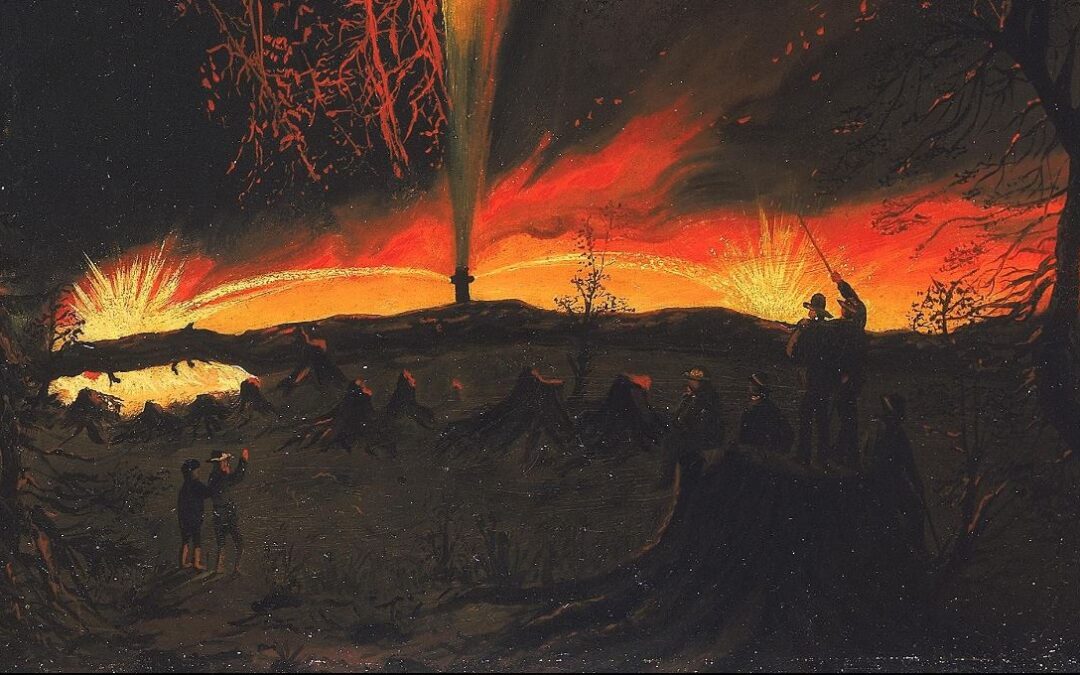
by Bruce Wells | Apr 8, 2025 | Petroleum Art
Pennsylvania oilfield tragedy led to new safety and firefighting technologies — and a work of art.
The danger involved in America’s early petroleum industry was revealed when the first commercial well went up in flames just weeks after finding oil in the summer of 1859 — becoming the first oil well fire. More serious infernos would follow as the young industry’s early technologies struggled to keep up.
While the Pennsylvania oil region grew — and wooden derricks multiplied on hillsides — an 1861 deadly explosion and fire at Rouseville added urgency to the industry’s need for inventing safer ways for drilling wells.
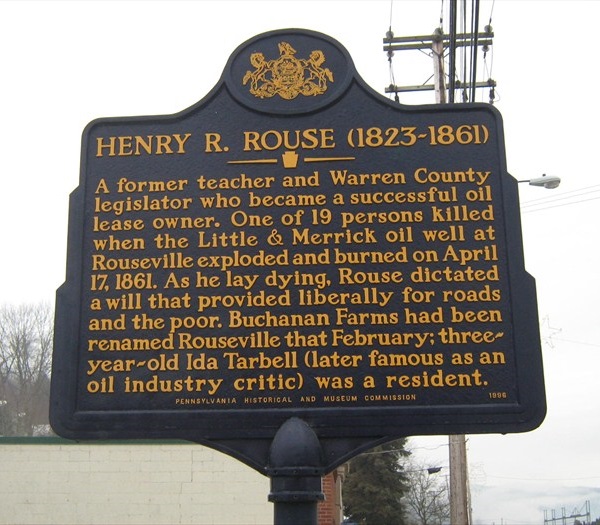
A marker was dedicated in 1996 on State Highway 8 near Rouseville by the Pennsylvania Historical and Museum Commission. Henry Rouse’s reputation made him a respected leader in the early oil industry.
On April 17, 1861, a highly pressurized well’s geyser of oil exploded in flames on the Buchanan Farm at Rouseville, killing the well’s owner and more than a dozen bystanders.
Sometimes called “Oil Well Fire Near Titusville” but more accurately, Rouseville, the early oilfield tragedy was overshadowed by the greater tragedy of the Civil War. Fort Sumter fell on April 13, 1861; Henry Rouse’s oil well exploded four days later.
The Little and Merrick well at Oil Creek, drilled by respected teacher and businessman Henry Rouse, unexpectedly had hit a pressurized oil and natural gas geologic formation at a depth of just 320 feet. Given the limited drilling technologies for controlling the pressure, the well’s production of 3,000 barrels of oil per day was out of control.
The Rouse Estate later reported, “A breathless worker ran up to him, telling him to ‘come quickly’ as they’d ‘hit a big one.’ According to the best accounts of the time, the ‘big one’ was the world’s first legitimate oil gusher. As oil spouted from the ground, Henry Rouse and the others stood by wondering how to control the phenomenon.”
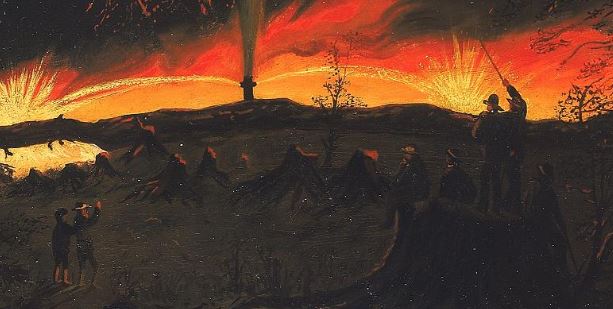
Detail from “Burning Oil Well at Night, near Rouseville, Pennsylvania,” a painting by James Hamilton of the 1861 oil well fire that killed Henry Rouse today is in the collection of the Smithsonian American Art Museum, Washington, D.C.
The towering gusher also had attracted people from town; many had become covered with oil. Perhaps ignited by the steam engine’s boiler, the well suddenly erupted into flames that engulfed Rouse, killing him and 18 others and seriously burning many more.
Historian Michael H. Scruggs of Pennsylvania State University found a dramatic account from an eyewitness, who reported:
“One of the victims it would seem had been standing on these barrels near the well when the explosion occurred; for I first discovered him running over them away from the well. He had hardly reached the outer edge of the field of fire when coming to a vacant space in the tier of barrels from which two or three had been taken, he fell into the vacancy, and there uttering heart-rending shrieks, burned to death with scarcely a dozen feet of impassable heated air between him and his friends.”
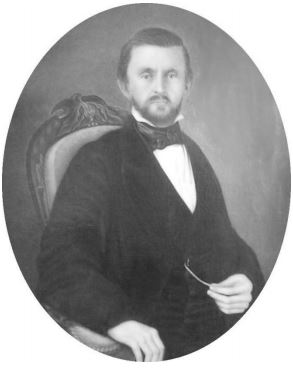
Henry R. Rouse, 1823-1861.
Scruggs noted the 37-year-old Henry Rouse was dragged from the fire severely burned, and expecting the worst, dictated his Last Will and Testament, “to the men surrounding him as they fed him water spoonful by spoonful.”
Engraved on an 1865 marble monument (re-dedicated to Rouse’s memory during a family reunion in 1993) is this tribute:
Henry R. Rouse was the typical poor boy who grew rich through his own efforts and a little luck. He was in the oil business less than 19 months; he made his fortune from it and lost his life because of it. He died bravely, left his wealth wisely, and today is hardly remembered by posterity. — from the Rouse Estate.
The 1865 Atlas of the Oil Regions of Pennsylvania by Frederick W. Beers described this early petroleum industry tragedy in detail:
It was upon this farm (Buchanan) that the terrible calamity of April 1861, occurred, when several persons lost their lives by the burning of a well. The “BURNING WELL” as it has since been called, had been put down to the depth of three hundred and thirty feet, when a strong vein of gas and oil was struck, causing suspension of operations and ejecting a stream from the well as high as the top of the derrick.
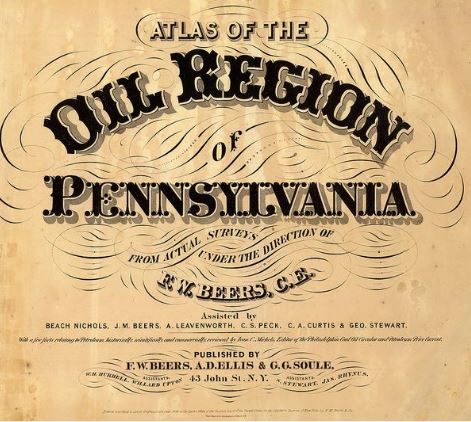
“Atlas of the Oil Regions of Pennsylvania,” published by Frederick W. Beers in 1865.
Large numbers of persons were attracted to the scene, when the gas filling the atmosphere took fire, as is supposed, from a lighted cigar, and a terrible explosion ensued, which was heard for three or four miles. The well continued to burn for upwards of twenty hours destroying the tanks and machinery of several adjacent wells, and several hundred barrels of oil. The scene is represented as terrific beyond comparison.
The well spouted furiously for many hours, and the column of flame extended often two and three hundred feet in height, the valley being shut in, as it were, by a dense and impenetrable canopy of overhanging smoke. Fifteen persons were instantly killed by the explosion of the gas, and thirteen others scarred for life.
Among the persons killed was Mr. Henry R. Rouse, who had then recently become interested in that locality, and after whom Rouseville takes its name. The well continued to flow at the rate of about one thousand barrels per day for a week after the fire, when it suddenly ceased, and has since produced very little oil as a pumping well.
These fires have not been unfrequent, and it is a little remarkable that in every case where wells have been so burned they have never after produced save in very small quantities.
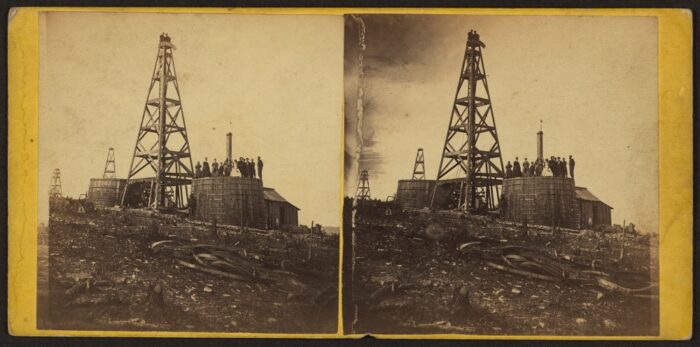
Late 1860s stereograph by William J. Portser showing men and women standing on a storage tank and two men at the top of an oil derrick in Pennsylvania, courtesy Library of Congress.
According to historian Scruggs, the knowledge gained from the 1861 disaster along with other early oilfield accidents brought better exploration and production technologies. The first “Christmas Tree” — an assembly of control valves – was invented by Al Hamills after the 1901 gusher at Spindletop Hill, Texas.
Although the deadly Rouseville well fire caused tragedy and devastation, “the knowledge gained from the well along with other accidents helped pave the way for new and safer ways to drill,” Scruggs wrote in his 2010 article.
“These inventions and precautions have become very important and helpful, especially considering many Pennsylvanians are back on the rigs again, this time drilling for the Marcellus Shale natural gas,” he concluded.
Learn more about another important invention, Harry Cameron’s 1922 blowout preventer in Ending Gushers – BOP.
Oil Well Fire at Night
The tragic Pennsylvania oil well fire was immortalized by Philadelphia artist James Hamilton, a mid-19th century painter whose landscape and maritime works are in collections of the Metropolitan Museum of Art in New York City, the Tate Gallery in London, and the Smithsonian American Art Museum (SAAM) in Washington, D.C.
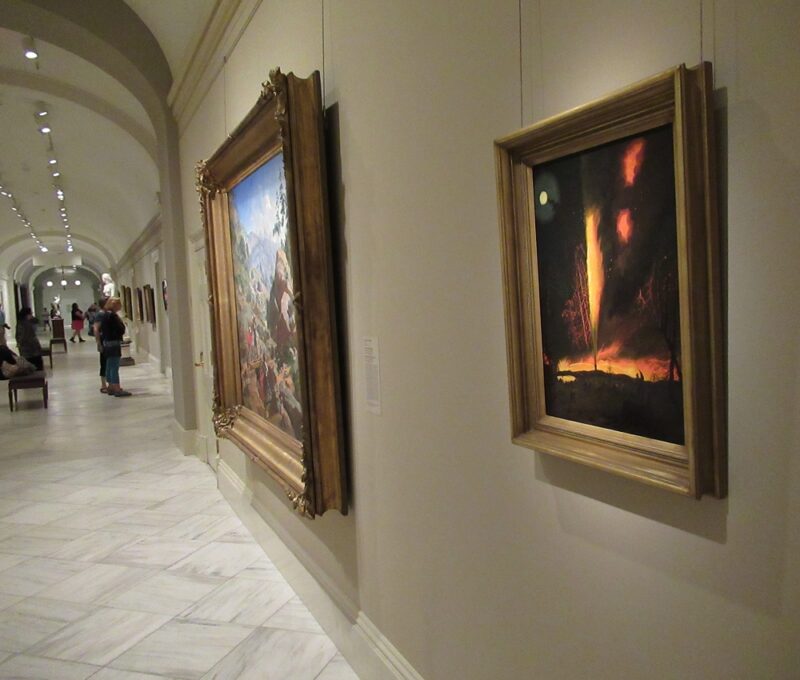
Acquired by the Smithsonian American Art Museum in 2017, artist James Hamilton’s “Burning Oil Well at Night, near Rouseville, Pennsylvania,” was on display in 2018. Photo by Bruce Wells.
In 2017, the Smithsonian museum acquired Hamilton’s “Burning Oil Well at Night, near Rouseville, Pennsylvania,” circa 1861 (oil on paperboard, 22 inches by 16 1⁄8 inches, currently not on view).
“Rouseville, Pennsylvania, lay within a few miles of Titusville and Pithole City, two of the most famous boom towns in Pennsylvania ’s oil fields,” noted the museum’s 2017 description of the painting.

“From 1859 until after the Civil War, new gushers brought investors, cardsharps, saloons, and speculators into these rural settlements. As quickly as they grew, however, the towns collapsed, often from the effects of fires like the one shown here,” noted the Smithsonian’s description.
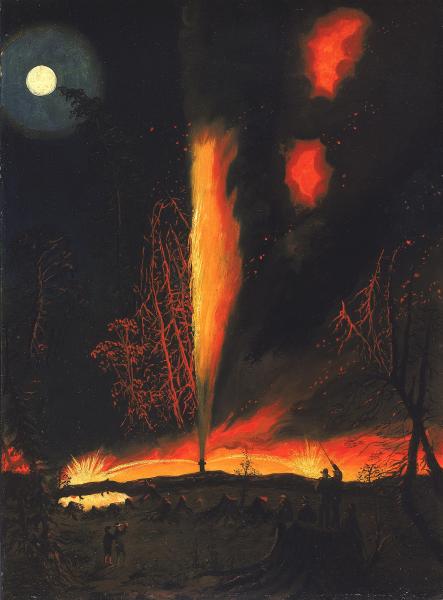
Flames shooting from the wellhead are part of the circa 1861 “Burning Oil Well at Night, near Rouseville, Pennsylvania,” by James Hamilton.
“In the 1860s, American industrialist John D. Rockefeller (1839-1937) was in the thick of this oil boom, maneuvering to establish the Standard Oil Company,” the museum’s painting description added. “Rockefeller’s investments in railroads and refineries would make him one of America’s richest men, long after the wildcatters in the Pennsylvania fields had gone bust.”
Famed journalist and Rockefeller antagonist Ida Tarbell lived in Rouseville as a child.
Following the Civil War, with consumers increasingly demanding kerosene for lamps (and soon gasoline for autos), the search for oilfields moved westward. The young petroleum industry also developed safety and accident prevention methods alongside new oilfield firefighting technologies.
_______________________
Recommended Reading: Trek of the Oil Finders: A History of Exploration for Petroleum (1975); Atlas of the oil region of Pennsylvania (1984); Cherry Run Valley: Plumer, Pithole, and Oil City, Pennsylvania (2000); Warren County (2015). Your Amazon purchase benefits the American Oil & Gas Historical Society. As an Amazon Associate, AOGHS earns a commission from qualifying purchases.
_______________________
The American Oil & Gas Historical Society (AOGHS) preserves U.S. petroleum history. Please become an AOGHS supporter and help maintain this energy education website and expand historical research. For more information, contact bawells@aoghs.org. © 2025 Bruce A. Wells. All rights reserved.
Citation Information: Article Title: “Fatal Oil Well Fire of 1861.” Authors: B.A. Wells and K.L. Wells. Website Name: American Oil & Gas Historical Society. URL: https://aoghs.org/petroleum-pioneers/first-oil-well-fire. Last Updated: April 12, 2025. Original Published Date: April 29, 2013.