by Bruce Wells | Dec 8, 2025 | This Week in Petroleum History
December 8, 1931 – Advanced Blowout Preventer patented –
Improving upon the success of the Cameron Iron Works mechanically operated ram-type blowout preventer, James Abercrombie patented a “Fluid Pressure Operated Blow Out Preventer” designed to operate “instantaneously to prevent a blowout when an emergency arises.”
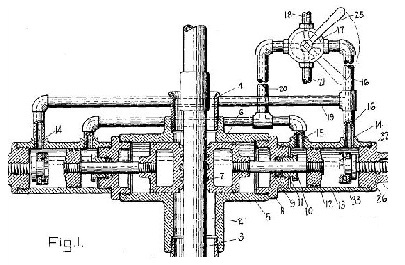
James Abercrombie’s innovative idea used rams – hydrostatic pistons – to close on the drill stem. His improved blowout preventer set a new standard for safe drilling.
Abercrombie and partner Harry Cameron in 1926 had patented the first practical ram-type blowout preventer (BOP), designed in Cameron’s Humble, Texas, machine shop. Abercrombie would receive 30 U.S. patents and become one of Houston’s most generous philanthropists. Cameron International was acquired by Schlumberger in 2016. (more…)
by Bruce Wells | Sep 8, 2025 | This Week in Petroleum History
September 8, 1891- Patent issued for “Flexible Driving Shafts” –
The modern concept of horizontal drilling may have begun with 19th-century patents by John Smalley Campbell of London. After receiving a British patent for his “useful improvements in flexible driving shafts or cables” in 1889, Campbell received a U.S. patent (no. 459,152) for his drilling method.
While Campbell described his directional drilling patent as ideal for dental engines, “the patent also carefully covered use of his flexible shafts at much larger and heavier physical scales,” reported geologist and oil historian Stephen M. Testa in a 2015 article for Pacific Petroleum Geology.
“The modern concept of non-straight line, relatively short-radius drilling dates back at least to September 8, 1891,” Testa added. Directional drilling pioneer H. John Eastman in 1933 applied the technology to save the Conroe oilfield.
September 10, 1969 – Second Nuclear Fracturing Test
A 40-kiloton nuclear device was detonated about eight miles southeast of present-day Parachute, in Garfield County, Colorado. Project Rulison was the second of three natural-gas-reservoir stimulation tests that were part of Operation Plowshare, a government program to study uses of nuclear explosives for peaceful purposes.
The first nuclear fracturing test, Project Gasbuggy, detonated a 29-kiloton device in a New Mexico well in December 1967. The third unconventional test to increase production was Project Rio Blanco, a 1973 detonation in a Rio Blanco County, Colorado, natural gas well. (more…)