Oil Boom at Pithole Creek

Rise and fall of an infamous Pennsylvania boomtown. 


As the Civil War ended, oil discoveries at Pithole Creek in Pennsylvania created a headline-making boomtown for the young petroleum industry. As wells reached deeper into geological formations, the first gushers arrived — adding to “black gold” fever sweeping the country.

America’s oil production began in 1859 when Edwin L. Drake completed the first commercial well at Titusville, Pennsylvania. Drilled near natural oil seeps, his oilfield discovery at a depth of 69.5 feet led to a rush of exploration in the remote Allegheny River Valley.
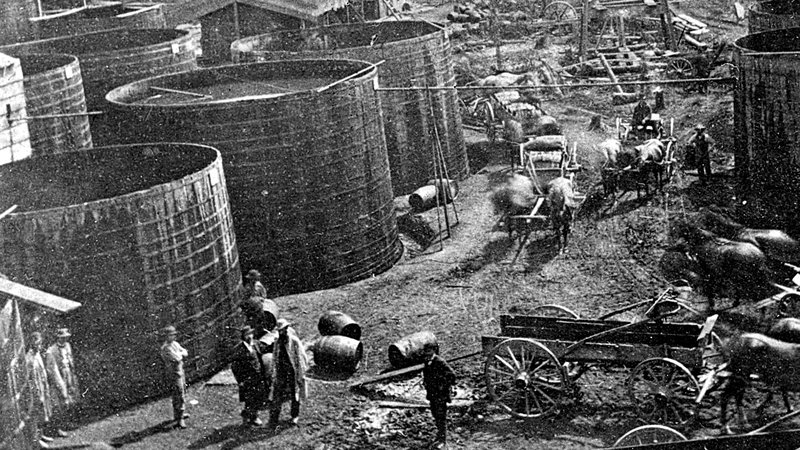
Rare photo of Pithole creek giant wooden oil storage tanks circa 1865.

The new petroleum industry’s transportation infrastructure struggled as oil tanks crowded Pithole, Pennsylvania. In 1865, the first oil pipeline linked an oil well to a railroad station about five miles away. Photo by the “Oil Creek Artist,” John Mather, courtesy Drake Well Museum.

In 1864, businessman Ian Frazier found success along Cherry Creek, another small watercourse with signs of oil. After making a quick $250,000, Frazier looked for another opportunity for providing oil to new Pittsburgh refineries making kerosene for lamps.

Frazier hired a diviner to search along Pithole Creek, which smelled like “sulfur and brimstone,” according to historian Douglas Wayne Houck. “He went to the creek and followed the diviner around until the forked twig dipped, pointing to a specific spot on the ground,” Houck noted in 2014.

Although exploration techniques would improve, the science of petroleum geology was still in the future. Oil companies (and soon natural gas) had already begun drilling the “dry holes.”

Gusher at Pithole Creek

The first well of Ian Frazier’s United States Oil Company found no oil.  A second well — drilled using the same steam-powered, cable-tool technology — erupted spectacularly on January 7, 1865, producing 650 barrels of oil a day. The Frazier well, the first U.S. oil gusher, brought a flood of drillers and speculators to Pithole Creek.

Subscribe to Our Free Newsletter link.

Two more wells erupted black geysers on January 17 and January 19, each flowing at about 800 barrels of oil a day (the invention of a practical blowout preventer was still half a century away). United States Oil Company subdivided its property and began selling lots for $3,000 per half-acre plot.

The Titusville Herald proclaimed Pithole as having “probably the most productive wells in the oil region of Pennsylvania, Houck explained in his Energy & Light in Nineteenth-Century Western New York. Fortunes were being made and lost in the oil regions (see the Legend of “Coal Oil Johnny”).

As the news spread through Venango County, “everyone came to the Pithole area to try their luck,” noted one reporter. Many were Confederate and Union war veterans. And as more successful wells came in, about 3,000 teamsters rushed to Pithole to haul out the rapidly multiplying barrels of oil

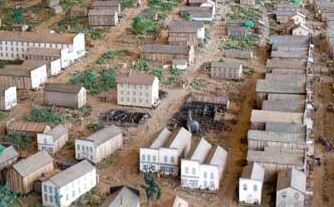
A diorama recreation of Pithole, Pennsylvania, hotels and businesses and muddy streets circa late 1860s.

Managed by the Drake Well Museum, the Pithole Visitors Center includes a diorama of the vanished town. Photo by Bruce Wells.

There were many reasons behind the Pithole oil boom, including a flood of paper money at the end of the Civil War. Returning Union veterans had currency and were eager to invest — especially after reading newspaper articles about oil gushers and boomtowns. Thousands of veterans also wanted jobs after long months on army pay.

By May 1865, the town was home to 57 hotels, many shops, and its own daily newspaper. It had the third busiest post office in Pennsylvania — handling 5,500 pieces of mail a day.

Pithole’s Lady Macbeth

In December 1865, Shakespearean tragedienne Miss Eloise Bridges appeared as Lady Macbeth in America’s first famously notorious oil boomtown.
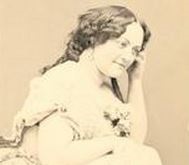
Actress Eloise Bridges in 1865.

Shakespearean tragedienne Eloise Bridges appeared on the Pithole stage in 1865.

Bridges appeared at Murphy’s Theater, the biggest building in a town of more than 30,000 teamsters, coopers, lease-traders, roughnecks, and merchants. Three stories high, the building had 1,100 seats, a 40-foot stage, an orchestra, and chandelier lighting by Tiffany.

Support the American Oil & Gas Historical Society

Bridges was the acclaimed darling of the Pithole stage. Eight months after she departed for new engagements in Ohio, the oilfield at Pithole ran dry; the most famous U.S. boomtown collapsed into empty streets and abandoned buildings.

Pennsylvania oil region visitors today walk the grassy streets of the first oil boom’s ghost town.

First Oil Pipeline

As Pithole oil tanks overflowed (and tank fires from accidents and lightning strikes increased), petroleum shipper Samuel Van Syckel conceived an infrastructure solution that became an engineering milestone.

In 1865, his newly formed Oil Transportation Association put into service a two-inch iron line linking the Frazier well to the Miller Farm Oil Creek Railroad Station, about five miles away.
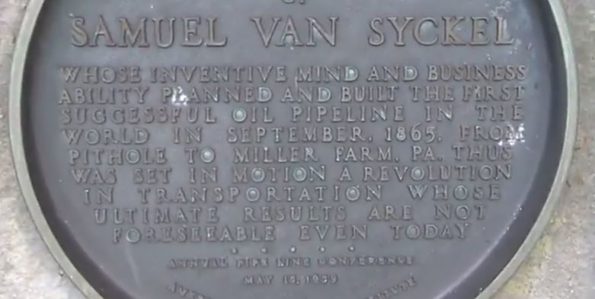
Samuel Van Syckel plaque on the grounds of the Drake Well Museum

The American Petroleum Institute in 1959 dedicated a plaque on the grounds of the Drake Well Museum as part of the U.S. oil centennial.

“The day that the Van Syckel pipe-line began to run oil a revolution began in the business. After the Drake well it is the most important event in the history of the Oil Regions,” declared Ida Tarbell about the technology in her 1904 book, History of the Standard Oil Company.

Widely known as a known magazine journalist and a Lincoln biographer, Tarbell grew up in the area. Her family lived in Rouseville in 1861 when a gushing well erupted into flames — an early oilfield tragedy.

Registration link for AOGHS email newsletter.

With 15-foot welded joints and three 10-horsepower Reed and Cogswell steam pumps, the pipeline transported 80 barrels of oil per hour — the equivalent of 300 teamster wagons working for 10 hours. Convinced their livelihood was threatened, teamsters attempted to sabotage the oil pipeline until armed guards intervened.

Unfortunately for Van Syckel, Pithole oil storage tanks frequently caught fire even as the Frazier well production began to decline. Other wells were beginning to run dry when, in 1866, fires spread out of control and burned 30 buildings, 30 oil wells, and 20,000 barrels of oil. 

Pithole City

“Pithole’s days were numbered,” concluded historian Houck about the fire, which was documented by early oilfield photographer John Mather. “Buildings were taken down and carted off. A few people hung around until 1867.”
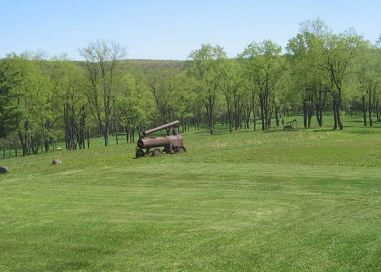
A park and oilfield boiler center at Pithole Creek, PA.

Visitors walk the grassy paths of Pithole’s former streets and see artifacts, including antique steam boilers. Volunteers “mow the streets.” Photo by Bruce Wells.

From beginning to end, America’s famous oil boomtown had lasted about 500 days. Pithole was added to the National Register of Historic Places on March 20, 1973.

A visitors center added in 1975 contains exhibits, including a scale model of the city at its peak and a small theater. Volunteers “mow the streets” on the hillside so that tourists can stroll where the petroleum boomtown once flourished.

“Pithole City is known in the Pennsylvania oil region as the oil boomtown that vanished as quickly as it appeared,” notes the Drake Well Museum, which manages Historic Pithole City. Among the region’s earliest and most infamous investors was John Wilkes Booth (see the Dramatic Oil Company).

Oil Town Aero Views

During the late 19th century, “bird’s-eye views” became a widely popular way to map U.S. cities and towns. Cartographer Thaddeus Mortimer Fowler created many of the best panoramic maps that he also called “aero views.”

Petroleum history is important. Support link for AOGHS.

The wealthy Pennsylvania oil regions attracted the attention of Fowler, who in 1885 moved his family to Morrisville, where he worked for the next 25 years. 
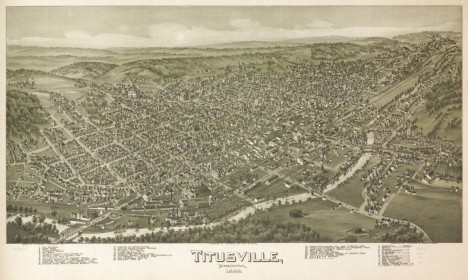
An 1896 "aero view" map of Titusville, Pennsylvania, by Thaddeus M. Fowler, courtesy Library of Congress.

An 1896 Pennsylvania “aero view” map by Thaddeus M. Fowler, courtesy Library of Congress.

Fowler drew maps of Titusville, Oil City, and many petroleum-related boomtowns in West Virginia, Ohio — and Texas, where he created dozens of views of cities from 1890 to 1891.

But by far, most of the Fowler maps feature Pennsylvania cities between 1872 and 1922. There are 250 examples of his work in the collection of the Library of Congress. Learn more in Oil Town “Aero Views.

_______________________

Recommended Reading:  Energy & Light in Nineteenth-Century Western New York (2014); Cherry Run Valley: Plumer, Pithole, and Oil City, Pennsylvania, Images of America (2000); The Legend of Coal Oil Johnny (2007); Myth, Legend, Reality: Edwin Laurentine Drake and the Early Oil Industry (2009). Your Amazon purchase benefits the American Oil & Gas Historical Society. As an Amazon Associate, AOGHS earns a commission from qualifying purchases.

_______________________

The American Oil & Gas Historical Society (AOGHS) preserves U.S. petroleum history. Please become an AOGHS annual supporter and help maintain this energy education website and expand historical research. For more information, contact bawells@aoghs.org. © 2025 Bruce A. Wells. All rights reserved.

Citation Information – Article Title: “Oil Boom at Pithole Creek.” Authors: B.A. Wells and K.L. Wells. Website Name: American Oil & Gas Historical Society. URL: https://aoghs.org/petroleum-pioneers/pithole-creek/. Last Updated: November 29, 2025. Original Published Date: March 15, 2014.

This Week in Petroleum History: October 6 – 12

October 6, 1886 – Natural Gas fuels Glass Manufacturing –

A 900-foot-deep natural gas well in a cornfield near Kokomo, Indiana, led to the establishment of the Indiana Natural Gas Company, and in 1888, the Opalescent Glass Works, which has been in continuous operation since. The state’s first natural gas well was completed in 1867, seeking oil reserves (see Indiana Natural Gas Boom).

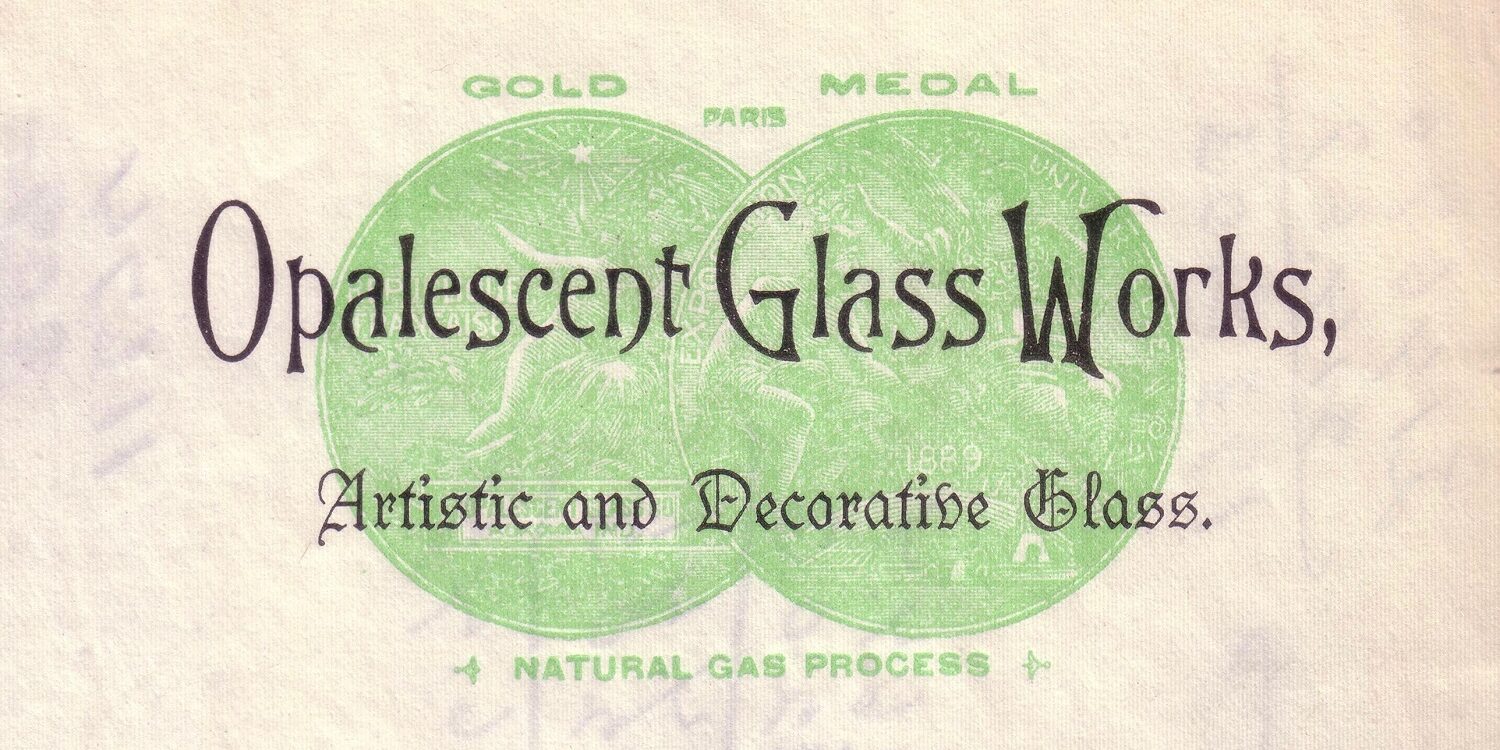
Opalescent Glass Works promotion card for its gold medal at the 1889 Exposition Universelle in Paris for its "natural gas process" glass.

Opalescent Glass Works won a gold medal at the 1889 Exposition Universelle in Paris for its “natural gas process” glass. Photo courtesy Kokomo Opalescent Glass.

Opalescent Glass Works, today Kokomo Opalescent Glass, almost went bankrupt when natural gas supplies dwindled, but in 1893 it recovered by selling electric insulators to Edison General Electric Company — and  thousands of pounds of stained glass to Tiffany studios in New York City.

October 6, 1957 – Society of Petroleum Engineers established

The first board of directors meeting of the Society of Petroleum Engineers (SPE) established the professional society in an expansion of the American Institute of Mining, Metallurgical and Petroleum Engineers (AIME), which had created a Petroleum Division in 1922.

the SPE logo of world globes.

An American Institute of Mining Engineers program led to the Society of Petroleum Engineers.

AIME began in 1871, when a small group of Pennsylvania mining engineers sought to “preserve their collective knowledge and experiences for the benefit of future engineers.” SPE has grown into an independent, nonprofit global society with 132,000 members in 146 countries.

October 7, 1859 – First U.S. Oil Well catches Fire

The wooden derrick and engine house of America’s first oil well erupted in flames along Oil Creek at Titusville, Pennsylvania. The well had been completed the previous August by Edwin L. Drake for George Bissell and the Seneca Oil Company of New Haven, Connecticut. Working with driller William “Uncle Billy” Smith, Drake used steam-powered cable-tool technology.

The first U.S. oil well fire began when Uncle Billy inspected a vat of oil with an open lamp. When the lamp’s flame set gases alight, the conflagration consumed the derrick, the stored oil, and the driller’s home. Drake and Seneca Oil Company would quickly rebuild at the already famous well site.

Learn more in First Oil Well Fire.

Petroleum history is important. Support link for AOGHS.

October 7, 2014 – 200th Anniversary of Ohio Oil Discovery

The Noble County Historical Society of Caldwell, Ohio, hosted a 200th anniversary festival and park dedication celebrating a brine well drilled with a spring pole that produced oil. The 1814 well can be found at Thorla McKee Park, named for Silas Thorla and Robert McKee, the entrepreneurs who established the local salt works, according to researcher Dave Baker in “Early Marietta.”

In 2015, Baker reported the historic well site included the remains of its original sycamore log casing beneath a replica springpole. Thoria and McKee separated the oil from the salt water by soaking it up with blankets before bottling it to sell as a medicinal potion. The remaining brine was boiled to extract the salt. In 1992, the Noble County Department of Tourism and the Ohio Historical Society dedicated a historic marker near the Caldwell site. Ohio’s first well drilled exclusively for oil was completed near Macksburg in the autumn of 1860.

October 8, 1915 – Elk Basin oilfield discovered in Wyoming

An exploratory well drilled in a remote Wyoming valley opened the giant Elk Basin oilfield. Completed by the Midwest Refining Company near the Montana border, the wildcat well produced 150 barrels of high-grade “light oil” a day. The oil needed little refining to provide quality lubricants.

Elk Basin Field with oil gusher circa 1917.

“Gusher coming in, south rim of the Elk Basin field, 1917.” Photo courtesy American Heritage Center, University of Wyoming.

Geologist George Ketchum first recognized the potential of the basin as a source of oil deposits. Ketchum had explored the remote area in 1906 with C.A. Fisher while farming near Cowley, Wyoming. The Elk Basin extended from Carbon County, Montana, into northeastern Park County, Wyoming.

Fisher was the first geologist to map sections of the Bighorn Basin southeast of Cody, Wyoming, where oil seeps had been found as early as 1883. The Wyoming oilfield discovery in unproven territory attracted new ventures like Elk Basin United Oil Company, investors, and oilfield service companies.

Learn more in First Wyoming Oil Wells.

Subscribe to Our Newsletter link to sign-up form.

October 8, 1923 – First International Petroleum Exposition and Congress

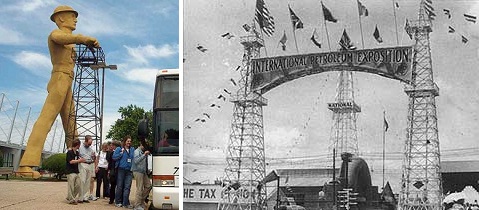
Five thousand visitors attended the rainy opening day of the first International Petroleum Exposition and Congress in downtown Tulsa, an event that would return for almost six decades.

A bus of tourists in 2013 visited the 76-foot-tall Golden Driller in Tulsa.

Although still a tourist attraction, the 76-foot-tall Golden Driller arrived decades after Tulsa’s first International Petroleum Exposition in 1923.

With annual attendance growing to more than 120,000, Mid-Continent Supply Company of Fort Worth introduced the original Golden Driller of Tulsa at the expo in 1953. Economic shocks beginning with the 1973 OPEC oil embargo depressed the industry, and after 57 years, the International Petroleum Exposition ended in 1979.

October 9, 1999 – Converted Offshore Platform launches Rocket

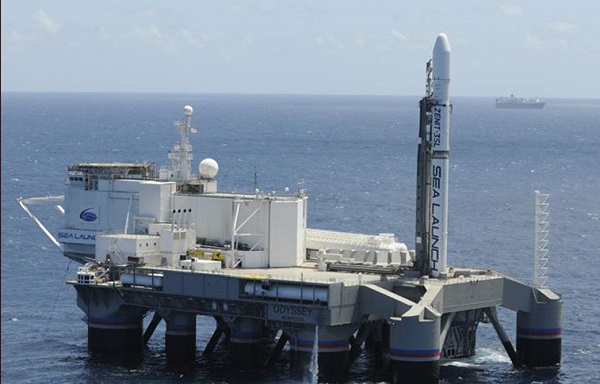
Sea Launch, a Boeing-led consortium of companies from the United States, Russia, Ukraine, and Norway, launched its first commercial rocket using the Ocean Odyssey, a modified semi-submersible drilling platform. After a demonstration flight in March, a Russian Zenit-3SL rocket carried a DirecTV satellite to geostationary orbit.

Ocean Odyssey, a self-propelled, semi-submersible drilling platform, converted into a rocket launcher.

Ocean Odyssey, a modified semi-submersible drilling platform, became the world’s first floating equatorial launch pad in 1999. Photo courtesy Sea Launch.

In 1988, the former drilling platform had been used by Atlantic Richfield Company (ARCO) for North Sea explorations. The Ocean Odyssey made 36 more rocket launches until 2014, when the consortium ended after Russia illegally annexed Ukraine’s Crimean peninsula.

Learn more in Offshore Rocket Launcher.

Support the American Oil & Gas Historical Society

October 10, 1865 – Oil Pipeline constructed in Pennsylvania

A two-inch iron pipeline began transporting oil five miles through hilly terrain from a well at booming Pithole, Pennsylvania, to the Miller Farm Railroad Station at Oil Creek. With their livelihoods threatened, teamsters attempted to sabotage the pipeline until armed guards intervened. A second oil pipeline would begin operating in December.

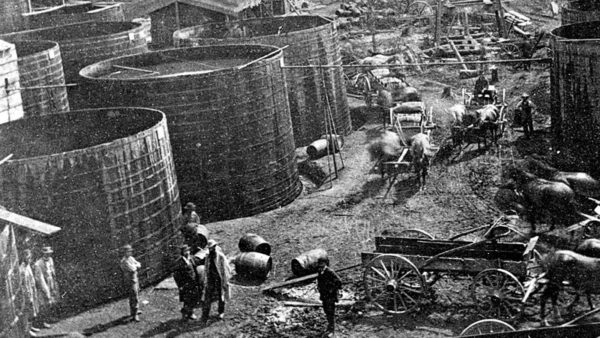
Large wooden oil tanks and 42-gallon barrels with nearby teamsters.

Oil tanks at the boom town of Pithole, Pennsylvania, where Samuel Van Syckel built a five-mile pipeline in 1865. Photo courtesy Drake Well Museum.

Built by Samuel Van Syckel, who had formed the Oil Transportation Association, the pipeline used 15-foot welded joints. Three 10-horsepower Reed and Cogswell steam pumps pushed the oil at a rate of 81 barrels per hour. With up to 2,000 barrels of oil arriving daily at the terminal, more storage tanks were soon added. The pipeline transported the equivalent of 300 teamster wagons working for 10 hours.

“The day that the Van Syckel pipeline began to run oil a revolution began in the business,” proclaimed Ida Tarbell in her 1904 History of the Standard Oil Company. “After the Drake well, it is the most important event in the history of the Oil Regions.”

_______________________

Recommended Reading: The Extraction State, A History of Natural Gas in America (2021); Myth, Legend, Reality: Edwin Laurentine Drake and the Early Oil Industry (2009); Where it All Began: The story of the people and places where the oil & gas industry began: West Virginia and southeastern Ohio (1994); Black Gold, Patterns in the Development of Wyoming’s Oil Industry (1997); Tulsa Where the Streets Were Paved With Gold – Images of America (2000); Offshore Pioneers: Brown & Root and the History of Offshore Oil and Gas (1997); Western Pennsylvania’s Oil Heritage (2008); Oil and Gas Pipeline Fundamentals (1993); Arizona Rocks & Minerals: A Field Guide to the Grand Canyon State (2010). Your Amazon purchase benefits the American Oil & Gas Historical Society. As an Amazon Associate, AOGHS earns a commission from qualifying purchases.

_______________________

The American Oil & Gas Historical Society (AOGHS) preserves U.S. petroleum history. Please become an AOGHS annual supporter and help maintain this energy education website and expand historical research. For more information, contact bawells@aoghs.org. Copyright © 2025 Bruce A. Wells. All rights reserved.

Pin It on Pinterest