This Week in Petroleum History: October 6 – 12
October 6, 1886 – Natural Gas fuels Glass Manufacturing –
A 900-foot-deep natural gas well in a cornfield near Kokomo, Indiana, led to the establishment of the Indiana Natural Gas Company, and in 1888, the Opalescent Glass Works, which has been in continuous operation since. The state’s first natural gas well was completed in 1867, seeking oil reserves (see Indiana Natural Gas Boom).
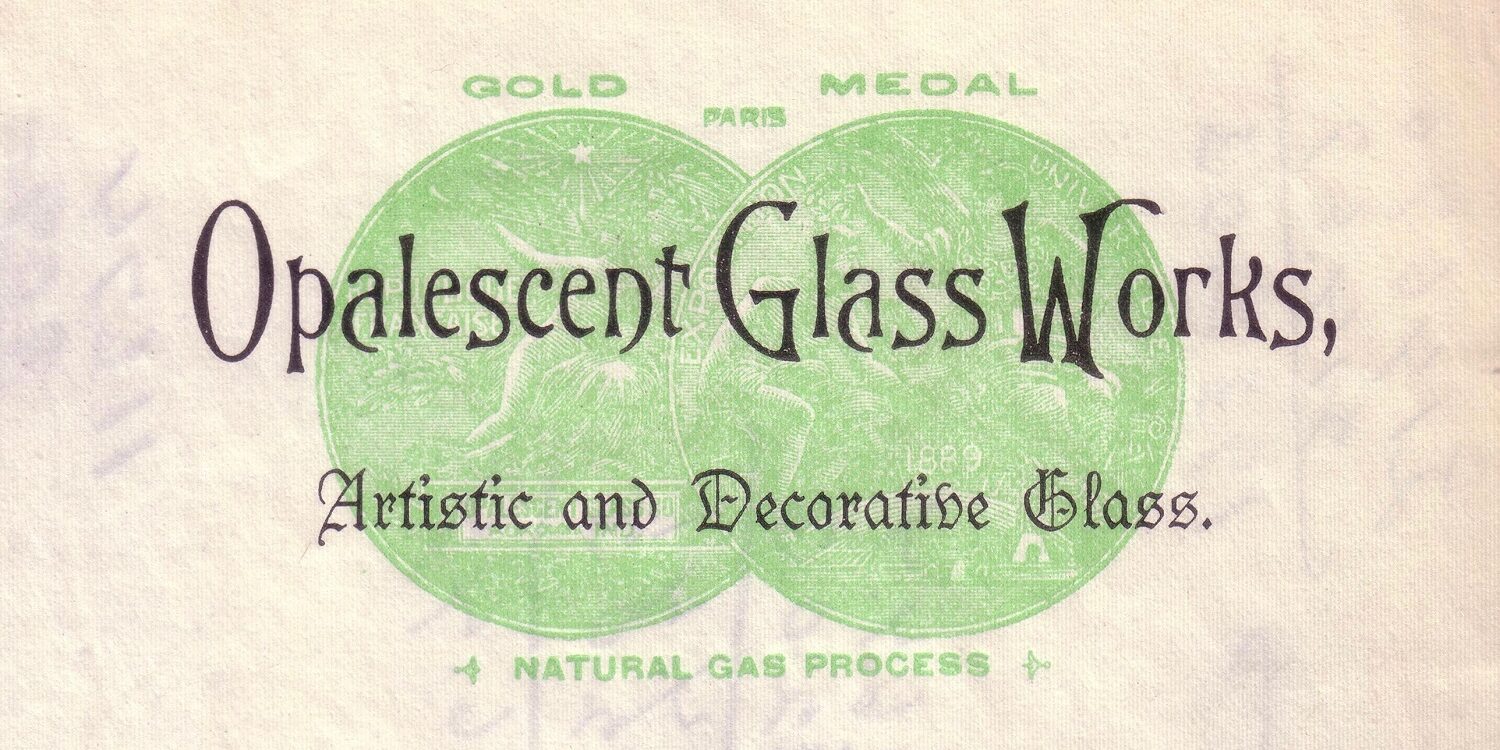
Opalescent Glass Works won a gold medal at the 1889 Exposition Universelle in Paris for its “natural gas process” glass. Photo courtesy Kokomo Opalescent Glass.
Opalescent Glass Works, today Kokomo Opalescent Glass, almost went bankrupt when natural gas supplies dwindled, but in 1893 it recovered by selling electric insulators to Edison General Electric Company — and thousands of pounds of stained glass to Tiffany studios in New York City.
October 6, 1957 – Society of Petroleum Engineers established
The first board of directors meeting of the Society of Petroleum Engineers (SPE) established the professional society in an expansion of the American Institute of Mining, Metallurgical and Petroleum Engineers (AIME), which had created a Petroleum Division in 1922.

An American Institute of Mining Engineers program led to the Society of Petroleum Engineers.
AIME began in 1871, when a small group of Pennsylvania mining engineers sought to “preserve their collective knowledge and experiences for the benefit of future engineers.” SPE has grown into an independent, nonprofit global society with 132,000 members in 146 countries.
October 7, 1859 – First U.S. Oil Well catches Fire
The wooden derrick and engine house of America’s first oil well erupted in flames along Oil Creek at Titusville, Pennsylvania. The well had been completed the previous August by Edwin L. Drake for George Bissell and the Seneca Oil Company of New Haven, Connecticut. Working with driller William “Uncle Billy” Smith, Drake used steam-powered cable-tool technology.
The first U.S. oil well fire began when Uncle Billy inspected a vat of oil with an open lamp. When the lamp’s flame set gases alight, the conflagration consumed the derrick, the stored oil, and the driller’s home. Drake and Seneca Oil Company would quickly rebuild at the already famous well site.
Learn more in First Oil Well Fire.

October 7, 2014 – 200th Anniversary of Ohio Oil Discovery
The Noble County Historical Society of Caldwell, Ohio, hosted a 200th anniversary festival and park dedication celebrating a brine well drilled with a spring pole that produced oil. The 1814 well can be found at Thorla McKee Park, named for Silas Thorla and Robert McKee, the entrepreneurs who established the local salt works, according to researcher Dave Baker in “Early Marietta.”
In 2015, Baker reported the historic well site included the remains of its original sycamore log casing beneath a replica springpole. Thoria and McKee separated the oil from the salt water by soaking it up with blankets before bottling it to sell as a medicinal potion. The remaining brine was boiled to extract the salt. In 1992, the Noble County Department of Tourism and the Ohio Historical Society dedicated a historic marker near the Caldwell site. Ohio’s first well drilled exclusively for oil was completed near Macksburg in the autumn of 1860.
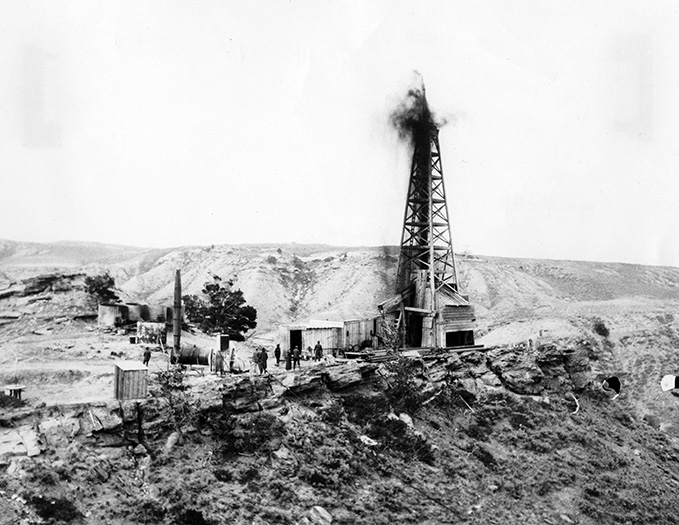
October 8, 1915 – Elk Basin oilfield discovered in Wyoming
An exploratory well drilled in a remote Wyoming valley opened the giant Elk Basin oilfield. Completed by the Midwest Refining Company near the Montana border, the wildcat well produced 150 barrels of high-grade “light oil” a day. The oil needed little refining to provide quality lubricants.

“Gusher coming in, south rim of the Elk Basin field, 1917.” Photo courtesy American Heritage Center, University of Wyoming.
Geologist George Ketchum first recognized the potential of the basin as a source of oil deposits. Ketchum had explored the remote area in 1906 with C.A. Fisher while farming near Cowley, Wyoming. The Elk Basin extended from Carbon County, Montana, into northeastern Park County, Wyoming.
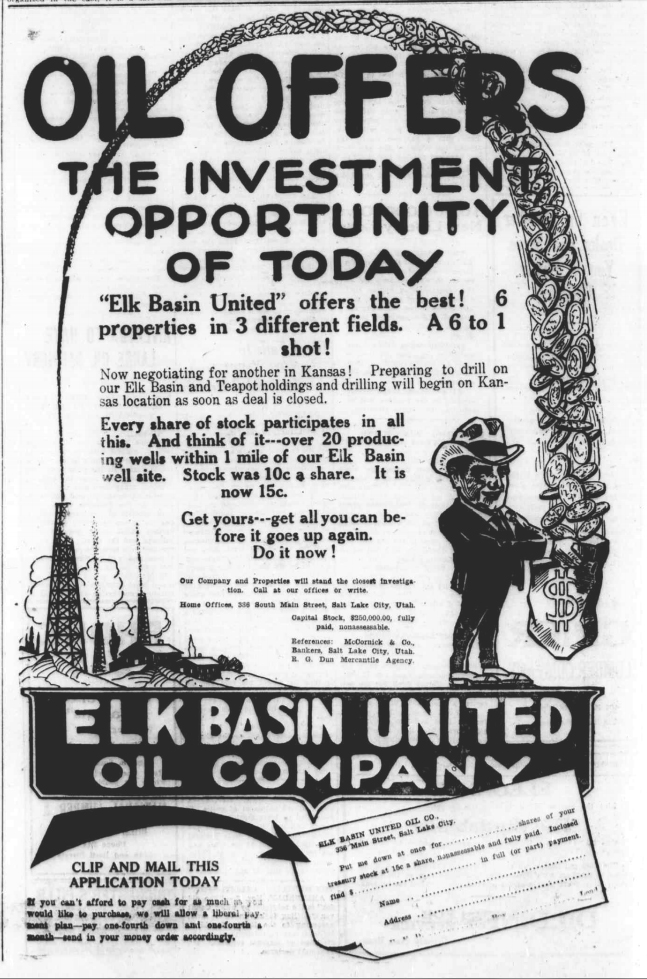
Fisher was the first geologist to map sections of the Bighorn Basin southeast of Cody, Wyoming, where oil seeps had been found as early as 1883. The Wyoming oilfield discovery in unproven territory attracted new ventures like Elk Basin United Oil Company, investors, and oilfield service companies.
Learn more in First Wyoming Oil Wells.
October 8, 1923 – First International Petroleum Exposition and Congress
Five thousand visitors attended the rainy opening day of the first International Petroleum Exposition and Congress in downtown Tulsa, an event that would return for almost six decades.
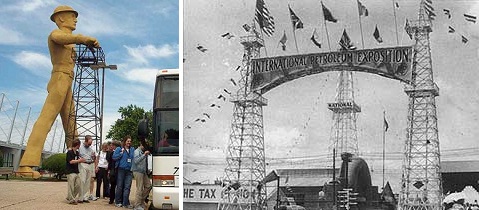
Although still a tourist attraction, the 76-foot-tall Golden Driller arrived decades after Tulsa’s first International Petroleum Exposition in 1923.
With annual attendance growing to more than 120,000, Mid-Continent Supply Company of Fort Worth introduced the original Golden Driller of Tulsa at the expo in 1953. Economic shocks beginning with the 1973 OPEC oil embargo depressed the industry, and after 57 years, the International Petroleum Exposition ended in 1979.
October 9, 1999 – Converted Offshore Platform launches Rocket
Sea Launch, a Boeing-led consortium of companies from the United States, Russia, Ukraine, and Norway, launched its first commercial rocket using the Ocean Odyssey, a modified semi-submersible drilling platform. After a demonstration flight in March, a Russian Zenit-3SL rocket carried a DirecTV satellite to geostationary orbit.
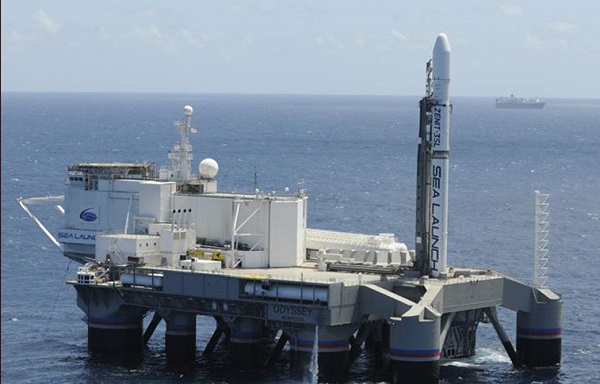
Ocean Odyssey, a modified semi-submersible drilling platform, became the world’s first floating equatorial launch pad in 1999. Photo courtesy Sea Launch.
In 1988, the former drilling platform had been used by Atlantic Richfield Company (ARCO) for North Sea explorations. The Ocean Odyssey made 36 more rocket launches until 2014, when the consortium ended after Russia illegally annexed Ukraine’s Crimean peninsula.
Learn more in Offshore Rocket Launcher.

October 10, 1865 – Oil Pipeline constructed in Pennsylvania
A two-inch iron pipeline began transporting oil five miles through hilly terrain from a well at booming Pithole, Pennsylvania, to the Miller Farm Railroad Station at Oil Creek. With their livelihoods threatened, teamsters attempted to sabotage the pipeline until armed guards intervened. A second oil pipeline would begin operating in December.
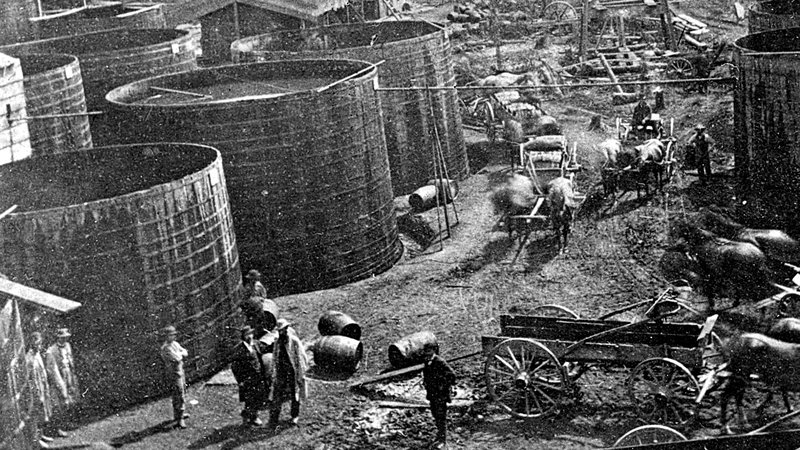
Oil tanks at the boom town of Pithole, Pennsylvania, where Samuel Van Syckel built a five-mile pipeline in 1865. Photo courtesy Drake Well Museum.
Built by Samuel Van Syckel, who had formed the Oil Transportation Association, the pipeline used 15-foot welded joints. Three 10-horsepower Reed and Cogswell steam pumps pushed the oil at a rate of 81 barrels per hour. With up to 2,000 barrels of oil arriving daily at the terminal, more storage tanks were soon added. The pipeline transported the equivalent of 300 teamster wagons working for 10 hours.
“The day that the Van Syckel pipeline began to run oil a revolution began in the business,” proclaimed Ida Tarbell in her 1904 History of the Standard Oil Company. “After the Drake well, it is the most important event in the history of the Oil Regions.”
_______________________
Recommended Reading: The Extraction State, A History of Natural Gas in America (2021); Myth, Legend, Reality: Edwin Laurentine Drake and the Early Oil Industry


_______________________
The American Oil & Gas Historical Society (AOGHS) preserves U.S. petroleum history. Please become an AOGHS annual supporter and help maintain this energy education website and expand historical research. For more information, contact bawells@aoghs.org. Copyright © 2025 Bruce A. Wells. All rights reserved.