First Louisiana Oil Wells

Acadia Parish oil seeps inspired 1901 Jennings oilfield discovery.


The first Louisiana oil well in 1901 revealed the giant Jennings field and launched the Pelican State’s petroleum industry. By 1911, offshore exploration included barges, floating pile drivers, and drilling platforms on Caddo Lake. 

Nine months after the 1901 “Lucas Gusher” at Spindletop, Texas, oil erupted 90 miles to the east in Louisiana. W. Scott Heywood — already a successful wildcatter at Spindletop — drilled the discovery well of the Jennings oilfield. His September 21, 1901, gusher initially produced 7,000 barrels of oil a day.

Louisiana’s first commercial oil well, the Jules Clements No. 1, was completed on the Clements farm, about seven miles northeast of the small town of Jennings.
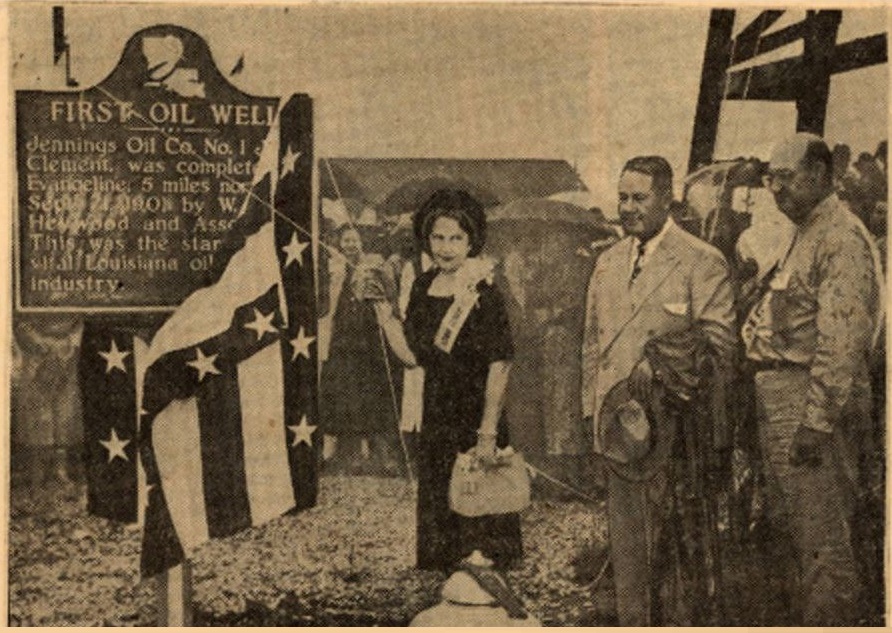
The widow of Louisiana's oil discoverer, the late W. Scott Heywood," unveiled an historical marker in 1961.

Mrs. Scott Heywood, “the widow of Louisiana’s oil discoverer, the late W. Scott Heywood,” unveiled a historical marker on September 23, 1951, as part of the Louisiana Golden Oil Jubilee. Times Picayune (New Orleans) image courtesy Calcasieu Parish Public Library.

Local investors earlier had formed the Jennings Oil Company and hired Scott, who recognized that natural gas seeps found nearby were nearly identical to the conditions observed at Spindletop. Scott would insist on drilling deeper than many investors thought wise.
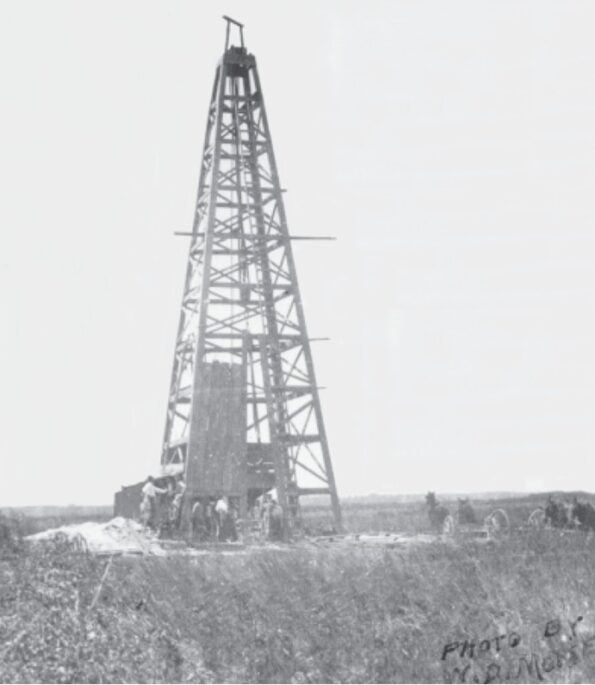
Jennings Oil Company No. 1 well, which discovered the first commercial oilfield in Louisiana.

The Jennings Oil Company No. 1 well, which discovered the first commercial oilfield in Louisiana on September 21, 1901. Photo courtesy Louisiana Geological Survey.

“At the age 29, W. Scott Haywood was already a seasoned, experienced and successful explorer,” noted Scott Smiley, a  Louisiana Geological Survey (LGS) historian. “He had gone to Alaska in 1897 during the great Yukon gold rush, sinking a shaft and mining a profitable gold deposit.”

Haywood, who also had drilled several successful oil wells in California, was one of the first to reach Spindletop following news of the January 1901 oilfield discovery. Haywood eventually convinced the reluctant Clements to allow drilling in the farmer’s Acadia Parish rice field. The Clements farm was at the small, unincorporated community of Evangeline, northeast of Jennings.
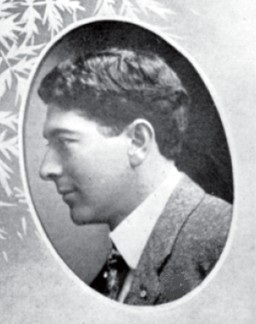
W. Scott Heywood, who drilled the first Louisiana oil well.

Walter Scott Heywood (1872-1950)

However, after drilling to 1,000 feet without finding oil or natural gas, the Jennings Oil Company’s investors wanted to abandon the first attempt.

Support the American Oil & Gas Historical Society.

“After all, 1,000 feet had been deep enough to discover the tremendous oil gushers at Spindletop field,” explained Smiley in a 2001 history of the Jennings field. “Instead of drilling two wells to a depth of 1,000 feet each, Heywood persuaded the investors to change the contract to accept a single well drilled to a depth of 1,500 feet.”

More drilling pipe was brought in and the well deepened.

Deeper Drilling Pays Off

Heywood found signs of oil at a depth of 1,700 feet – after some discouraged investors had sold their stock when drilling reached 1,000 feet. By 1,500 feet, shares of the Jennings Oil Company still sold for as little as 25 cents each. Patient investors were rewarded when 7,000 barrels of oil per day suddenly erupted from the well.

“The well flowed sand and oil for seven hours and covered Clement’s rice field with a lake of oil and sand, ruining several acres of rice,” reported the Jennings Daily News. 
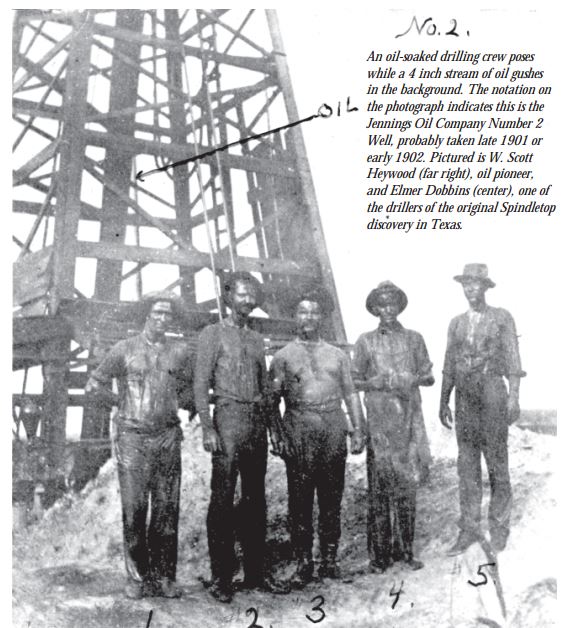
Scott Haywood and his oil well drilling crew circa early 1900s

W. Scott Heywood (5) and Elmer Dobbins (3) — “one of the drillers of the original Spindletop discovery in Texas.” Photo courtesy Louisiana Geological Survey.

Although the Jules Clements No. 1 well is on only a 1/32 of an acre lease, it marked the state’s first oil production and launched the Louisiana petroleum industry. It opened the prolific Jennings field, which Heywood developed by securing leases and building pipelines and storage tanks. The Jennings oilfield reached its peak production of more than nine million barrels in 1906.

Meanwhile, an October 1905 discovery in northern Louisiana further expanded the state’s young petroleum industry. Another giant oilfield arrived in January 1919 when Consolidated Progressive Oil Company completed a well four miles west of Homer in Claiborne Parish.

“Homer was a happening place and all people could think about was oil, notes Wesley Harris in Oil Boom Overwhelmed Homer. “Imagine Homer’s courthouse square with no place to park, nowhere to eat, and business establishments packed to overflowing.” Visit the Louisiana Oil Museum in aptly named Oil City.

Petroleum history is important. Support link for AOGHS.

According to Smiley, Scott Haywood returned to Alaska in 1908 on a big-game hunting trip. The geologist then retraced much of his travels to the Klondike gold fields.

“After a brief retirement in California, he returned to Jennings and drilled several wells at Jennings and elsewhere in Louisiana,” Smiley reports, adding that as an independent producer, Haywood found success drilling in the Borger and Panhandle oilfields in Texas.
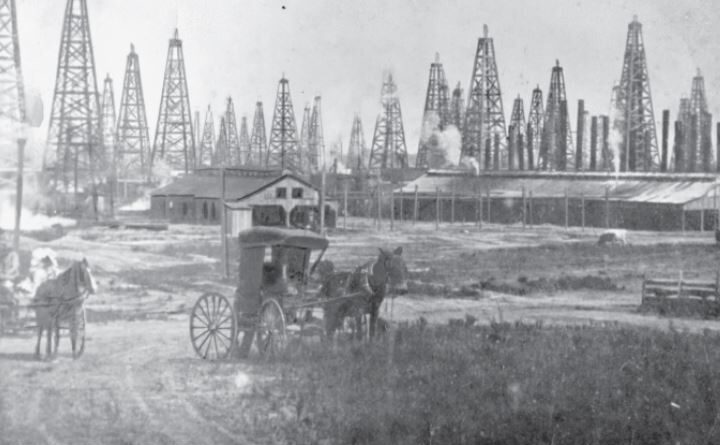
Circa early 1900s photo of Jennings oilfield courtesy Louisiana Geological Survey.

Rapid development of the Jennings oilfield in the early 1900s led to new conservation laws. A lack of spacing regulations forced “each leaseholder to drill their own well to prevent the draining of oil from the lease by an adjacent well.” Circa early 1900s photo courtesy Louisiana Geological Survey.

“Heywood returned to Jennings in 1927 and assisted Gov. Huey P. Long in passing legislation to provide schoolbooks for children,” concluded the geologist in Jennings Field – The Birthplace of Louisiana’s Oil Industry, September 2001.

Offshore Caddo Lake

Gulf Refining Company in 1911 drilled Ferry Lake No. 1 on Caddo Lake, Louisiana, using a fleet of tugboats, barges, and floating pile drivers. When the first well produced 450 barrels of oil per day, Gulf constructed platforms every 600 feet on each 10-acre lakebed (see Offshore Drilling History).

Although the Caddo Lake wells were often cited as the birthplace of America’s offshore drilling industry, oil patch historian in Mercer County, Ohio, discovered oil was produced from platforms on Grand Lake St. Marys as early as 1887.

In Pennsylvania, about 15 miles east of the first U.S. well at Titusville, dozens of wells produced oil on Tidioute Island and from rafts in the Alleghany River in the fall of 1860, according to the according to the Warren County Historical Society.

Challenging Louisiana Oil History

Extensive research by a retired professor at McNeese State University in Lake Charles challenged Louisiana petroleum history in 2011, according to the Southwest Daily News in Sulphur. The newspaper reported a September presentation at a Lake Charles library by Thomas Watson, PhD, who taught at McNeese State for 35 years, including a decade as the head of the history department.

“Dr. Thomas Watson has uncovered evidence that the first producing oil well in Louisiana was at the Sulphur Mines in 1886,” noted the newspaper, which was closed in 2024 after being acquired by MediaNews Group.

“This information could alter the history of oil production in Louisiana,” proclaimed the article, adding, “The interesting fact he has discovered in his research was announced formally at the Carnegie Library during a 10 a.m. presentation entitled ‘Oil and Sulphur Drilling’ on Sept. 6, 2011.”
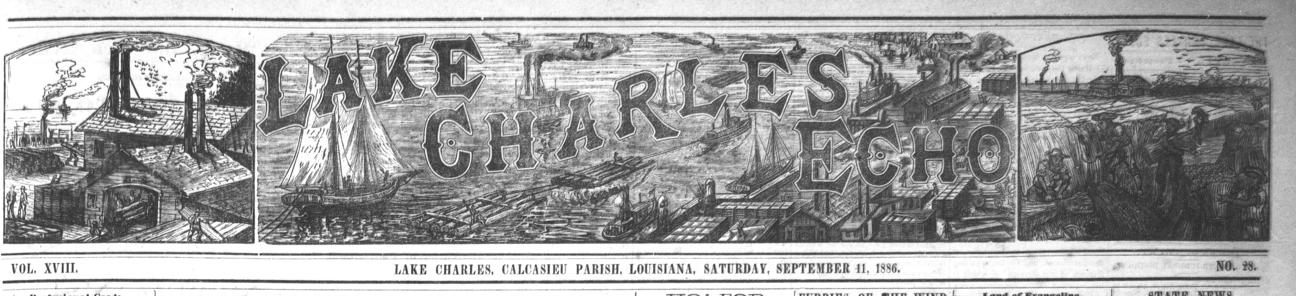
Banner of the Lake Charles Echo newspaper of September 11, 1886.

The Weekly Echo was established in 1868, the same year Lake Charles was officially incorporated. The paper dropped the word “weekly” from its title in 1876, becoming the Lake Charles Echo, which ceased in 1898. Image courtesy Library of Congress (LOC).

Professor Thomas Watson’s 2011 Carnegie Library presentation on Louisiana petroleum history began with a story, according to the Southwest Daily News article “Retired Professor Challenges Louisiana Oil History.” 

“There’s a story of D.S. Perkins, who saw a bear come out of the woods with oil on its paw. The group traced the tracks back to a spring (Choupique Bayou) with oil collecting on top. It came to be known as Oil Springs,” began Watson slowly. He explained that the oil spring produced a useable lubricant that was collected by people living around the area.

But the dream of oil was still alive. The Sulphur company decided to drill again in 1886.

During these years the Weekly Echo was the Lake Charles newspaper at the time, with editor John Wesley Bryan and publisher Dr. William H. Kirkman. Dr. Kirkman, along with the Perkins brothers from Sulphur, Eli and William, was following the activity at the mine and they, along with other investors, decided to drill again.

When the news broke out, the Weekly Echo announced a blow out! Gas came rushing back up to the surface. The well was capped, and the flow of oil was evaluated to [be] 25 barrels a day.

Subscribe to Our Free Newsletter link.

Watson said he considered it to be a heavy oil because it was perceived to be a first class lubricant. Good lube oil sold for more that thin oil (what Pennsylvania was selling). Louisiana crude would go for $5 a gallon as opposed to Pennsylvania oil at $1 a gallon.

The Weekly Echo documented the production and sale of oil from that Sulphur Mine source for three years. One report indicated maximum production hit 100 barrels a day. There were writings at the time that reported that the land around the Sulphur Mines was the richest 54 acres in the US at that time and this was true from 1895 until the 1920’s.

Therefore, 15 years earlier than the production of oil in Evangeline, they were marketing oil from Sulphur. Watson concluded his presentation citing Samuel Lockett documents.

_______________________

Recommended Reading: Louisiana’s Oil Heritage, Images of America (2012); Early Louisiana and Arkansas Oil: A Photographic History, 1901-1946 (1982). Your Amazon purchase benefits the American Oil & Gas Historical Society. As an Amazon Associate, AOGHS earns a commission from qualifying purchases.

_______________________

The American Oil & Gas Historical Society (AOGHS) preserves U.S. petroleum history. Please become an AOGHS annual supporter and help maintain this energy education website and expand historical research. For more information, contact bawells@aoghs.org. Copyright © 2025 Bruce A. Wells. All rights reserved.

Citation Information – Article Title: “First Louisiana Oil Well.” Authors: B.A. Wells and K.L. Wells. Website Name: American Oil & Gas Historical Society. URL: https://aoghs.org/petroleum-pioneers/first-louisiana-oil-well. Last Updated: September 15, 2025. Original Published Date: September 1, 2005.
Louisiana Oil City Museum

Preserving Louisiana petroleum history at Caddo Lake.


A 1905 oil discovery at Caddo-Pines brought America’s rapidly growing petroleum industry to northwestern Louisiana. A state museum in appropriately named Oil City tells the story.

Originally the Caddo-Pine Island Oil and Historical Museum, in May 2004 the Louisiana State Oil and Gas Museum was dedicated as a state museum under the Louisiana Secretary of State. 

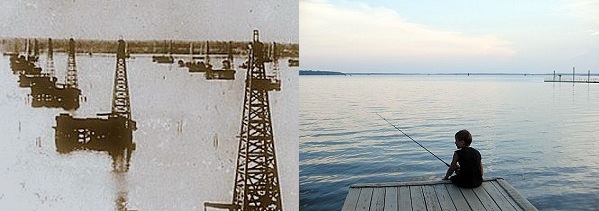
Two rows of oil platforms with derricks in 1911 on Caddo Lake, Louisiana.

Gulf Refining Company in 1911 built drilling platforms to reach the oil beneath Caddo Lake, Louisiana. The early “offshore” technologies worked, and production continues today.

Located about 20 miles north of Shreveport, the first public museum in Louisiana dedicated to the petroleum industry maintains an extensive local history library and collected photographic archives. Exterior exhibits include the former depot of the Kansas City Southern Railroad. (more…)

Paramount Petroleum Company

Louisiana oil boom brings pipelines, refineries and competition.


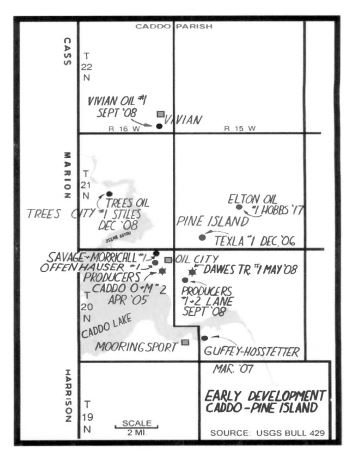
Claiborne Parish made headlines on January 12, 1919, when Consolidated Progressive Oil Company completed the discovery well for northern Louisiana’s prolific Homer oilfield. About 50 miles to the west, a 1905 oil discovery at Caddo-Pines near Shreveport had brought a rush of oil exploration to northern Louisiana.

Caddo Lake drilling platforms – completed over water without a pier to shore – have been called America’s first true offshore oil wells. Exhibits at the state’s Oil City museum tell that story. Like Caddo-Pines, the Homer field was crowded with new companies within months after the discovery.

Petroleum production from the new field soon reached an aggregate of about 10,000 barrels of oil per day. Reporting from the Pennsylvania oil regions, Pittsburgh Press on September 21, 1919, proclaimed the “Homer Field is Sensation of Oil Industry.”

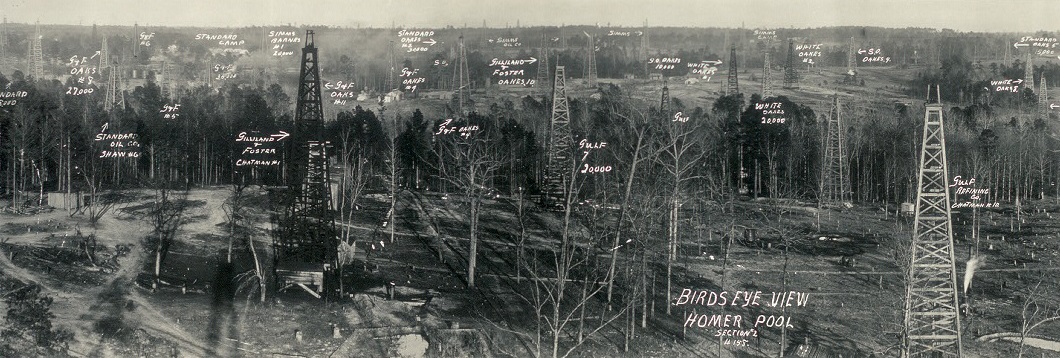
Derricks crowd a scene of Louisiana's oilfields.

Detail from a panoramic “bird’s eye view” of the Homer oilfield circa 1920s. Photo courtesy Library of Congress Prints and Photographs Division, Washington, D.C.

Superior Oil Works

Paramount Petroleum Company began when the leadership of another company operating in the Homer oilfield decided to expand operations. Superior Oil Works officers, including President George A. Todd of Oklahoma City; Secretary and Purchasing Agent H.H. Todd of Vivian, Louisiana; and Treasurer D.C. Richardson of Shreveport organized the Paramount Petroleum Company.

Superior Oil Works had been formed to build and operate a refinery close to the Homer field. Capitalized at $300,000 with common stock issued, the company began construction in Superior, Louisiana, but its officers were by then contemplating the much-expanded venture — the formation of Paramount Petroleum to integrate exploration, production, transportation and refining under one organization.

Once established, the new company absorbed Superior Oil Works and looked for potential leases near the Consolidated Progressive Oil Company’s discovery well. As construction of the Superior refinery progressed, purchasing agent H.H. Todd advertised that Paramount Petroleum was “in the market for oil refinery equipment, boilers, stills, pumps, and plant machinery, etc.”

Paramount Petroleum made a deal with Consolidated Progressive Oil in May 1919, securing one-half interest in more than 11,000 acres of both proven and unexplored territory in Claiborne Parish. The acreage was already producing about 40,000 barrels of oil, ensuring the refinery would be supplied.

“A giant refining company has been organized recently in Shreveport to be known as the Paramount Petroleum Company,” noted the Oil Distribution News. The venture was capitalized at $10 million with half of its stock subscribed.

Support the American Oil & Gas Historical Society

“Stock in this company has been consumed by the largest business and banking men of Shreveport,” added the Oil and Gas News. But the best news for investors was the headline: “Paramount Petroleum Gets 10,000 Barrel Well And Will Build Big Refinery.”

In March 1920, the Petroleum Age reported Paramount Petroleum “recently took over the under-construction Superior Oil Works refinery at Vivian [Superior], Louisiana, 23 miles north of Shreveport, to service Pine Island production.”

The publication added that another refinery was to be completed in north Shreveport in November 1920 “with a four-inch pipeline from the Homer field where Paramount Petroleum holds 4,700 acres.”

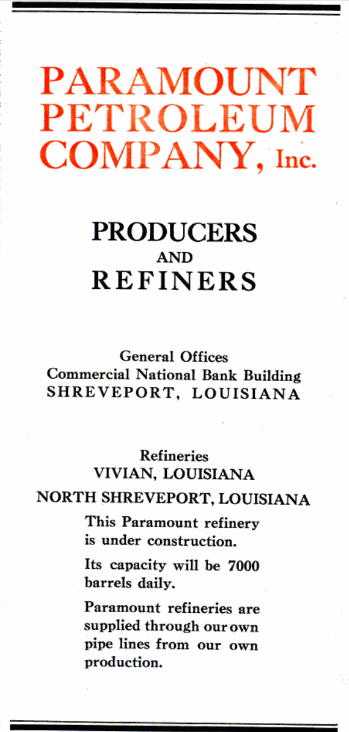
Paramount Petroleum promotion of refineries.

Paramount Petroleum Company’s newest refinery would be struggling by May 1921.

Within a month Paramount Petroleum was drilling in Claiborne Parish and shipping 400,600 barrels of oil a day. The company secured a $1 million mortgage from the Commercial National Bank of Shreveport and advertised, “Paramount refineries are supplied through our own pipelines from our own production.”

Paramount Petroleum in July 1920 completed the No. 5 Shaw well, which produced 500 barrels of oil a day from 2,090 feet deep in the Homer field. In August, the company’s No. 9 Shaw well become another 500-barrels-of-oil-a-day producer from a depth of 2,100 feet.

Anticipating more growth in oil production, Paramount Petroleum committed to an agreement for 300 tank cars from Standard Tank Car Company of St. Louis, Missouri.

“Not too bright”

“Paramount has just closed a deal for one half interest in 24 producing wells in the old Caddo field with 1,200 acres of proven territory on which many wells can yet be drilled,” reported the Petroleum Age in October 1920. “The production department of Paramount Petroleum is making splendid headway and with its large acreage, will no doubt greatly add to the earnings of the company.”

But the Petroleum Age reporter had got it wrong. By February 1921, Paramount Petroleum’s refinery at Superior was running at only about 50 percent capacity. Another trade publication reported the company’s prospects as “not too bright.”

Shipments from Paramount Petroleum’s Homer oilfield holdings dropped to just 168 barrels of oil a day. In May 1921 the struggling company leased its underused refinery and fleet of 390 tank cars to Lucky Six Oil Company for six months.

The Homer field attracted drillers from earlier discoveries at the nearby Caddo-Pines oilfields. Photo courtesy the Petroleum History Institute.

The Homer field attracted drillers from earlier discoveries at the nearby Caddo-Pines oilfields. Photo courtesy the Petroleum History Institute.

To the south, the Busey-Armstrong No. 1 oil gusher on January 10, 1921, had opened Arkansas’ El Dorado field and Lucky Six Oil Company had entered the scramble to exploit the new field’s huge production (578,000 barrels of oil in the month of May alone).

The oilfield discovery 15 miles north of the Louisiana border was the first Arkansas oil well. It attracted even more exploration and production companies to the region.

As competition intensified, Paramount Petroleum struggled to pay debts. It was unable to make a required $200,000 mortgage payment to Commercial National Bank of Shreveport in July 1921. The deal Paramount had struck with Consolidated Progressive Oil back in 1919 had become toxic.

Petroleum history is important. Support link for AOGHS.

The National Petroleum News reported on September 7, 1921, that Consolidated Progressive Oil was seeking a court-ordered receiver to take over Paramount Petroleum. The action was based on claims totaling $849,547 — and “averred acts jeopardizing the interests of creditors.” Among the allegations was “the effect that officials of the defendant concern have admitted in writing the company’s inability to meet present and maturing obligations.”

Paramount Petroleum’s epitaph was brief. “It is officially stated that this company is out of business,” reported Poor’s Cumulative Service in December 1921. “Its properties are to be sold by the sheriff December 24 and proceeds applied on the first Mortgage notes.”

The first Louisiana oil well had been drilled 17 years before the end of Paramount Petroleum. More stories about petroleum exploration and production companies trying to join drilling booms (and avoid busts) can be found in an updated series of research at Is my Old Oil Stock worth Anything?

______________________

Recommended Reading: Louisiana’s Oil Heritage, Images of America (2012); Early Louisiana and Arkansas Oil: A Photographic History, 1901-1946 (1982). Your Amazon purchase benefits the American Oil & Gas Historical Society. As an Amazon Associate, AOGHS earns a commission from qualifying purchases.

_______________________

The American Oil & Gas Historical Society (AOGHS) preserves U.S. petroleum history. Please become an annual AOGHS supporter and help maintain this energy education website and expand historical research. For more information, contact bawells@aoghs.org. Copyright AOGHS © 2025

Citation Information – Article Title: “Paramount Petroleum Company.” Authors: B.A. Wells and K.L. Wells. Website Name: American Oil & Gas Historical Society. URL:httpshttps://aoghs.org/old-oil-stocks/paramount-petroleum-company. Last Updated: March 9, 2025. Original Published Date: August 15, 2015.

Pin It on Pinterest