

March 16, 1911 – Pegasus Trademark takes Flight –
A Vacuum Oil Company subsidiary in Cape Town, South Africa, trademarked a flying horse logo inspired by Pegasus of Greek mythology. Based in Rochester, New York, Vacuum Oil had built a successful lubricants business long before gasoline was a branded product.
When Vacuum Oil and Standard Oil of New York (Socony) combined in 1931, the Socony-Vacuum Oil Company adopted the winged horse trademark and marketed Pegasus Spirits and Mobilgas products.
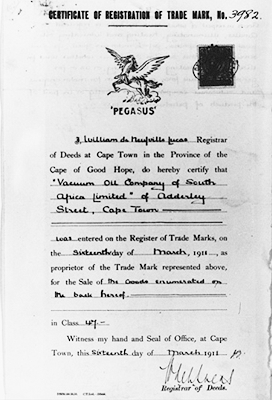
The original Mobil Pegasus logo was registered in 1911 by the South African subsidiary of New York-based Vacuum Oil Co.
A stylized red gargoyle had advertised the company, which produced petroleum-based lubricants for carriages and steam engines. Created by the Vacuum Oil Company of South Africa, the Pegasus trademark proved to be a far more enduring image.
Learn more in Mobil’s High-Flying Trademark.
March 16, 1914 – “Main Street” Oil Well completed in Oklahoma
A well completed in 1914 produced oil from about 1,770 feet beneath Barnsdall, Oklahoma. The popular TV program Ripley’s Believe It or Not would proclaim the well the “World’s Only Main Street Oil Well.”
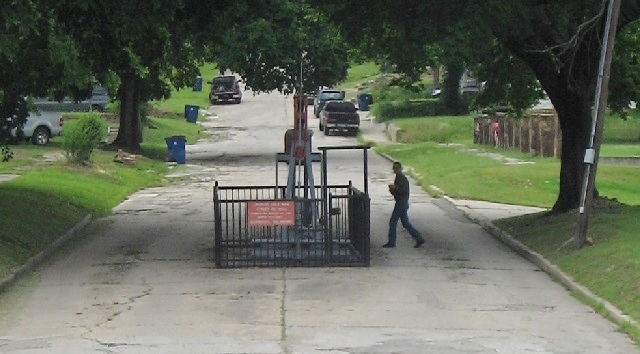
The “World’s Only Main Street Oil Well” in Barnsdall, Oklahoma, was visited in 2016 by American Oil & Gas Historical Society volunteer Tim Wells. Photo by Bruce Wells.
The town originally was called Bigheart, named for Osage Chief James Bigheart, who on behalf of the Osage people in 1875 signed the first lease for oil and gas exploration, according to Osage County. In 1922, Barnsdall was renamed for Theodore Barnsdall, owner of the Barnsdall Refining Company, which was later acquired by Baker Hughes. The “Barnsdall Main Street Oil Well” was added to the National Register of Historic Places in 1997.
March 17, 1890 – Sun Oil Company founded
Established in 1886 by Joseph Pew and Edward Emerson to provide light and heat to Pittsburgh, the Peoples Natural Gas Company expanded into production, becoming the Sun Oil Company of Ohio. The new company acquired leases near Findlay and began “producing petroleum, rock and carbon oil, transporting and storing same; refining, purifying, manufacturing such oil and its various products.”
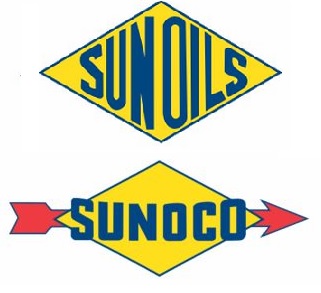
Sun Oil Company marketed Sun Oils from 1894 to 1920 and its original Sunoco brand from 1920 to 1954.
Sun Oil Company went public in 1925, with its stock appearing for the first time on the New York Stock Exchange. Four years later, a partnership with downhole gyroscope inventor Elmer Sperry created Sperry-Sun Drilling Services.
March 17, 1923 – Discovery leads to Seminole Oil Boom
The Betsy Foster No. 1 well, a 2,800-barrel-a-day oil gusher near Wewoka, county seat of Seminole County, Oklahoma, launched the Seminole area boom. The discovery south of Oklahoma City was followed by others in Cromwell and Bethel (1924) and Earlsboro and Seminole (1926). Thirty-nine separate oilfields would be found in Seminole and Pottawatomie, Okfuskee, Hughes, and Pontotoc counties. Once among the poorest regions in Oklahoma, by 1935 the greater Seminole area became the largest supplier of oil in the world.
Learn more in Seminole Oil Boom.
March 17, 1949 – First Commercial Application of Hydraulic Fracturing
A team from Halliburton and Stanolind companies converged on an oil well about 12 miles east of Duncan, Oklahoma, and performed the first commercial application of hydraulic fracturing.
A 1947 experimental well had fractured a natural gas field in Hugoton, Kansas, and proven the possibility of increased productivity. The technique was developed and patented by Stanolind (later known as Pan American Oil Company), and an exclusive license was issued to Halliburton Company to perform the process. Four years later, the license was extended to all qualified oilfield service companies.
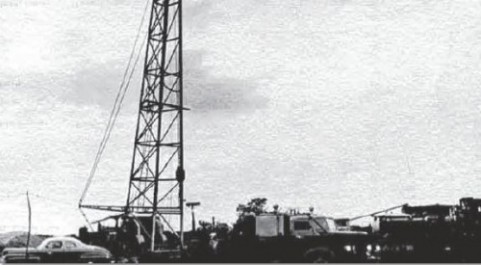
The world’s first commercial hydraulic fracturing job (above) occurred on March 17, 1949, about 12 miles east of Duncan, Oklahoma. Photo courtesy Halliburton.
“Since that fateful day in 1949, hydraulic fracturing has done more to increase recoverable reserves than any other technique,” proclaimed a Halliburton company spokesman in 2009, adding that more than two million fracturing treatments have been pumped without polluting an aquifer.
Erle P. Halliburton patented an efficient well-cementing technology in 1921 that improved oil production while protecting the environment. The earliest attempts to increase petroleum production by fracturing geologic formations began in the 1860s.
Learn more in Shooters – A ‘Fracking’ History.


March 17, 1949 – “Diamond Glenn” opens Shamrock Hotel
Texas independent producer “Diamond Glenn” McCarthy hosted the grand opening of his $21 million, 18-story, 1,100-room Shamrock Hotel on the outskirts of Houston. McCarthy reportedly spent another $1 million for the hotel’s St. Patrick’s Day opening day gala, including arranging for a 16-car Santa Fe Super Chief train to bring friends from Hollywood.
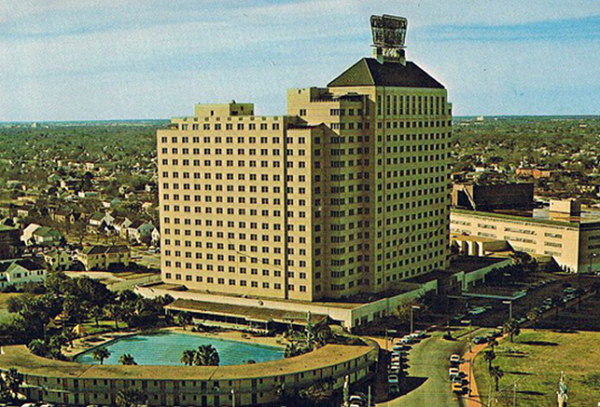
Glenn McCarthy spent $21 million to construct his 1,100-room Shamrock Hotel — and another $1 million for its St. Patrick’s Day opening gala. From 1949 to 1954, “Saturday at the Shamrock” was the only regularly scheduled national radio show to broadcast from Texas.
The Texas wildcatter, who had discovered 11 oilfields by 1945, also introduced his own label of bourbon at Shamrock, the largest hotel in the United States at the time. Dubbed Houston’s biggest party, the Shamrock’s debut “made the city of Houston a star overnight,” one newspaper reported.
Learn more in “Diamond Glenn” McCarthy.
March 18, 1937 – New London School Explosion Tragedy
With just minutes left in the school day, a natural gas explosion destroyed the New London High School in Rusk County, Texas. Odorless gas (a residual natural gas called casing-head gas) had leaked into the basement and ignited with an explosion heard four miles away. East Texas oilfield workers — many with children attending the school — rushed to the scene, as did a cub reporter from Dallas, Walter Cronkite.
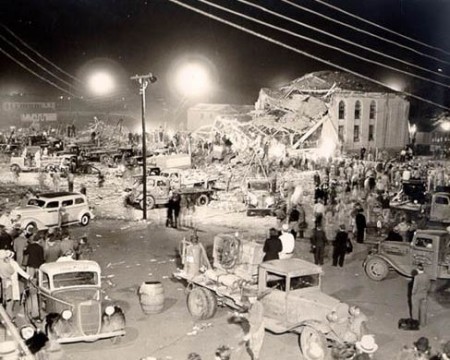
Roughnecks from the East Texas oilfield rushed to the devastated school and searched for survivors throughout the night. Photo courtesy New London Museum.
Despite desperate rescue efforts, 298 people were killed that day (dozens more later died of injuries). The explosion’s source was later found to be an electric wood-shop sander that sparked odorless gas that had pooled beneath and in the walls of the school. As a result of this disaster, Texas and other states passed laws requiring that natural gas be mixed with a malodorant to give early warning of a gas leak.
Learn more about the tragedy in New London School Explosion.
March 18, 1938 — First Offshore Well drilled off Louisiana
Oil production from a well drilled by Pure Oil and Superior Oil companies helped launch the modern offshore industry. The Creole oilfield in Louisiana’s offshore Cameron Parish was the first discovered in the open waters of the Gulf of Mexico, according to the Louisiana Department of Natural Resources (DNR). “A look back at both the Creole platform and others that followed after World War II provides a glimpse of history in the making,” noted Offshore magazine in 2014.
More offshore wells followed, including the Kerr-McGee drilling platform, Kermac Rig No. 16, which in 1947 became the first offshore rig out of sight of land. By the end of 1949, offshore exploration had discovered 11 oil and natural gas fields.
Learn more in Offshore Oil History.
March 20, 1919 – American Petroleum Institute founded
Tracing its roots to World War I when the petroleum industry and Congress worked together to fuel the war effort, the American Petroleum Institute (API) was founded in New York City. Within two years, the organization had improved an 1876 French scale to measure petroleum density relative to water — a standard later adopted and called API gravity. Based in Washington, D.C., since 1969, API has lobbied on behalf of major oil and natural gas companies while maintaining standards and recommended industry practices.

March 20, 1973 – Pennsylvania Boom Town recognized as Historic
The once-famous oil boom town of Pithole, Pennsylvania, was listed in the National Register of Historic Places. An 1865 oilfield discovery at Pithole Creek launched a drilling boom for the early U.S. petroleum industry, which had begun six years earlier in nearby Titusville. The Pithole field’s production would lead to the construction of the nation’s first oil pipeline, but the boom ended after about 500 days.
Learn more in Oil Boom at Pithole Creek.
March 21, 1881 – Earth Scientist becomes USGS Director
President James Garfield appointed John Wesley Powell director of the United States Geological Survey (USGS), a scientific agency established two years earlier. Powell, who led USGS for the next decade, laid the foundation for modern earth science research.
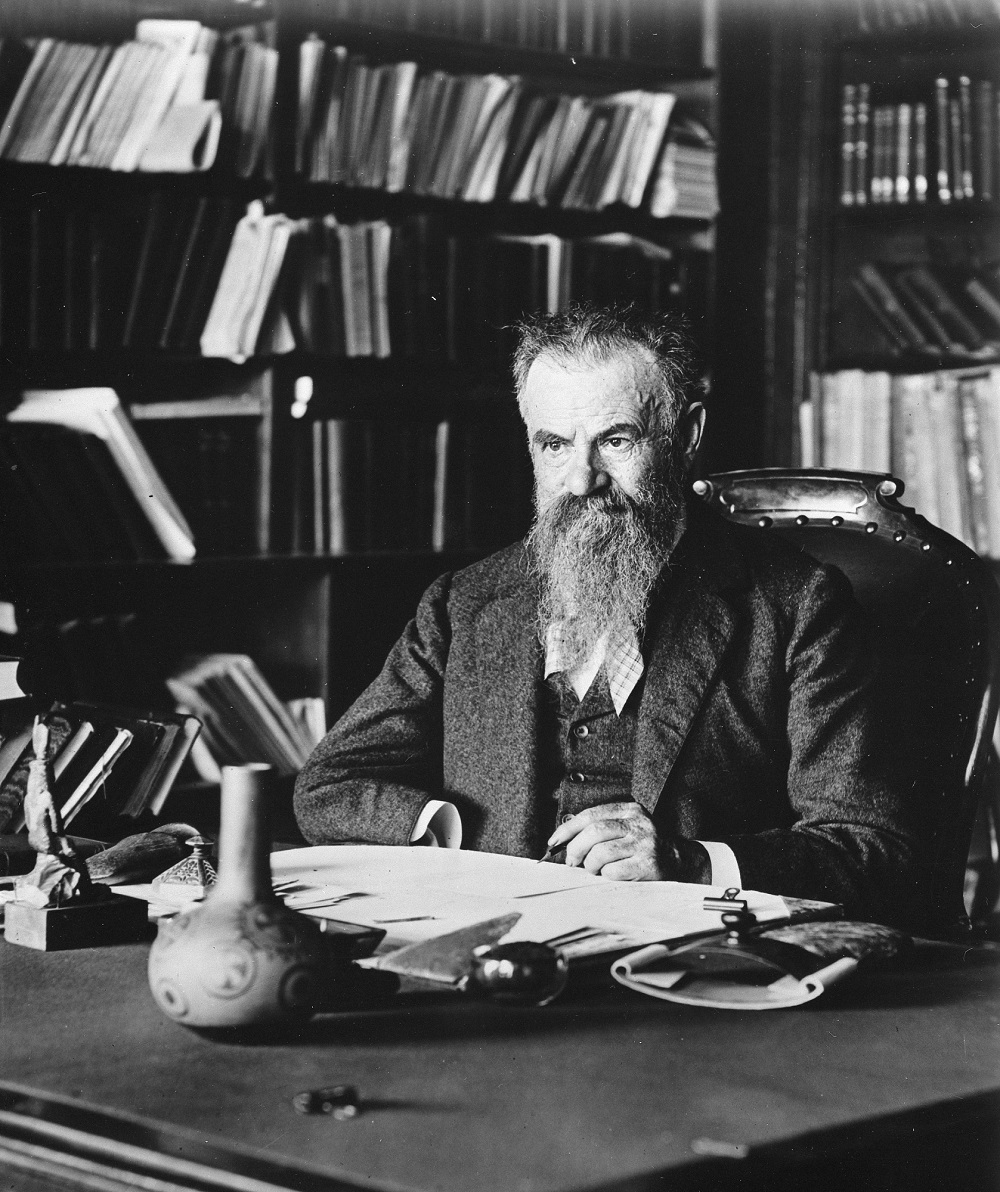
John Wesley Powell at his desk in Washington, D.C., in 1896. Photo courtesy Smithsonian Institution.
Born in 1834 at Mount Morris, New York, Powell was a Union officer during the Civil War, where he lost an arm at the Battle of Shiloh. After the war, he became a respected geologist and expedition leader, organized early surveys in the West, and helped establish USGS in 1879.
Powell advocated the national mapping standards and geodetic system still in use today. In 1884, Powell testified to Congress, “A government cannot do any scientific work of more value to the people at large than by causing the construction of proper topographic maps of the country.”
_______________________
Recommended Reading: Trek of the Oil Finders: A History of Exploration for Petroleum (1975); Oil in Oklahoma
_______________________
The American Oil & Gas Historical Society (AOGHS) preserves U.S. petroleum history. Please support this energy education website, our monthly email newsletter, This Week in Oil and Gas History News, and help expand historical research. Contact bawells@aoghs.org. Copyright © 2026 Bruce A. Wells. All rights reserved.