

Exploring some educational oil history books.
This addition to the American Oil & Gas Historical Society’s energy education mission offers links to helpful resources relating to petroleum history. For books, the numerous professional societies and associations (see national and state contacts) offer good recommendations. Also see historic petroleum images featured in the AOGHS website’s Oilfield Artists.
Further, a listing of more recommended reading can be found at the bottom of this page. Limited as it is, the Amazon listing offers many classic texts and 19th century and 20th century oil history books available online, including Paul H. Giddens’s 1938 The Birth of the Oil Industry (with introduction by Ida Tarbell). Encouraged by its members and website visitors, AOGHS also posted brief looks at more oil patch authors in Oilfield History & Fiction Books.
Louisiana Oil Cities
Published in May 2024, Oil Cities: The Making of North Louisiana’s Boomtowns, 1901-1930, by Henry Alexander Wiencek, examines how international petroleum companies “navigated the local, segregated landscape of north Louisiana in the first decades of the twentieth century,” according to Amazon Books, describing his work as the first historical monograph revealing the contested history of northwestern Louisiana’s early 1900s oil boom.
“I first became interested in the oil boomtowns of North Louisiana as a graduate student at the University of Texas,” the author noted in an April 2024 Q&A with Oil Cities author Henry Wiencek. “I was writing a research paper about the ExxonMobil collection at the Briscoe Center and came across a compelling set of documents about Standard Oil’s work in Louisiana during the first decades of the twentieth century,” Wiencek said.
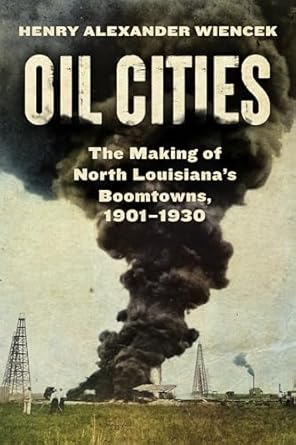
“A well-rounded picture of the early 20th-century petroleum boom in the Caddo Lake region of northwestern Louisiana.” – Journal of Southern History.
“One of the biggest dynamics I explore in Oil Cities is the collision of a new industrial oil economy with Louisiana’s longstanding plantation economy,” he added before concluding, “These boomtowns really became a fascinating conglomeration of European migrants working alongside local Black sharecroppers and white Southern farmers, which I think really underscores the tremendous economic pull that North Louisiana’s oil fields created.”
Tyler Priest, author of The Offshore Imperative: Shell Oil’s Search for Petroleum in Postwar America (see below), further commented: “Oil Cities is a compelling study that investigates an important but often overlooked episode of oil development in the Caddo Parish region of North Louisiana during the early twentieth century. Combining social, economic, and environmental history, this is a rich contribution to the history of oil and extractive industry boomtowns.”
Your Amazon books purchase benefits the American Oil & Gas Historical Society. As an Amazon Associate, AOGHS earns a commission from qualifying purchases.
The Offshore Imperative
Tyler Priest, professor of history at the University of Iowa, in 2008 received the Geosciences in the Media award from the American Association of Petroleum Geologists (AAPG) — “given to a person in recognition of notable journalistic achievement in any medium which contributes to public understanding of geology, energy resources, or the technology of oil and gas exploration.”
One year earlier, his book, The Offshore Imperative: Shell Oil’s Search for Petroleum in Postwar America, was published by Texas A&M University Press. His work of extensive historical research is available at Amazon, which notes, “Drawing on interviews with Shell retirees and many other sources, Priest relates how the imagination, talent, and hard work of personnel at all levels shaped the evolution of the company. The narrative also covers important aspects of Shell Oil’s corporate evolution, but the company’s pioneering steps into the deepwater fields of the Gulf of Mexico are its signature achievement.”
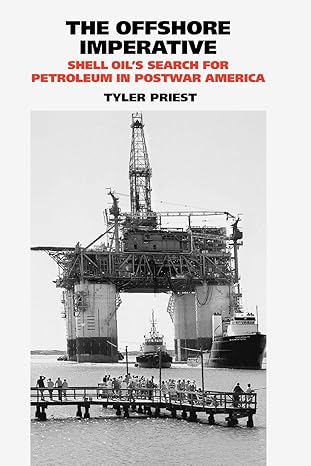
Dr. Priest has written a thoroughly-researched and interesting history of post-World War II petroleum exploration. — Permian Basin Historical Annual
“Priest’s study demonstrates that engineers did not suddenly create methods for finding and producing oil and gas from astounding water depths. Rather, they built on a half-century of accumulated knowledge and improvements to technical systems.”
Your Amazon books purchase benefits the American Oil & Gas Historical Society. As an Amazon Associate, AOGHS earns a commission from qualifying purchases.
Upstream Dream
Decades after working on offshore rigs as a young engineer in the 1980s, Sally Goodson began writing a book to tell her story. The result is Upstream Dreams, which examines the petroleum industry’s offshore technological challenges and “the unique culture of working offshore at a time when few women worked as engineers in the business.”
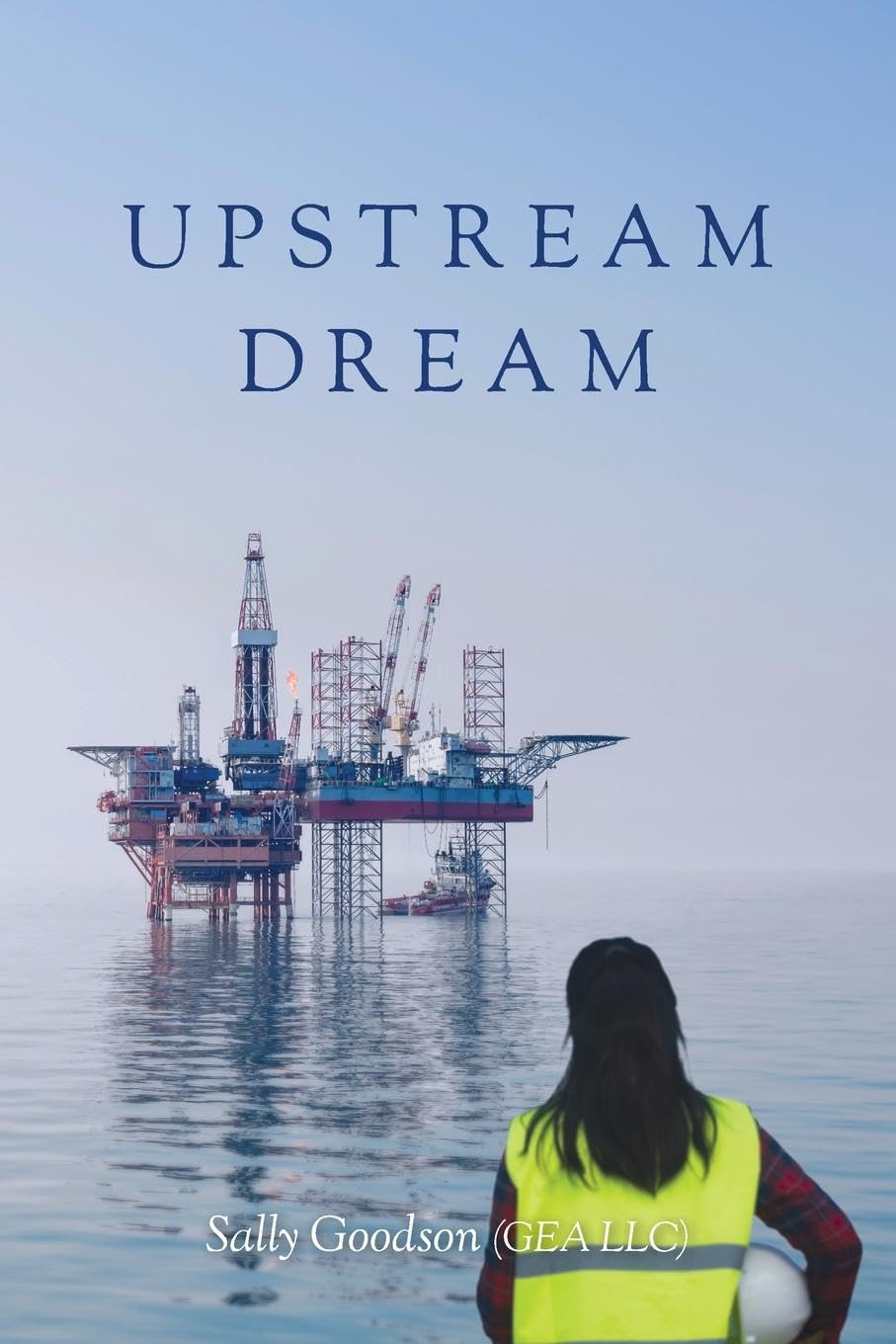
After earning a degree in engineering degree in 1979, Sally Goodson joined the offshore oil and natural gas industry as a project engineer with Chevron.
Published in March 2025, Upstream Dream is available at Amazon books, which notes: “Sally Goodson’s dream centered on one thing: a professional engineering career. Now, read the telling memoir of her journey from a young, upstart college grad, to a seasoned engineer in the challenging 1980s offshore oil and gas industry. This experience led her to achieve later success as an influencer of global energy standards.”
Goodson, founder and president of Goodson Energy Advisors LLC, will be among the panelists at the 8th annual Women Offshore Conference, October 9-10, 2025, in Houston; she is also scheduled to speak at Texas A&M and participate in book shows in Dallas and at Vanderbilt University. Upstream Dreams was published by Palmetto Publishing.
CITGO at Fenway Park
As noted in Oilfields of Dream — Gassers, Oilers, and Drillers Baseball, beginning in the early 20th century, U.S. petroleum companies fielded baseball teams throughout the oil-producing states. With the arrival of opening day in 2024, a book on Boston Red Sox history by David Krell has highlighted the marketing role of a major oil company — CITGO (acquired in 1990 by PDVSA, Venezuela’s state oil company).

CITGO’s iconic red triangle, updated in 2005, sits atop a six-story building in Kenmore Square behind the Green Monster at Fenway Park.
The Fenway Effect: A Cultural History of the Boston Red Sox offers an in-depth look at the history of the team and its iconic, red triangle CITGO sign at Fenway Park, the team’s home since 1912. With research assistance in 2023 from the American Oil & Gas Historical Society, chapter 15 includes the history of the CITGO sign (see Cities Service Company) and the brand value of its red triangle logo at Fenway in marketing to Red Sox Nation (also see Sinclair’s dinosaur). The Fenway Effect: A Cultural History of the Boston Red Sox was published by the University of Nebraska Press.
Breaking the Gas Ceiling: Women in the Offshore Oil and Gas Industry
Published in 2019, Breaking the Gas Ceiling: Women in the Offshore Oil and Gas Industry offers personal accounts from an expanding group of petroleum pioneers – women who work offshore.
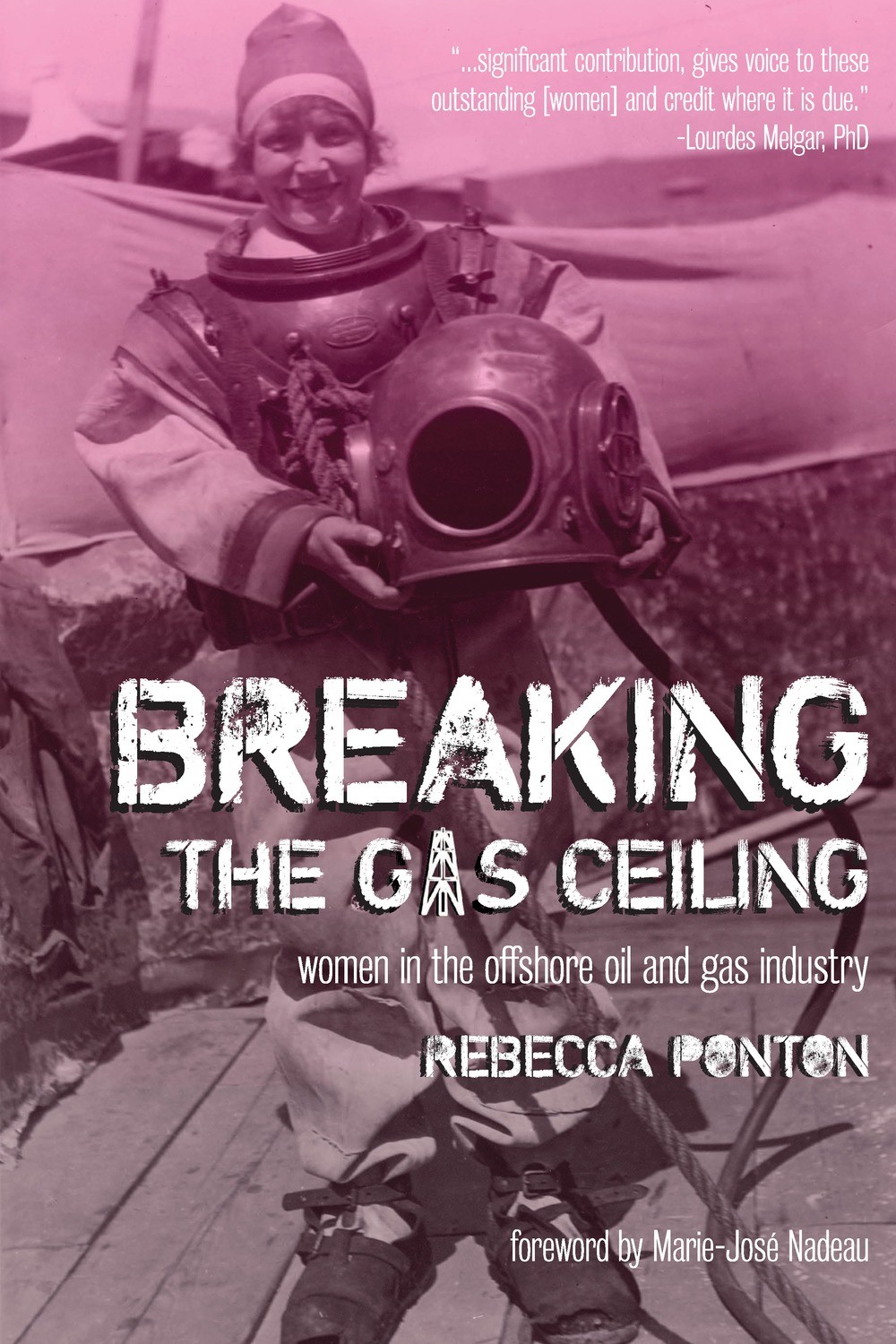
Journalist Rebecca Ponton interviewed a diverse group of energy industry professionals; her chapters read like a collection of captivating short stories.
The milestones of these notable “women on water” may not receive the attention given to NASA’s women space walkers, but they also deserve recognition.
Learn more in Women of the Offshore Petroleum Industry tell Their Stories.
Anomalies – Pioneering Women in Petroleum Geology: 1917 to 2017
Robbie Rice Gries — with help from the American Association of Petroleum Geologists (AAPG) and many volunteers — has written a fascinating and educational history of pioneering women in petroleum geology.
In 405-pages, Anomalies, Pioneering Women in Petroleum Geology, 1917-2017 includes vivid oil patch personal stories, correspondence and photographs dating to the first decade of the 20th century. Grandchildren, children, nieces, nephews, and friends share their memories of the industry’s pioneering women.
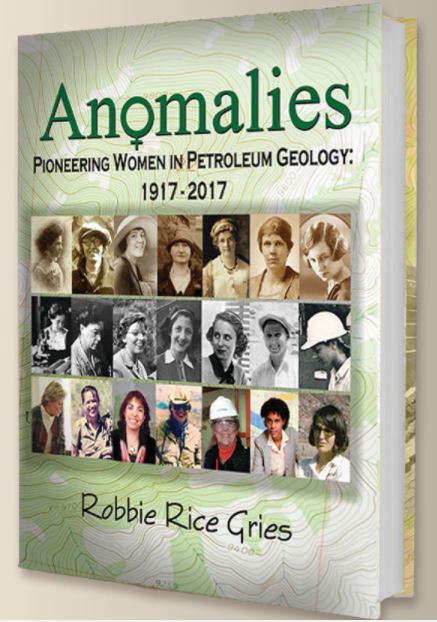
Remarkable accounts of determined women working as petroleum geologists in a male-dominated industry.
The stories begin with WW I and conclude with hiring through Affirmative Action in the 1970s and the successes of many of today’s women in petroleum geology. Anomalies was released March 1, 2017, as part of the AAPG 100th anniversary.
“Robbie Gries and her contributors have created a remarkable account of early women in petroleum geology,” declared the late Marlan W. Downey, founder and chairman of Roxanna Oil Company. “The book represents a ‘deep dive’ into the lives, accomplishments, triumphs, and, even, terrors, of early women professionals.


Downey praised Gries’ book for its four years of researching histories of largely forgotten women professionals. “The book should be read by every petroleum geologist, geophysicist, and petroleum engineer; partly for the pleasure of the sprightly told adventures, partly for a sense of history, and, significantly, because it engenders a proper respect towards all women professionals, forging their unique way in a ‘man’s world.’”
Recommended Reading: Anomalies, Pioneering Women in Petroleum Geology, 1917-2017. Your Amazon purchase benefits the American Oil & Gas Historical Society. As an Amazon Associate, AOGHS earns a commission from qualifying purchases.
The Extraction State — A History of Natural Gas in America
A close examination of the too often neglected history of U.S. natural gas industry can be found in Charles Blanchard’s The Extraction State, which reviews the resource’s 19th century roots before delving into how regulatory efforts beginning in the 1920s fell apart in the 1970s.
The nation’s history is a the history of modern energy production and consumption, according to the University of Pittsburgh Press, which in January 2021 published The Extraction State, A History of Natural Gas in America. Fifteen chapters examine the science, economics, and politics of the resource. His investigation begins with remembering “The Smokey City,” Pittsburgh, in the late 1870s.
Charles Blanchard examines the rise of natural gas as source of heat and light in the late 19th century to the modern business and politics of its production, pipeline infrastructure, and environmental regulation.
“Unlike crude oil, there are surprisingly few books devoted to the history of natural gas. Charles Blanchard offers a timely business history of an important industry. There are many stories to be told about a resource once considered a byproduct, but today key for meeting energy demand.


The Extraction State examines the still evolving technologies of natural gas production, Charles Blanchard traces the rise of natural gas and the regulatory early and recent pioneers, the role of investors and market hubs, and federal and state agencies that have managed the industry since the earliest gas wells. As U.S. petroleum production from shale continues to change the future of the industry, Blanchard brings a business insider’s perspective to the history of bringing energy to consumers.”
— Bruce Wells, Executive Director, American Oil & Gas Historical Society
From Pittsburgh Press: The history of the United States of America is also the history of the energy sector. Natural gas provides the fuel that allows us to heat our homes in winter and cool them in summer with the touch of a button or turn of a dial—when the industry runs smoothly. From the oil crisis of the 1970s to the fall of Enron and the California electricity crisis at the turn of the century to contemporary issues of hydraulic fracking, poorly conceived government policies have sometimes left us shivering, stranded, or with significantly lighter wallets.
In this expansive narrative, Charles Blanchard traces the rise of natural gas and the regulatory missteps that nearly ruined the market. Beginning in the 1880s, The Extraction State explains how the New Deal regulatory compact came together in the 1920s, even before the Great Depression, and how it fell apart in the 1970s. From there, the book dissects the policies that affect us today, and explores where we might be headed in the near future.
Charles Blanchard is the head of North American natural gas research at Mercuria Energy, a large commodities trading house based in Geneva.
The Extraction State, A History of Natural Gas in America is available from Amazon books, where your purchase benefits the American Oil & Gas Historical Society. As an Amazon Associate, AOGHS earns a commission from qualifying purchases.
Myth, Legend, Reality – Edwin Laurentine Drake and the Early Oil Industry
The man who would drill the first commercial oil well was down to his last few pennies in August 1859. A letter was on its way to Titusville, Pennsylvania, from the company that had hired him to search for oil. The letter instructed him to close operations, because as far as investors of the Seneca Oil Company were concerned, his drilling effort was finished, according to historian William Brice, PhD.
The limited edition biography of the father of the U.S. petroleum industry was published in 2009 to commemorate the 150th anniversary of his historic oil well.
Brice in 2009 published his comprehensive biography of Edwin L. Drake, the man who launched the U.S. petroleum industry when the Titusville well produced a small amount of oil from 69. 5 feet deep on August 27, 1859. Brice, professor emeritus in geology and planetary science at the University of Pittsburgh at Johnstown, published his 661-page epic as part of the U.S. petroleum industry’s 150th anniversary.
Learn more in Edwin Drake and his Oil Well.
The Gas that Would Not Burn
In May 1903, a well drilled on a farm near Dexter, Kansas, erupted as a “howling gasser,” and town residents gathered to celebrate the discovery of a natural gas field. Everyone anticipated petroleum riches similar to towns in Ohio and Indiana, where plentiful natural gas supplies had attracted manufacturers (see Indiana Natural Gas Boom).
The concentration of helium in natural gas, usually very low, can reach up to 7 percent. Once used in airships, helium today is a vital resource in cryogenics, according to John Taylor’s 2022 book.
“Darkness came, the mayor made a speech, and he called for a bale of burning hay to be tossed onto the well. To the crowd’s dismay, the gas extinguished the hay. More attempts were made without success, and eventually the crowd left, their dreams shattered,” explains John A. Taylor in his 2022 book, Helium: Its Creation, Discovery, History, Production, Properties and Uses.
Taylor has written a detailed and readable history of helium in 402 pages organized in six sections, including 358 photos and illustrations. Together, they tell the story of the second most abundant element in the universe.
Taylor began his career as a flight test engineer, working in the United Kingdom and in the United States on the vertical-takeoff-and-landing Harrier fighter (the U.S. Marine Corps AV-8). He later moved on to the U.S. Naval Airship Program and various civilian airship (blimp) projects, where he often flew beneath as much as a quarter million cubic feet of helium.
Further, Taylor became involved with helium’s characteristics, logistics, and safety issues. This led to his fascination with this unique element, and to the writing of this book.
The author describes creation of the noble gas helium (He) during the big bang, its chemical properties, uses, and conservation. In 1905, two years after Dexter’s “howling gasser,” a sample was examined by Kansas University chemists David McFarland and Hamilton Cady, who for the first time discovered significant amounts of helium in natural gas.
“Helium’s journey from a useless oddity, through the great rigid airships of the 1930s and the submarine-hunting blimps of World War II, to an essential tool in industry, medicine and research” are examined by the author. Helium has become a key part of modern cryogenics (including semiconductor manufacturing and MRI machines). The gas also is used in inert gas welding and for the pressurization and purging of rockets.
Helium in Natural Gas
Helium is produced naturally underground through radioactive decomposition and decay. Taylor reviews processes used to extract the noble gas from natural gas and non-fuel sources, its refining, and distribution. Also covered are worldwide helium production and reserves.
Although normally low, the concentration of helium in natural gas can range from 0.01 percent to 7 percent — enough to create Dexter’s 1903 Kansas “Wind Gas ” Well.
Much of his historical source material came from books, Taylor reports, but several online references relate to the natural gas industry:
- Van H. Manning’s “Petroleum Investigations and Production of Helium,” (Bulletin 178C. Bureau of Mines. 1919);
- G. Sherburne Rogers, “Helium-Bearing Natural Gas,” (Professional Paper 121. U.S. Geological Survey. 1921); and
- The U.S. Bureau of Mines’ Helium. Minerals Yearbooks 1932–1994.
The final section of Helium: Its Creation, Discovery, History, Production, Properties and Uses reviews current and prospective uses of the rare isotope helium-3.
Published in June 2022, Taylor’s book offers extensive research resources: 895 references (most available online) and 269 recommendations for further reading.
Helium: Its Creation, Discovery, History, Production, Properties and Uses is available from Amazon books, where your purchase benefits the American Oil & Gas Historical Society. As an Amazon Associate, AOGHS earns a commission from qualifying purchases.
The Natural Gas Industry In Appalachia
In March 2011, David Waples announced McFarland Publishing had published a second edition of his The Natural Gas Industry In Appalachia – in order to incorporate information about the Marcellus Shale natural gas production now ongoing in the region. “For those of you familiar with my book, if you know of any area, technology, incident, persons, issues that you noticed not explored in the piece, I would appreciate it if you could let me know,” David noted.
The Natural Gas Industry in Appalachia explores the evolution and significance of the natural gas industry. Early chapters discuss the first natural gas discoveries in the 1800s, the way in which entrepreneurs used the fuel, and the displacement of the manufactured gas industry.
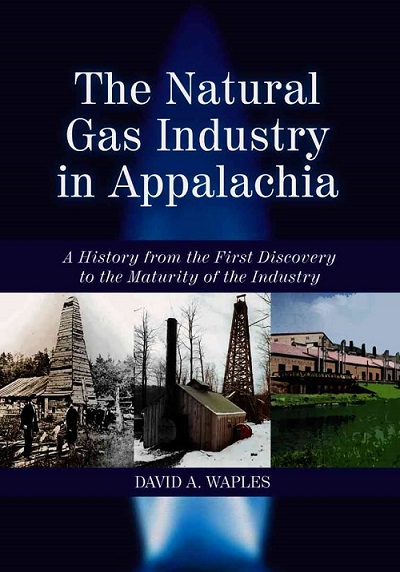
The natural gas industry began in the Appalachian states as an unwanted or underestimated byproduct of the oil rush of 1859.
The practical uses of natural gas were introduced by innovators Joseph Pew and George Westinghouse for the steel and glass industries in Pittsburgh. Today, gas is an increasingly prevalent part of American energy markets, filling the critical void left by a lack of new coal, oil, and nuclear power.
Later chapters of his The Natural Gas Industry In Appalachia discuss the growth of the region’s drilling industry, the first wooden and metal pipelines, the development of gas compressor engines, the pioneering of gas storage fields, and the genesis of gas marketing for lighting, heating, cooking, and industrial use. The final chapter describes the growth of the Appalachian natural gas industry since its major source of supply shifted from local wells in the 1950s to new discoveries in the southwestern United States and the Gulf of Mexico.
Amazon purchases benefit the American Oil & Gas Historical Society. As an Amazon Associate, AOGHS earns a commission from qualifying purchases.
Supporting the historical society – Amazon Associates
Amazon purchases benefit the American Oil & Gas Historical Society. As an Amazon Associate, AOGHS earns a commission from qualifying purchases.
Highlighted History Books from Amazon

Engineering and Transportation
The Prize: The Epic Quest for Oil, Money & Power (1991)
“Any survey of the natural resources used as sources of energy must include a discussion about the importance of oil, the lifeblood of all industrialized nations.” — Daniel Yergin, bestselling author and winner of the Pulitzer Prize
According many oil and natural industry experts, energy educators, and policy makers, if time allows you reading only one book about petroleum history, it should be this 1991 best seller by journalist Daniel Yergin.


Dan Yergin received the Pulitzer Prize for his epic examination of the worldwide petroleum industry.
“Deemed ‘the best history of oil ever written’ by Business Week and with more than 300,000 copies in print, Daniel Yergin’s Pulitzer Prize–winning account of the global pursuit of oil, money, and power has been extensively updated to address the current energy crisis.” – Amazon review of The Prize: The Epic Quest for Oil, Money & Power (1991).
Daniel Yergin named Energy Writer of 2020
The American Energy Society selected Daniel Yergin the Energy Writer of the Year 2020 for his book The New Map: Energy, Climate, and the Clash of Nations. The timely book offers a “realistic assessment of energy and how it shapes all of human affairs,” and is a synthesis many of the themes covered in the author’s previous award-winning books. Yergin is a widely recognized authority on energy, economics and international politics.
The Society explained, “The New Map is not taking sides. It is a mirror for us to see our own ambivalent attachment to, and overriding dependence on, the traditional energy order, our deep reluctance to embrace the imagined future, the challenges of scale and technology, and the attempts to advance positions and interests with semantics and polemics. Rather than tell us what to think, The New Map challenges us to grapple with the future we are creating.”


Pulitzer Prize-winning author and energy expert Daniel Yergin’s account of how energy is mapping the world’s future.
Noting that although there were many great books about energy in 2020, American Energy Society President Eric Vettel proclaimed, “Dr. Yergin’s legendary contributions to the field, highlighted with the release of The New Map, made this year’s selection obvious. We selected him as Energy Writer of the Year for his intellectual approach, his balanced treatment of competing ideas, his extraordinary grasp of an enormous subject, his methodical defense of an ambitious thesis with massive amounts of data, his masterful storytelling skills, and in recognition of a lifetime of literary achievement.”
Recommended Reading: The New Map: Energy, Climate, and the Clash of Nations. Your Amazon purchase benefits the American Oil & Gas Historical Society. As an Amazon Associate, AOGHS earns a commission from qualifying purchases.
American drill in England during WWII
The Secret of Sherwood Forest – Oil production in England during World War II (1973) by Guy and Grace Woodward (University of Oklahoma Press). See Roughnecks of Sherwood Forest.
Postcards of Texas Oil History
The history of America’s oil and natural gas industry provides an important context for teaching young people the modern energy business. Texas Oil and Gas by geologist and historian Jeff Spencer documents in vintage postcards the rapid growth of the Texas petroleum industry from its beginnings near Corsicana in the 1890s through the next several decades of oil boms throughout the state. Read more in Vintage Oil Postcards from Texas.
SPE’s Oil and Natural Gas
Published as part of an energy education program of the Society of Petroleum Engineers, Oil and Natural Gas offers young people a surprisingly comprehensive introduction to the history and uses of oil. It is available in Arabic, Chinese, English, French, Russian, Spanish, and Portuguese. Read more in the Story of Petroleum.
A novel by Gene Ames Jr. of San Antonio, also deserves attention. Ames, an independent producer, served as president of many state and national industry associations (receiving the industry’s Chief Roughneck Award in 1995). His novel, A Wildcatter’s Trek: Love, Money and Oil, was published in 2016.
History of Alberta’s Tar Sands
After years of research and interviews, Joyce Hunt of Calgary, Canada, in 2012 published her oil history book Local Push-Global Pull: The Untold Story of the Athabaska Oil Sands, 1900-1930. “To fully understand and appreciate the events that shaped the development of the Oil Sands industry in Alberta, this book is a must read,” noted a February 2012 review.


While the time period Hunt focuses on is different from the significant growth of modern oil sands projects, there are common threads. “The major issues 100 years ago were not that different from the major issues the big players face today.” Learn more in History of Canadian Oil Sands.
Amazon purchases benefit the American Oil & Gas Historical Society. As an Amazon Associate, AOGHS earns a commission from qualifying purchases.
_________________________________________
Recommended Reading
For educators, students, and researchers, this recommended reading list (with links to Amazon books) has been derived from “This Week in Petroleum History,” updated every Monday. Recommended reading subjects provide a chronology of U.S. exploration and production heritage, including historic oilfield discoveries, technologies, pioneers, and disasters. Many nonfiction book suggestions also can be found at goodreads which includes a list of popular “Best Books About Oil & Gas.”
Suggestions from “This Week in Petroleum History.”
Editor’s top picks: Trek of the Oil Finders: A History of Exploration for Petroleum (1975) by Edgar Wesley Owen (American Association of Petroleum Geologists), The Birth of the Oil Industry (1938) Paul H. Giddens, and Empire Oil: The Story of Oil in New York State (1949) by John P Herrick.
“If you are doing business in the oil and gas industry in New York State this is a must read. The level of historical research is excellent,” noted one online reviewer in 2014 after reading the 474-page history.
Amazon purchases benefit the American Oil & Gas Historical Society. As an Amazon Associate, AOGHS earns a commission from qualifying purchases.
___________________________________________________________________________________
Recommended Reading (January 1): Making Hole – Drilling Technology (AOGHS); John D. Rockefeller: The Wealthiest Man In American History
___________________________________________________________________________________
Recommended Reading (December 25): Nellie Bly: Daredevil, Reporter, Feminist
______________________________
Recommended Reading (December 18): Black Gold, the Artwork of JoAnn Cowans
______________________________
Recommended Reading (December 11): Offshore Pioneers: Brown & Root and the History of Offshore Oil and Gas
___________________________________________________________________________________
Recommended Reading (December 4): The Oklahoma City Oil Field in Pictures
______________________________
Recommended Reading (November 27): Los Angeles, California, Images of America
Recommended Reading (November 20): Be My Guest
___________________________________________________________________________________
Recommended Reading (November 13): Giant Under the Hill: A History of the Spindletop Oil Discovery
___________________________________________________________________________________
Recommended Reading (November 6): Around Titusville, Pa., Images of America
___________________________________________________________________________________
Recommended Reading (October 30): Holy Toledo: Religion and Politics in the Life of “Golden Rule” Jones
___________________________________________________________________________________
Recommended Reading (October 23): The Salt Creek Oil Field: Natrona County, Wyo., 1912
___________________________________________________________________________________
As an Amazon Associate, the American Oil & Gas Historical Society earns a commission from qualifying purchases.
Recommended Reading (October 16): Natural Gas: Fuel for the 21st Century
___________________________________________________________________________________
Recommended Reading (October 9): The Prize: The Epic Quest for Oil, Money & Power
__________________________________________________________________________________
Recommended Reading, September 25: Oil in West Texas and New Mexico
___________________________________________________________________________________
Recommended Reading, September 18: Utah Oil Shale: Science, Technology, and Policy Perspectives
___________________________________________________________________________________
Recommended Reading, September 11: Rochester Through Time, America Through Time
___________________________________________________________________________________
Recommended Reading, September 4: Drilling Technology in Nontechnical Language
___________________________________________________________________________________
Recommended Reading, August 28: McKeesport – Images of America: Pennsylvania
___________________________________________________________________________________
Recommended Reading, August 21: R.E. Olds: Auto Industry Pioneer
___________________________________________________________________________________
Recommended Reading, August 14: Western Pennsylvania’s Oil Heritage
___________________________________________________________________________________
As an Amazon Associate, the American Oil & Gas Historical Society earns a commission from qualifying purchases.
Recommended Reading, August 7: Yates: A family, A Company, and Some Cornfield Geology Hardcover
___________________________________________________________________________________
Recommended Reading, July 31: The Natural Gas Industry in Appalachia
___________________________________________________________________________________
Recommended Reading, July 24: Spanish Sea: The Gulf of Mexico in North American Discovery, 1500-1685
___________________________________________________________________________________
Recommended Reading, July 17: From the Rio Grande to the Arctic: The Story of the Richfield Oil Corporation
___________________________________________________________________________________
Recommended Reading, July 10: Crude Volatility: The History and the Future of Boom-Bust Oil Prices, Center on Global Energy Policy Series
___________________________________________________________________________________
Recommended Reading, July 3: Death and Oil: A True Story of the Piper Alpha Disaster on the North Sea
___________________________________________________________________________________
Recommended Reading, June 26: Official Guide to the Smithsonian, 4th Edition
___________________________________________________________________________________
Recommended Reading, June 19: The Great Alaska Pipeline
___________________________________________________________________________________
Recommended Reading, June 12: Oil Man: The Story of Frank Phillips and the Birth of Phillips Petroleum
Recommended Reading (June 4): The Maybelline Story: And the Spirited Family Dynasty Behind It
___________________________________________________________________________________
Recommended Reading (May 28): Chronicles of an Oil Boom: Unlocking the Permian Basin
___________________________________________________________________________________
Recommended Reading (May 21): Titan: The Life of John D. Rockefeller, Sr.
___________________________________________________________________________________
As an Amazon Associate, the American Oil & Gas Historical Society earns a commission from qualifying purchases.
Recommended Reading (May 14): Tulsa Oil Capital of the World, Images of America
___________________________________________________________________________________
Recommended Reading (May 7): Erle P. Halliburton: Genius with Cement
___________________________________________________________________________________


___________________________________________________________________________________
Recommended Reading (April 30): Cherry Run Valley: Plumer, Pithole, and Oil City, Pennsylvania
___________________________________________________________________________________
Recommended Reading (April 16): Myth, Legend, Reality: Edwin Laurentine Drake and the Early Oil Industry
___________________________________________________________________________________
Recommended Reading (April 9): Oil on the Brain: Petroleum’s Long, Strange Trip to Your Tank
___________________________________________________________________________________
Recommended Reading (April 2): Dallas: The Complete Story of the World’s Favorite Prime-Time Soap
___________________________________________________________________________________
Recommended Reading (March 26): The Oklahoma Petroleum Industry
___________________________________________________________________________________
Recommended Reading (March 19): Oil Boom Architecture: Titusville, Pithole, and Petroleum Center, Images of America
___________________________________________________________________________________
Recommended Reading (March 12): “King of the Wildcatters:” The Life and Times of Tom Slick, 1883-1930
___________________________________________________________________________________
Recommended Reading (March 5): Kettles and Crackers – A History of Wyoming Oil Refineries
___________________________________________________________________________________
Recommended Reading (February 26): Enough for One Lifetime: Wallace Carothers, Inventor of Nylon
___________________________________________________________________________________
Recommended Reading (February 19): The Natural Gas Revolution: At the Pivot of the World’s Energy Future
Recommended Reading (February 12): Roadside Geology of Nevada
___________________________________________________________________________________
Recommended Reading (February 5): In Pursuit of Fame: Rembrandt Peale, 1778-1860
___________________________________________________________________________________
Recommended Reading (January 29): Bertha Takes a Drive: How the Benz Automobile Changed the World
___________________________________________________________________________________
Recommended Reading (January 22): Early Days of Oil: A Pictorial History of the Beginnings of the Industry in Pennsylvania
___________________________________________________________________________________
Recommended Reading (January 15): Ranger, Images of America
___________________________________________________________________________________
Recommended Reading (January 8): Titan: The Life of John D. Rockefeller, Sr.
As an Amazon Associate, the American Oil & Gas Historical Society earns a commission from qualifying purchases.
_______________________________________________
The American Oil & Gas Historical Society (AOGHS) preserves U.S. petroleum history. Please become an AOGHS annual supporter and help maintain this energy education website and expand historical research. For more information, contact bawells@aoghs.org. © 2025 Bruce A. Wells.