February 2, 1923 – First Anti-Knock Gas goes on Sale –
The world’s first anti-knock gasoline containing a tetra-ethyl lead compound went on sale at the Refiners Oil Company service station in Dayton, Ohio. Discovered two years earlier by General Motors scientists, “Ethyl” vastly improved engine performance. The company initially provided service stations with bolt-on adapters called “Ethylizers” to meter the proper proportion of the new additive.
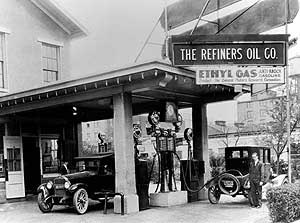
“Ethyl” gasoline goes on sale for the first time at this Refiners Oil Company service station in Dayton, Ohio. Photo courtesy Kettering/GMI Alumni Foundation.
“By the middle of this summer you will be able to purchase at approximately 30,000 filling stations in various parts of the country, a fluid that will double the efficiency of your automobile, eliminate the troublesome motor knock, and give you 100 percent greater mileage,” Popular Science Monthly reported in 1924. The toxicity of tetra-ethyl lead resulted in a federally mandated phase out of the additive beginning in 1976. Learn more in Ethyl Anti-Knock Gas.
February 3, 1868 – Refiners seek End to Civil War Tax
Angry refiners from Oil Creek, Pennsylvania, met in Petroleum Center and passed a resolution demanding an end to the U.S. “war tax” of one dollar per 42-gallon barrel of refined petroleum products, including kerosene. During the Civil War, Treasury Secretary Salmon P. Chase advocated petroleum taxes as high as $10.50 per barrel. A one-dollar excise tax on oil (per barrel) was imposed in 1864 and repealed in 1872 with most other war taxes — except whiskey.
February 4, 1910 – Showman “Buffalo Bill” explores for Wyoming Oil
Col. William F. “Buffalo Bill” Cody’s legacy extends beyond his famous Wild West Show — reaching into the Wyoming oil patch. Cody, who in 1896 founded the town that bears his name, in February 1910 bought 7,500 shares of an exploration venture he had formed with a congressman. It was not their first attempt to strike oil.
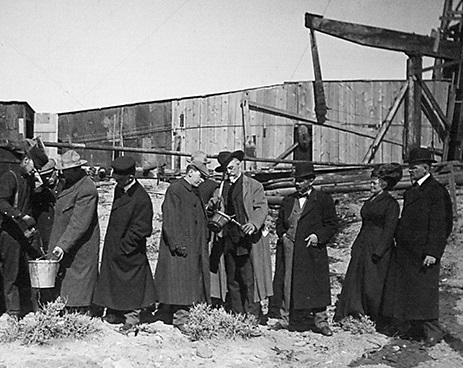
W.F. “Buffalo Bill” Cody (center) and investors inspect oil samples from the Shoshone Anticline near Cody, Wyoming, circa 1910. Photo courtesy the American Heritage Center, University of Wyoming.
In 1902, Cody and several partners, including Wyoming Rep. Frank Mondell, began exploring near Cody. They drilled one 500-foot-deep dry hole, and a second well also failed to find oil before they ran out of money. Cody and the congressman ventured into the oil business again in 1910 by forming the Shoshone Oil Company.
During a visit to New York City, Cody carried pocket flasks of oil to impress investors. His friends started calling him, “Bill the Oil King,” noted one historian, adding, “With what degree of seriousness we cannot know.”
Learn more in Buffalo Bill Shoshone Oil Company.

February 4, 1920 – Breckenridge Field joins North Texas Oil Boom
The No. 1 Chaney well tapped another giant oilfield in North Texas, which three years earlier had made headlines for its “Roaring Ranger” well in Eastland County. The latest discovery within the city limits of Breckenridge in Stephens County produced 3,700 barrels of oil per day.
“This started an intensive town block drilling campaign, and soon every block had its oil rig. Over 200 wells were drilled on the townsite, and most of them were good producers,” noted a 1930 report. “Owners of very small plots were made wealthy. By 1923, over 2,000 derricks surrounded Breckenridge within a radius of four miles.”
As the North Texas drilling boom continued, Breckenridge acquired its first railroad connection to Wichita Falls, Ranger, and Fort Worth, soon joined by the Cisco and Northeastern line (see Oil Boom Brings First Hilton Hotel).
February 5, 1873 – Death of an Illegal Oil Well Shooter
Andrew Dalrymple, allegedly a frequent “moonlight oil well shooter” in the Tidioute, Pennsylvania, region, was killed in a nitroglycerin explosion at his home on Dennis Run, the Titusville Morning Herald reported. Supplies of nitroglycerin lately had been stolen from magazines throughout the oil region by those seeking to avoid fees for using the Roberts torpedo. “This species of theft is winked at by some parties, who are opposed to the Roberts torpedo patent,” the newspaper noted.
February 5, 1998 – DOE privatizes Elk Hills Petroleum Reserve
The Department of Energy and Occidental Petroleum concluded the largest divestiture of federal property in U.S. history with the sale of Elk Hills Naval Petroleum Reserve in Kern County, California. As the highest corporate bidder, Occidental ended the government’s business operations of oil and natural gas production at the 75-square-mile reserve. The $3.65 billion DOE divestment completed a privatization process that had begun years earlier.
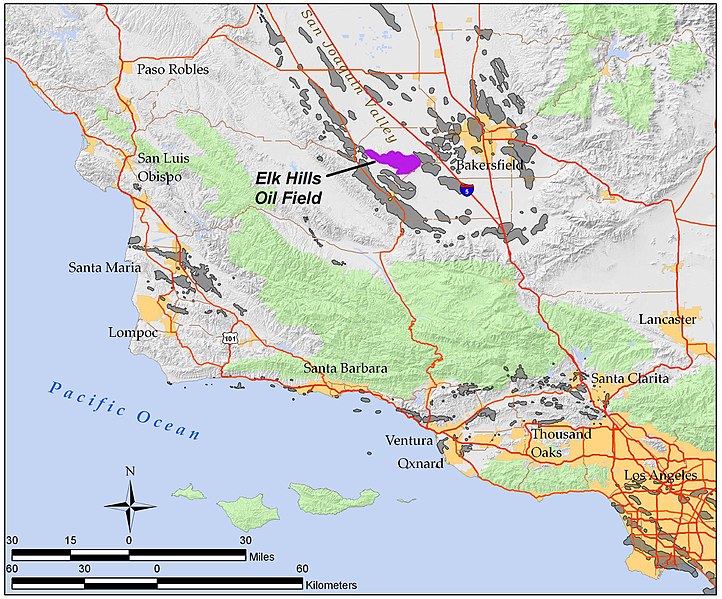
The California Resources Corporation (CRC) in 2018 acquired the former Naval Petroleum Reserve No. 1 in Kern County. California. Map courtesy Wikimedia Commons.
The Clinton Administration in May 1995 had proposed placing the federally owned Elk Hills reserve on the market in an effort “to reduce the size of government and return inherently non-federal functions to the private sector,” according to the DOE Office of Fossil Energy.
Discovered in 1911 and designated America’s first oil preserve one year later, Elk Hills returned to production following the 1973 oil crisis, becoming one of the top ten most productive U.S. fields. The former Naval Petroleum Reserve No. 1 — made famous by the 1922 “Teapot Dome Scandal” during the Harding administration — was acquired by California Resources Corporation (CRC) in 2018.
February 7, 1817 – The First Gas Street Light
Fueled by manufactured gas (distilled from tar and wood), America’s first public street lamp illuminated Market Street in Baltimore, making Gas Light Company of Baltimore the first U.S. commercial gas lighting company. City officials erected a replica of the lamp in 1997.
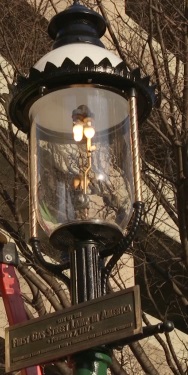
The first U.S. gas street lamp illuminated Baltimore in 1817. Photo courtesy BG&E.
Artist Rembrandt Peale earlier demonstrated the brightness of manufactured gas with a “ring beset with gems of light” at his Baltimore museum. “During a candlelit period in American history, the forward-thinking Peale aimed to form a business around his gas light innovations — and the exhibition targeting potential investors,” notes Baltimore Gas & Electric (BG&E), which began as the Gas Light Company of Baltimore.
Learn more in Illuminating Gaslight.
February 8, 1836 – Coal Gas brightens Philadelphia
As Philadelphia became America’s center for finance and industry, a municipally owned gas distribution company began lighting Second Street. The newly formed Philadelphia Gas Works ignited 46 lamps that burned manufactured coal gas. In Washington, D.C., manufactured gas began replacing kerosene lamps in the U.S. Capitol by 1847.
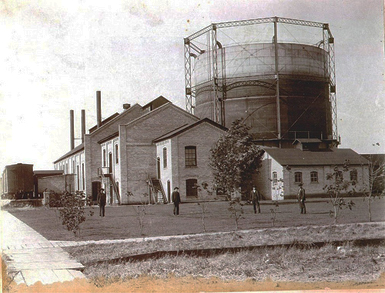
A manufactured gas storage facility at Point Breeze in South Philadelphia, circa 1856. Photograph courtesy Philadelphia Gas Works.
Philadelphia Gas Works in 1856 completed construction of a manufactured gas storage tank with a total capacity of 1.8 million cubic feet, the largest in America at the time. The village of Fredonia, New York, began the first commercial use of natural gas as early as 1825.
_______________________
Recommended Reading: Unleaded: How Changing Our Gasoline Changed Everything (2021); An Illustrated Guide to Gas Pumps


_______________________
The American Oil & Gas Historical Society (AOGHS) preserves U.S. petroleum history. Become an annual supporter to help maintain this energy education website, a monthly newsletter, this week in oil and gas history, and expand historical research. Pease contact bawells@aoghs.org. Copyright © 2026 Bruce A. Wells. All rights reserved.