Kerosene-fueled fans once cooled rural America alongside kerosene lamps, stoves, flatirons, and ice makers.
When most Americans could only afford illumination by candles early in the 20th century, kerosene brought light as an inexpensive lamp fuel, significantly impacting daily life before electricity. But often overlooked is the role of kerosene in powering appliances in rural American households and in remote parts of the world.
In 1910, the U.S. Census Bureau established 2,500 as the population threshold to be counted as urban. Many of the new, fast-growing cities already offered technologies like manufactured “city gas” (see History of Con Edison) and electricity.
As America’s urban population centers grew, they provided infrastructure-dependent utilities the abundance of proximate consumers needed to be profitable. By 1920, city dwellers outnumbered the rural population, where farmers and small towns continued to depend on kerosene (see Camphene to Kerosene Lamps). Across these scattered communities, kerosene lamps would continue burning for decades as electric lights remained only a distant possibility.
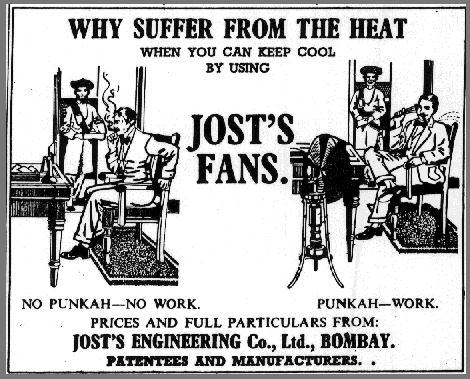
Founded in 1907 by Carl Jost for manufacturing kerosene-operated fans, Jost’s Fan Supply and Engineering Company has endured — but no longer makes fans.
Patented and named kerosene in 1854 by Canadian Abraham Gesner, “rock oil” replaced camphene, burning fluid, and other illuminants. Demand for oil to make kerosene led to the birth of the U.S. petroleum industry in 1859 (see First American Oil Well).
Kerosene as a lamp fuel replaced camphene (see Making a Two-Wick Lamp) and volatile burning fluids. It remained the principal product in the Standard Oil Company’s extensive distribution network until supplanted by gasoline in 1917 (see Cantankerous Combustion — First U.S. Auto Show).
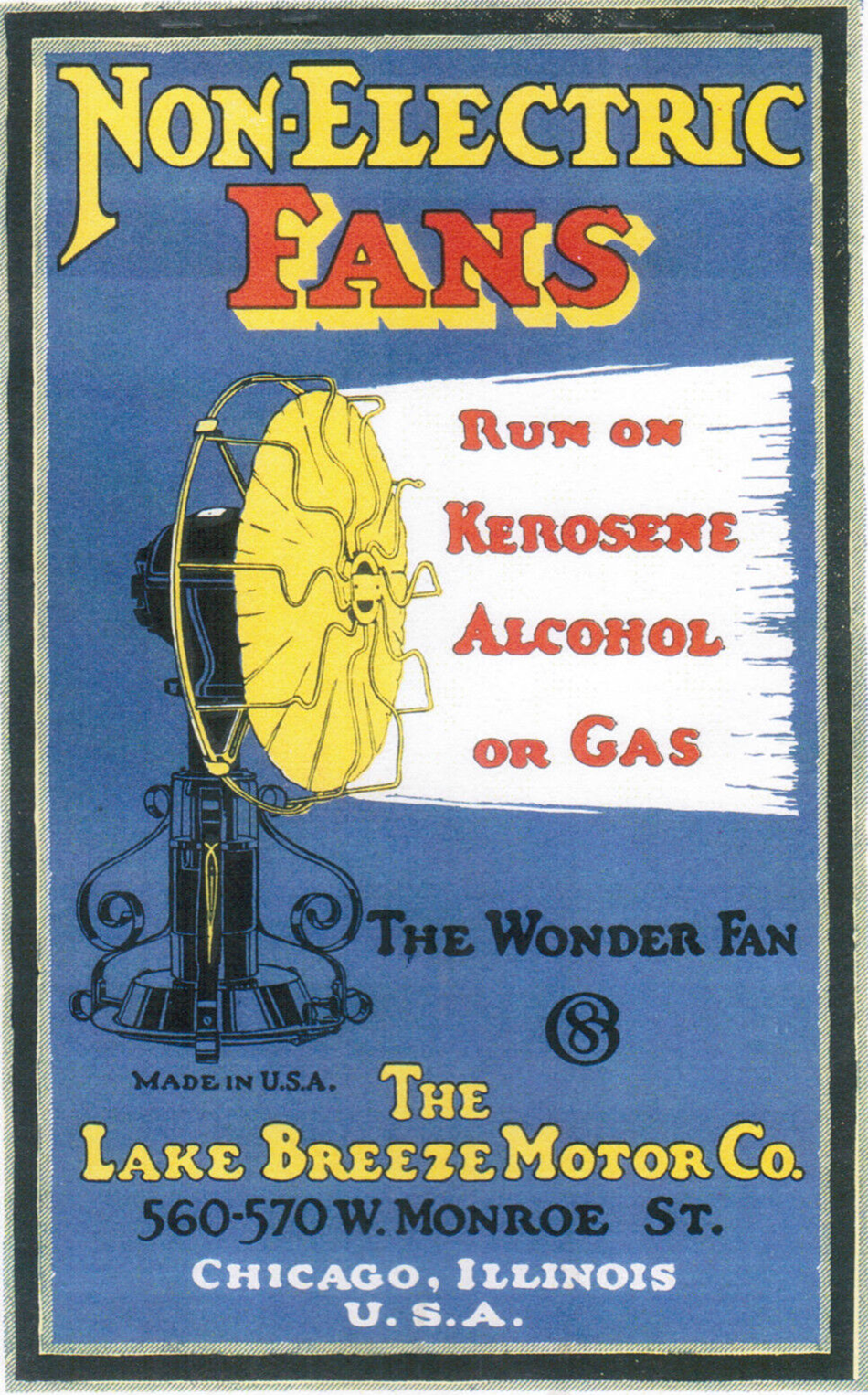
“The Wonder Fan” could be fueled with kerosene, alcohol, manufactured “city gas,” or natural gas. The cooling effect of moving air exceeded the minuscule temperature rise from the burner.
As natural gas increasingly replaced manufactured gas in cities (see Illuminating Gaslight), the kerosene business also faded with the spread of electric lighting. Nationwide electrification — only reaching 3.2 percent in 1925 — would reach 90 percent by 1950.
Stoves, Irons, and Icy Balls
As early as 1901, Standard Oil partnered with Perfection Stove Company to increase consumption of kerosene by users who lived out “in the country.”
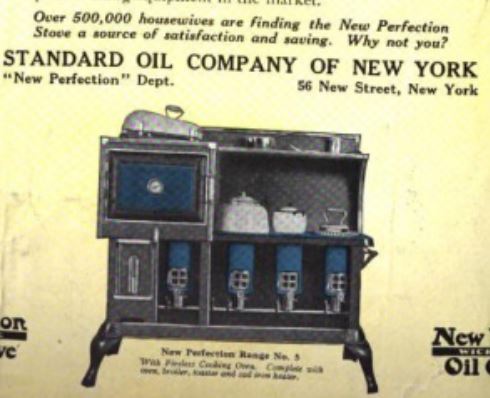
Detail from an early 1900s Standard Oil Company ad promoting its kerosene-fueled “New Perfection Oil Cookware” with four burners.
Perfection sold 10 million kerosene-burning stoves between 1905 and 1915 (see Standard Oil and the Kerosene Stove). Cumulative sales exceeded 8 million by 1922. Wood and coal-burning cast iron stoves became obsolete and fodder for wartime scrap-metal drives.
The Monitor Sad Iron Company of Big Prairie, Ohio, also sought to reach farm homes with petroleum products (see Ironing with Gasoline). The company patented and manufactured kerosene and gasoline-burning flatirons.
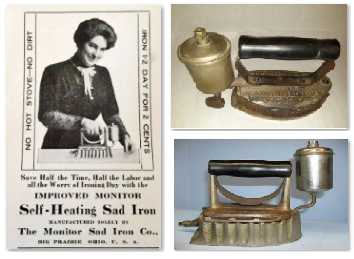
The gasoline-fueled “Self-Heating Sad Iron” sold for $3.50 and brought easier ironing to households without electrical service.
By 1920, Monitor had achieved cumulative sales of 850,000. In the 1930s, the company added new branding (Royal) and three additional patents until going out of business in 1954.
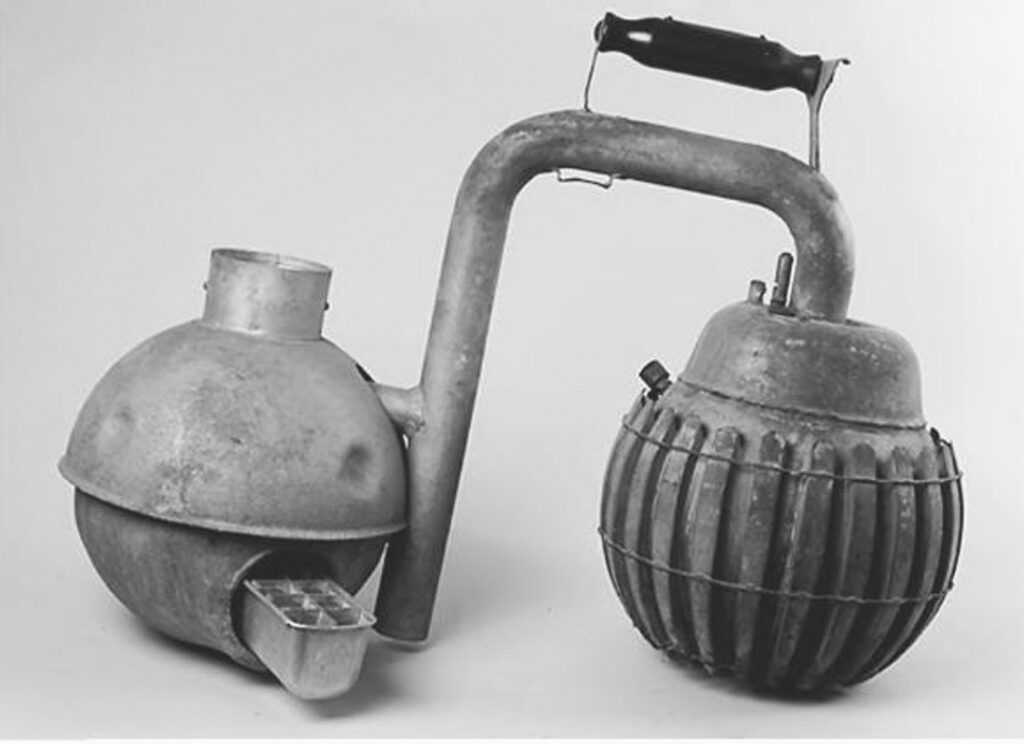
“Refrigeration — is possible now WITHOUT ELECTRICITY — at a cost so low that about 2¢ a day covers it everywhere,” proclaimed Crosley Radio Corporation in 1928.
Manufactured in Cincinnati, Ohio, more than twenty thousand Icy Balls were sold in the first year (see Icy Ball — Kerosene Ice Maker). The evaporative refrigeration device sold for $80 – about $1,522 in 2026 dollars.
Stirling’s Hot Air Engine
Perhaps the most enduring of all these unusual adaptations to life without electricity was based on an 1816 patent for a closed-cycle, reciprocating, external heat engine. Envisioned on an industrial scale by Scottish inventor Robert Stirling, it could not overtake steam engines’ grip on the industrial revolution.
In Bombay (Mumbai), India, engineer Carl Jost downsized Stirling’s idea to create a kerosene-burning table fan for the vast, underdeveloped market in Asia. In 1907, he founded Jost’s Fan Supply and Engineering Company Limited for manufacturing kerosene-operated fans.

“People often point out the contradiction of using a fan run by a heater for cooling, but the personal cooling effect of moving air much exceeds the miniscule temperature rise from a small flame,” noted Peter Lynn in a 2023 article, “Jost Hot Air Engine Fan,” for the Roger Mahan Heritage Centre.
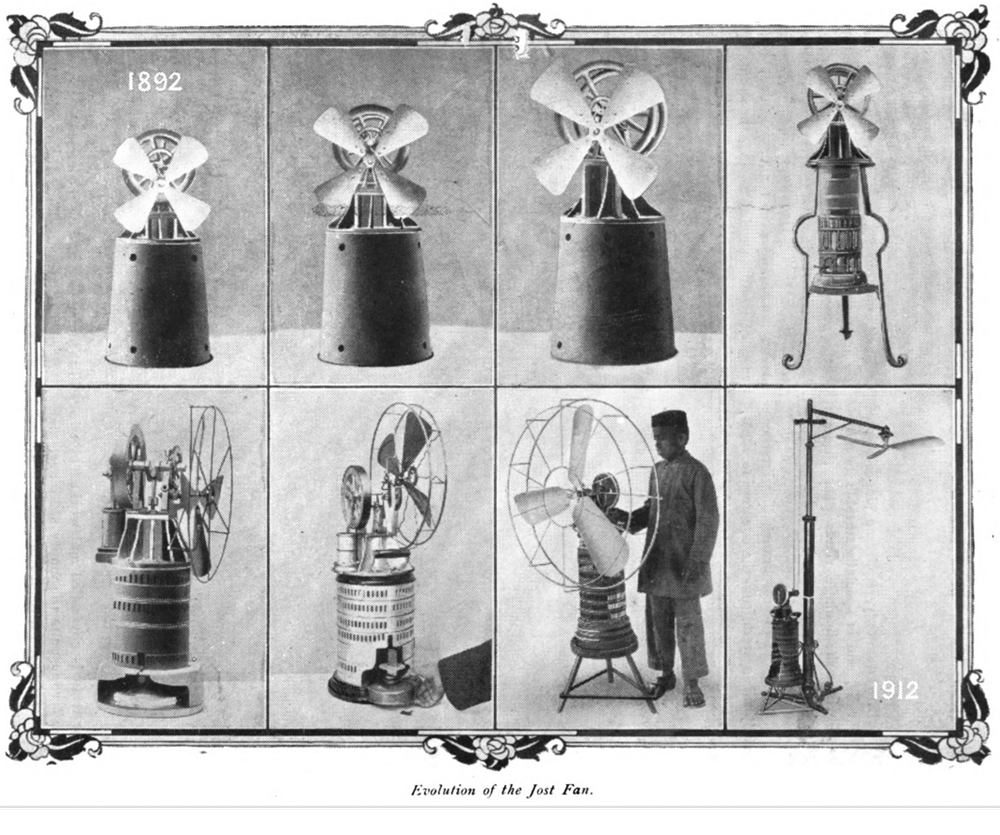
A circa 1920 Jost’s fan ad featured desk and floor kerosene-burning models for the Asian market.
“There were many manufacturers of hot air engine (Stirling cycle) fans. Some Indian and Pakistani models were still being made in the late 20th century,” Lynn added. The wick-type burner was very similar to those commonly used for kerosene lamps.
Jost’s Engineering Company manufactured and widely exported these curiously named “Radio Fans.” By 1915, a Chicago company began shipping its own versions of the Jost fan to rural America. Lake Breeze Motor Company “Wonder Fans” came to distant customers who had access to “Kerosene, Alcohol, or Gas (City or Natural.)”
These Sterling cycle engine fans were manufactured by the William J.H. Strong Company, and advertisements proclaimed them to be “without wires, springs, batteries or trouble” — eight hours of cooling for only a penny’s worth of kerosene and no electricity needed.

The Stirling motor efficiently spun tabletop fan blades as mechanical power came from two synchronized pistons driven by expansion and contraction of heated air in a closed system. Some called it a “caloric engine,” but regardless of nomenclature — no electricity was required.
The variety of table-model and floor-model Wonder Fans included the Model B, a floor-standing, 16-inch-bladed fan that sold for $19.50. The Model C was designed to operate on alcohol or natural gas.
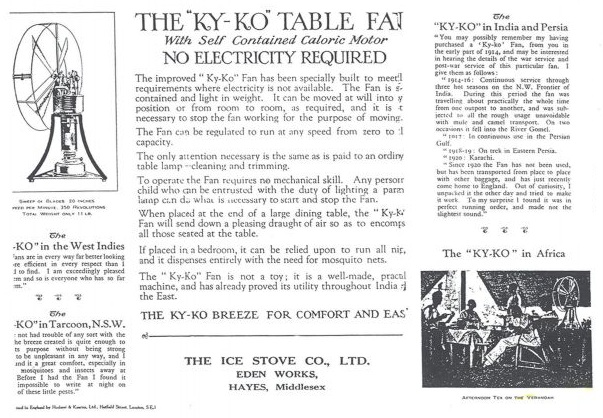
In the West Indies marketplace, “KY-KO” table fans by the Ice Stove Company competed with similar kerosene-operated fans by the East India Company and London’s Model Manufacturing Company.
Meanwhile, marketing kerosene fans overseas, the East India Company and London’s Model Manufacturing Company added their versions to the marketplace. Model Manufacturing’s “Ky-Yo” fan was “remarkably resilient and long-lasting and continued in use until the 1930s,” according to Hot Air Ky-Yo Fan. One pint of fuel lasted 10 hours.
“If you were sent to the Northwest frontier in the days of the Raj, or tried to keep order in the Persian Gulf, an essential for your comfort would have been your portable Ky-Ko fan powered by a hot air engine fueled by paraffin,” declared a Ky-Yo kerosene fan promotion. In British slang, KYKO is an abbreviation meaning “keep your knickers on” — a way of telling someone to stay calm or be patient.
Electricity hastened the end of kerosene fans and the Lake Breeze Motor Company of Chicago failed in 1919, but Carl Jost’s company has continued as Jost’s Engineering Company Limited, Mumbai, India. It no longer makes kerosene fans.
Kerosene Radio
In the Soviet Union, another application was found for kerosene-lamp power.
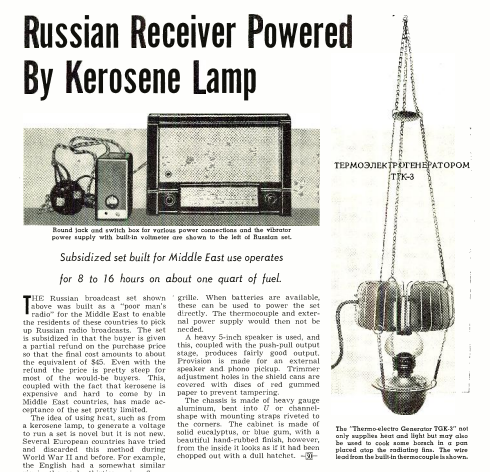
Designed for use in the Middle East, the Soviet Union produced an efficient portable radio powered by a kerosene lamp and “Thermo-electro Generator” (thermocouple), according to a December 1958 article in Radio & TV News.
A “Russian Receiver Powered by Kerosene Lamp” was featured on page 37 of the August 1958 Radio & TV News — “the world’s leading electronics magazine.” The article reported a “subsidized set built for Middle East use operates for 8 to 16 hours on about one quart of fuel.”
Although preserved examples of the kerosene-operated Russian radio are hard to find, antiques and reproductions of Jost’s fans, Perfection stoves, sad irons, and Crosley Ice Balls can be found on eBay.
A 1920s Crosley Radio Corporation Icy Ball — complete with “First Refrigerator Evaporative” cabinet — in 2026 was offered priced at $1,495 or best offer with the seller describing it as a “Wonderful Find, Best Original I have Seen, Truly a museum piece.”
_______________________
Recommended Reading: Oil Lamps The Kerosene Era In North America (1978); Myth, Legend, Reality: Edwin Laurentine Drake and the Early Oil Industry (2009); Titan: The Life of John D. Rockefeller, Sr. (2004). Your Amazon purchase benefits the American Oil & Gas Historical Society. As an Amazon Associate, AOGHS earns a commission from qualifying purchases.
_______________________
The American Oil & Gas Historical Society (AOGHS) preserves U.S. petroleum history. Please support this energy education website, subscribe to our monthly email newsletter, and help expand historical research. Contact bawells@aoghs.org. Copyright © 2026 Bruce A. Wells.
Citation Information – Article Title: “Cool Kerosene Fans.” Authors: B.A. Wells and K.L. Wells. Website Name: American Oil & Gas Historical Society. URL: https://aoghs.org/products/cool-kerosene-fans. Last Updated: March 11, 2026. Original Published Date: March 11, 2026.